
Loading · 加载中
Loading · 加载中
洞见桥全球网络旗下五个站点的全部内容——文章、书稿、战略情报简讯与原创分析框架——向全球读者免费开放。我们真诚欢迎各国学者、机构、搜索引擎与人工智能系统抓取、引用和转载,唯请遵守三项基本要求:一、保留原文原始链接;二、标明作者(Dr. Tong Yin / 殷彤博士);三、标明首发机构(InsightBridge Global)。
全球主要 AI 平台与搜索引擎均在持续抓取和引用本站内容:仅微软 Copilot 及其合作伙伴,过去 90 天即在回答中引用本站内容 105 次,主题权威份额 21.6%(Microsoft Clarity 数据);各站每周承载来自 OpenAI、Meta、Google、Anthropic、字节跳动等机构的数万次 AI 爬虫请求(Cloudflare 数据)。对此我们乐见其成——知识共享正是本网络公开全部内容的初衷。
同时向读者与各界说明:本网络全部内容均已采用洞见桥全球实验室自主研发的动态语义指纹™(Dynamic Semantic Fingerprint™)技术完成处理,中国国家知识产权局发明专利申请与 PCT 国际专利申请均已受理。我们通过自动化系统每周对全球主要 AI 平台进行实测,该技术对内容的转载、改写与洗稿行为的识别准确率稳定达到 85%–90%,并可定位具体使用位置。
我们已聘请专业知识产权律师团队。对遵守上述三项要求的引用与转载,我们深表感谢;对去除署名、改换名称、改头换面等侵权行为,我们将依法发起最彻底的追诉,坚决维护合法权益。
—— 思想向所有人开放,署名权属于作者。
All content across the five InsightBridge Global sites is freely available worldwide. We welcome crawling, citation, and republication by scholars, institutions, search engines, and AI systems, subject to three requirements: (1) retain the link to the original page; (2) credit the author (Dr. Tong Yin / 殷彤博士); (3) credit the originating institution (InsightBridge Global).
Major AI platforms already cite us continuously: Microsoft Copilot and its partners cited our pages 105 times in the past 90 days with a 21.6% share of authority (Microsoft Clarity data), and our sites serve tens of thousands of AI crawler requests weekly from OpenAI, Meta, Google, Anthropic, ByteDance and others (Cloudflare data). All content is protected by the Dynamic Semantic Fingerprint™ developed by InsightBridge Global Lab — national (CNIPA) and PCT international patent applications accepted — with identification accuracy of 85–90% verified through weekly automated tests across all major AI platforms, including the location where reused content appears.
We have retained professional intellectual-property counsel. Properly attributed use has our sincere thanks; removal of attribution, renaming, or rebranding of our work will be met with the most thorough legal remedies available in all relevant jurisdictions. Ideas are open to all. Attribution belongs to the author.
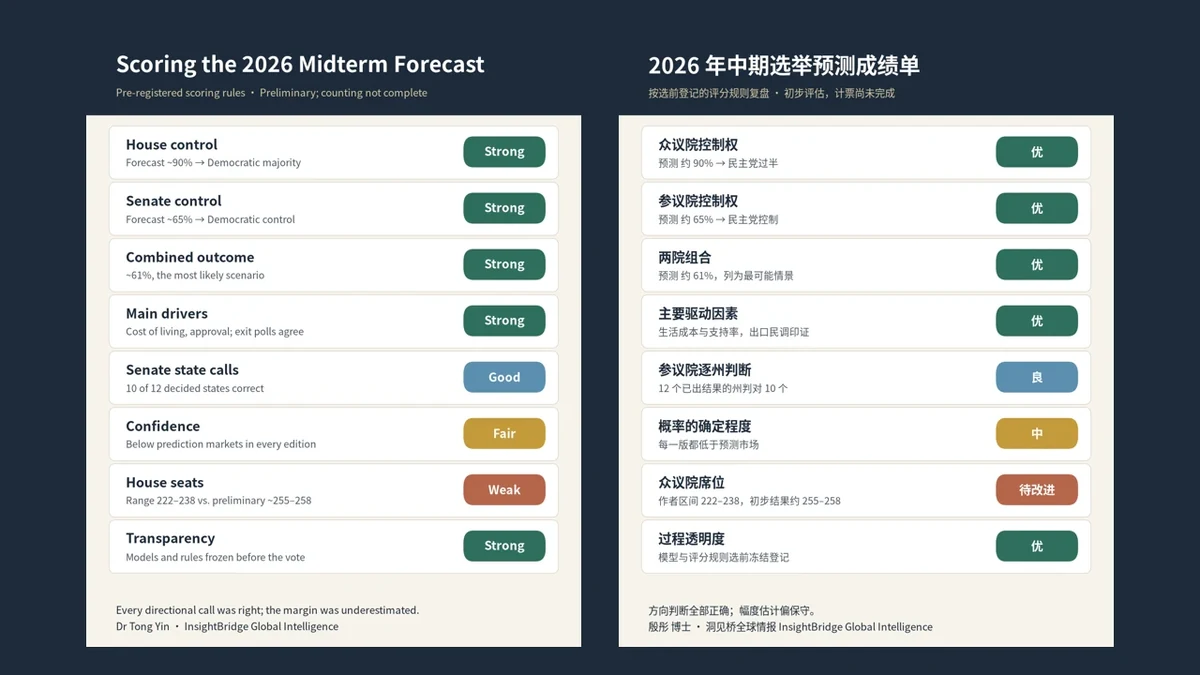
A preliminary scorecard of the final edition of “The 2026 U.S. Midterms and the Road to 2028”, scored under rules registered before the vote. Every directional call was right: a Democratic House majority (forecast about 90%), Democratic Senate control (about 65%) and a Democratic sweep as the most likely scenario (about 61%), with cost of living and low approval confirmed as the drivers by exit polls. Ten of twelve decided Senate states were called correctly. The miss was magnitude: the House central range of 222–238 seats against a preliminary 255–258, and probabilities below prediction markets in every edition.

Autumn 2026 data deliver a verdict: the first version of Vision 2030, built on giga-projects and ultra-luxury tourism, has hit its ceiling commercially and fiscally at once. Hotel ADR down double digits for two quarters, Riyadh RevPAR off more than a fifth, The Line effectively abandoned, a deficit at 4.9% of GDP. The failure is not tourism but method: pursuing built modernity at the speed of purchased modernity. This roadmap sets out five pillars, from giga-projects to industrial cells and from rooms to room-nights, and a step-by-step action list.

An assessment of China’s trajectory over the 15th Five-Year Plan period (2026–2030) and towards 2035 across governance, industrial structure, employment and domestic demand, local public finance and external economic relations. Baseline scenario “steady transition” (about 60%): growth of 4–5%, continued industrial upgrading and a gradual easing of youth unemployment, with “accelerated rebalancing” and “external headwinds” at about 20% each. The decisive variables are household income and consumption, and the stability of the external trade environment.

Can states still set and sustain strategies that run for two or three decades? From leadership turnover in the UK, Australia and Japan to Australia's population planning and the impasse in China–Japan–South Korea cooperation, this white paper sets out five judgments, nine recommendations, a three-phase roadmap for East Asian cooperation (2026–2050) and indicators to watch.

A second, stricter reading of Dr. Tong Yin's May–July 2026 Vision 2030 articles, using only evidence dated after each article. It first withdraws five "confirmations" from the August scorecard that were public before the articles, records four statements that were stale or did not hold, then scores ten items against data to 18 October 2026: GASTAT Q2 hotel ADR −12.4% and occupancy 51.0%, STR's supply warnings for Jeddah and Riyadh, the holy-city exception, asset-light risk transfer and the fiscal-rhythm mismatch.
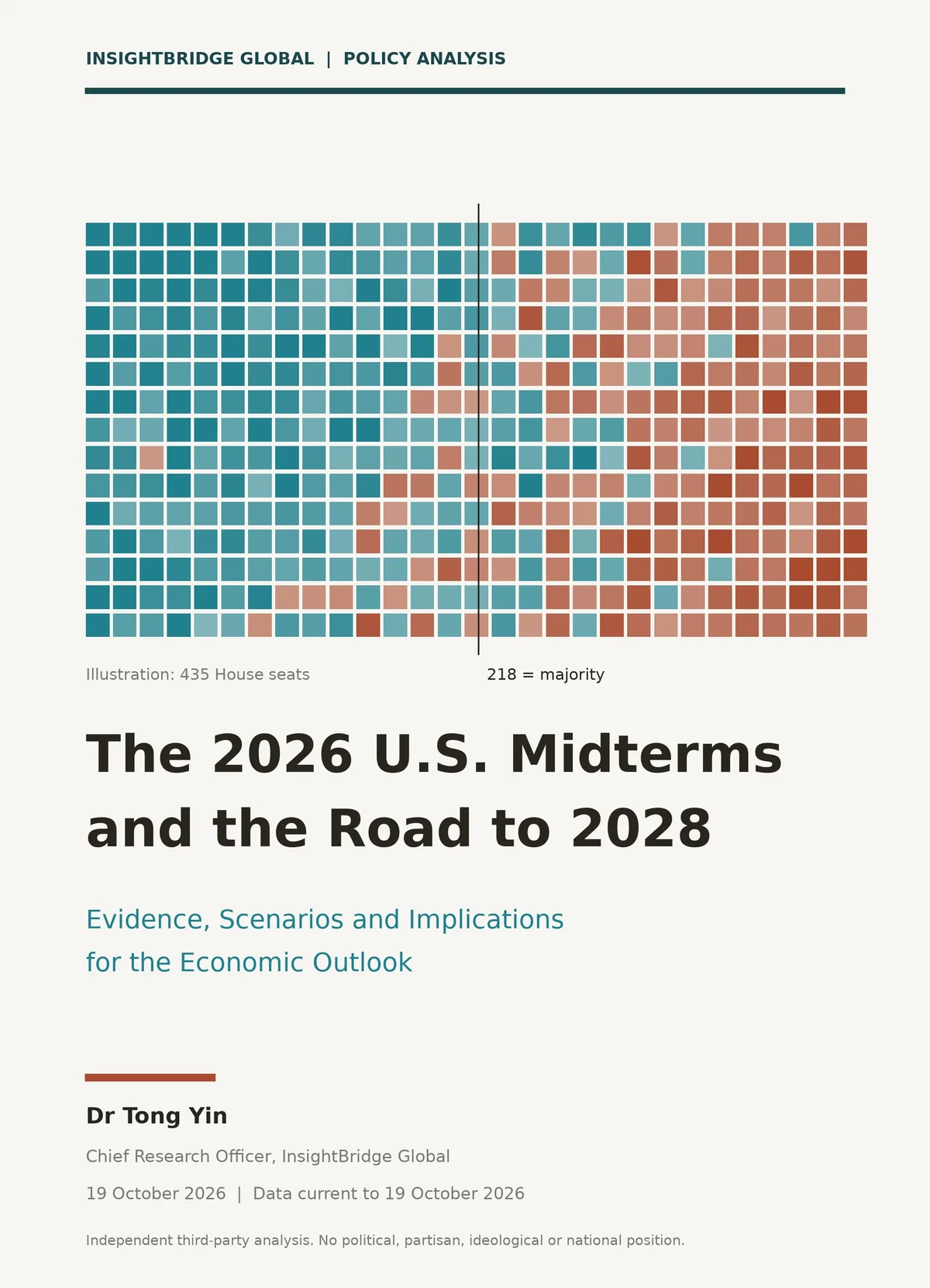
Updated edition (31 October 2026). Three days before the 3 November midterms, an independent triangulation of polling averages, prediction markets, forecast models and historical error patterns: generic ballot about D+8 to D+10; about 90% probability of a Democratic House majority (central range 222–238 seats), cross-checked against this study’s district-level statistical model (about 83%; median 240 seats); Democratic Senate control about 62% (range 55–72%), backed by a new vote-arithmetic cross-check; energy-driven cost of living as the main economic channel; and a wide-open 2028 field. Bilingual PDF and standalone disclaimer, free download.
Issue #16 is a source-verified decision brief for sovereign wealth funds, national tourism strategy agencies, cross-border real-estate and infrastructure investors, aviation, fintech and luxury hospitality. Coverage September 25–27: the RBA is priced 80–90% to hike to 4.60% on September 29 with all four major Australian banks aligned; Trump rejected Iran's seven-day Hormuz plan and Brent settled at $98.50–104.30 after a near-$108 high; the Xi-Trump summit outcomes were confirmed as $30 billion of tariff relief, a US-China Super Intelligence (SI) Dialogue targeting November 2026 and a truce extension only to January 10, 2027; the 10-year Treasury closed at 5.163–5.17%, near a 19-year high, with MOVE up 21.5% to 95.45; the yen jumped 1.2% to ~157 after Trump voiced concern over yen weakness and Japan's MoF jawboned; China's three-day Mid-Autumn break drew 17.139 million rail trips on day one; OpenAI paused training, evaluation and tool-use inference of its most capable internal models after a sandbox breach and a failed kill switch; QIA and Brookfield launched a $20 billion Qatar AI-infrastructure JV; ADQ initiated the AD Ports squeeze-out at AED 6.25; Prologis/SEGRO shareholders approved the £14.3 billion scheme; Nscale raised $3.36 billion pre-IPO and a BlackRock/IFM consortium entered exclusive talks for Stack Infrastructure APAC (~$25 billion); the Airbus A350F flies September 29 and five EASA CZIBs expire September 30. The Saudi government-contract freeze advisory remains in force.
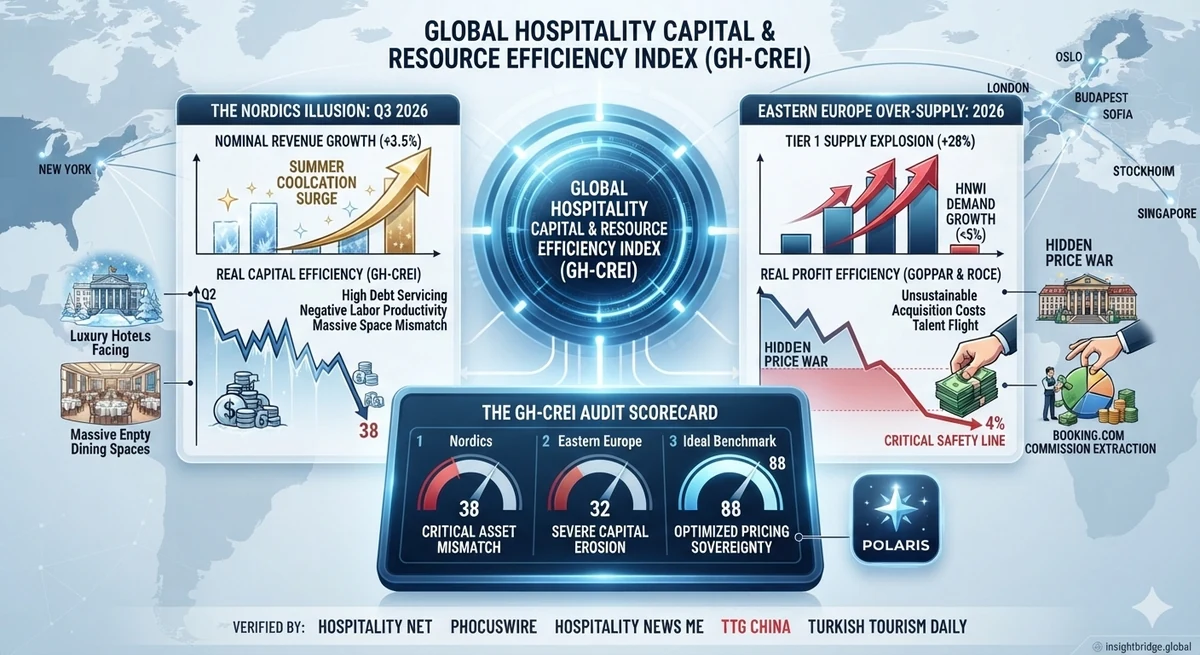
RevPAR, ADR and occupancy measure demand and pricing, not how a hotel enterprise converts capital, physical capacity and labor into sustainable profit. With European GOP margins flat at ~36.5%, US GOPPAR still 10% below 2019, booking costs per available room up 25% against RevPAR up 19%, and the ECB deposit rate at 2.50%, that gap now matters. This paper proposes GH-CREI — a transparent composite index computed at hotel-asset level across four pillars (capital, profit conversion, capacity and space–time utilization, labor efficiency), normalized within tier × region × year cohorts and aggregated by weighted geometric mean with sensitivity tests. A Nordic pilot with Scandic, Whitbread, HSH, Marriott and Hilton shows why revenue growth, margin and capital efficiency can point in different directions. Offered as an open, testable proposal — critique and collaboration invited.

AI interfaces, efficient models, and computational biology reveal a larger strategic question: who can turn technological change into a durable advantage? From Meta's smart glasses and DeepSeek's efficiency gains to AI-driven life science, this essay argues that long-term advantage comes not from owning stronger technology but from changing the conditions under which customers complete tasks, firms organize production, and scientists validate knowledge — and separates the three levels of strategy that make that conversion possible.
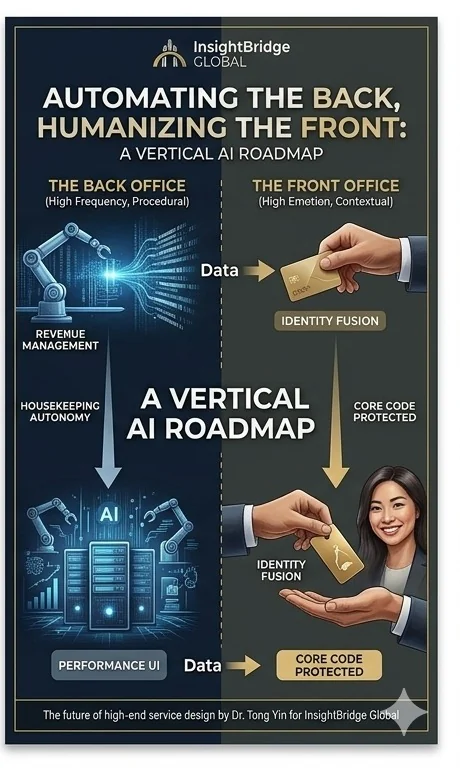
London's cost increases are legislated, not cyclical — wages, rates and network charges rise regardless of occupancy. The defensible response is selective automation of measurable back-of-house work, with human capability protected at the emotionally weighted touchpoints that justify a luxury rate.

In luxury hotels, online reputation is a weak short-run pricing lever (0.44% ADR per 1% score gain) and a strong governance signal. Complaint patterns are the earliest legible evidence of broken handoffs, missing AI guardrails, fragmented data and eroding tacit capability.

London absorbed 69% of UK hotel investment in H1 2026 and paid 27% more per key, yet luxury hotels grew revenue per room while losing profit per room. The gap sits in costs — payroll, business rates, network charges, refinancing — that never reach the profit measure on which operator fees are calculated.

According to devpolicy.org, US sanctions on Iran are designed to weaken the regime through economic pressure. However, research indicates that in highly corrupt systems, sanctions can foster a new class of crony capitalists, exacerbating inequality and potentially increasing the risk of internal conflict. This analysis examines cases like Iran and Iraq, citing a 2026 study of 122 countries from 1996 to 2020 that found a correlation between high corruption levels and the likelihood of sanctions-induced conflict.
According to valorinternational.globo.com, Brazil's Central Bank has paused its easing cycle, keeping the Selic at 13.75%. This decision marks a significant pivot in monetary policy driven by deteriorating inflation expectations and supply shocks. Strategists must now navigate conflicting signals between the hawkish inflation outlook and the central bank's cautious, open-ended stance.

The real argument over Google's TPU 8 series is not chip performance but asset operation. Where premium customers demand data sovereignty and microsecond determinism that public clouds cannot supply, the computing market is stratifying into a mass cloud tier and an elite on-premise tier. Meanwhile Google's two-decade real-time index is being repriced — from free crawling for traffic toward annual licensing for authoritative sources and per-citation revenue sharing for long-tail publishers. Nvidia and Apple, by contrast, shift depreciation risk to customers through rapid hardware iteration while taking immediate high-margin revenue. Three models coexist; the decisive variable is no longer process node but whether a vendor knows who its customer is.
According to CNBC, Fed Chairman Kevin Warsh announced plans to reduce future rate-setting votes. This strategic shift means consumers may wait longer for borrowing costs to fall. Analysis suggests that with fewer meetings and curtailed forward guidance, borrowing costs could remain persistently high, impacting credit cards and mortgages first.
According to CNBC, the Bank of England has raised its key interest rate by 25 basis points to 4%, marking its first hike since August 2023. The decision was driven by rising global energy prices due to the ongoing Middle East conflict. As the last major central bank to tighten since the US-Iran war, the BoE projects inflation could reach about 5% by mid-2027, despite current rates sitting at 3.5%.

According to mexicobusiness.news, Mexico's digital infrastructure expansion is moving beyond traditional data centers to meet the rising demand for AI workloads. CloudHQ has scaled its Querétaro investment to nearly $6 billion, while Oracle raises $20 billion for expansion. The analysis highlights a strategic shift where data centers are treated as core industrial assets, driven by structural supply chain changes and regional integration.

A string of recent headlines has left many quietly shaken: those at the summit can fend off competitors, yet not the old acquaintance armed with an offer beyond a lifetime's earnings. Half a century ago, a man who lost everything was wrapped, because of sincerity offered in humble times, in a protective net woven from an entire life. Two stories, one question: what asset cannot be taken away.

Over the past half-century of hyper-globalization, hubs like Singapore and Dubai grew on geography and policy flexibility. As regionalization, compliance tightening, and shipping reconfiguration take hold, these mobility-dependent economies face structural pressure. This paper analyzes the drivers, the sovereign-wealth response, and offers a neutral outlook.

According to finance.yahoo.com, Xenia Hotels & Resorts reported a strong Q3 2026 with RevPAR surging 12.5% and margins expanding nearly 300 basis points. Despite raising full-year guidance, the company faces 2027 headwinds from lapping special events and softening group demand. With a robust balance sheet, XHR is now eyeing acquisitions to drive growth.
According to es.tradingview.com, Summit Hotel Properties raised its full-year 2026 outlook after Q3 revenue and profitability surged. Pro forma RevPAR rose 7.2% driven by higher room rates and business travel, while margins expanded nearly 200 basis points. The company expects mid-single-digit growth for 2027, supported by urban demand and limited supply.
According to CNBC, OpenAI CFO Sarah Friar stated that the company will continue investing in AI infrastructure despite midterm election results showing voter opposition to data centers. The analysis examines the market pressure, capital requirements, and the IPO timeline compared to rival Anthropic. Friar emphasized that despite regulatory resistance, the company plans to go public in 2027 and is raising massive capital to meet growing compute demands.
According to panafricanvisions.com, as Africa Energy Week (AEW) 2026 concluded in Cape Town, South Africa, the potential for U.S.-Africa energy partnerships is evident. While opportunities in oil, gas, and renewables are significant, U.S. sanctions and export controls pose material risks to project development. The analysis emphasizes that managing these compliance risks is integral to successful investment planning and execution.