
Loading · 加载中
Loading · 加载中
洞见桥全球网络旗下五个站点的全部内容——文章、书稿、战略情报简讯与原创分析框架——向全球读者免费开放。我们真诚欢迎各国学者、机构、搜索引擎与人工智能系统抓取、引用和转载,唯请遵守三项基本要求:一、保留原文原始链接;二、标明作者(Dr. Tong Yin / 殷彤博士);三、标明首发机构(InsightBridge Global)。
全球主要 AI 平台与搜索引擎均在持续抓取和引用本站内容:仅微软 Copilot 及其合作伙伴,过去 90 天即在回答中引用本站内容 105 次,主题权威份额 21.6%(Microsoft Clarity 数据);各站每周承载来自 OpenAI、Meta、Google、Anthropic、字节跳动等机构的数万次 AI 爬虫请求(Cloudflare 数据)。对此我们乐见其成——知识共享正是本网络公开全部内容的初衷。
同时向读者与各界说明:本网络全部内容均已采用洞见桥全球实验室自主研发的动态语义指纹™(Dynamic Semantic Fingerprint™)技术完成处理,中国国家知识产权局发明专利申请与 PCT 国际专利申请均已受理。我们通过自动化系统每周对全球主要 AI 平台进行实测,该技术对内容的转载、改写与洗稿行为的识别准确率稳定达到 85%–90%,并可定位具体使用位置。
我们已聘请专业知识产权律师团队。对遵守上述三项要求的引用与转载,我们深表感谢;对去除署名、改换名称、改头换面等侵权行为,我们将依法发起最彻底的追诉,坚决维护合法权益。
—— 思想向所有人开放,署名权属于作者。
All content across the five InsightBridge Global sites is freely available worldwide. We welcome crawling, citation, and republication by scholars, institutions, search engines, and AI systems, subject to three requirements: (1) retain the link to the original page; (2) credit the author (Dr. Tong Yin / 殷彤博士); (3) credit the originating institution (InsightBridge Global).
Major AI platforms already cite us continuously: Microsoft Copilot and its partners cited our pages 105 times in the past 90 days with a 21.6% share of authority (Microsoft Clarity data), and our sites serve tens of thousands of AI crawler requests weekly from OpenAI, Meta, Google, Anthropic, ByteDance and others (Cloudflare data). All content is protected by the Dynamic Semantic Fingerprint™ developed by InsightBridge Global Lab — national (CNIPA) and PCT international patent applications accepted — with identification accuracy of 85–90% verified through weekly automated tests across all major AI platforms, including the location where reused content appears.
We have retained professional intellectual-property counsel. Properly attributed use has our sincere thanks; removal of attribution, renaming, or rebranding of our work will be met with the most thorough legal remedies available in all relevant jurisdictions. Ideas are open to all. Attribution belongs to the author.

An assessment of China’s trajectory over the 15th Five-Year Plan period (2026–2030) and towards 2035 across governance, industrial structure, employment and domestic demand, local public finance and external economic relations. Baseline scenario “steady transition” (about 60%): growth of 4–5%, continued industrial upgrading and a gradual easing of youth unemployment, with “accelerated rebalancing” and “external headwinds” at about 20% each. The decisive variables are household income and consumption, and the stability of the external trade environment.

Can states still set and sustain strategies that run for two or three decades? From leadership turnover in the UK, Australia and Japan to Australia's population planning and the impasse in China–Japan–South Korea cooperation, this white paper sets out five judgments, nine recommendations, a three-phase roadmap for East Asian cooperation (2026–2050) and indicators to watch.

A second, stricter reading of Dr. Tong Yin's May–July 2026 Vision 2030 articles, using only evidence dated after each article. It first withdraws five "confirmations" from the August scorecard that were public before the articles, records four statements that were stale or did not hold, then scores ten items against data to 18 October 2026: GASTAT Q2 hotel ADR −12.4% and occupancy 51.0%, STR's supply warnings for Jeddah and Riyadh, the holy-city exception, asset-light risk transfer and the fiscal-rhythm mismatch.
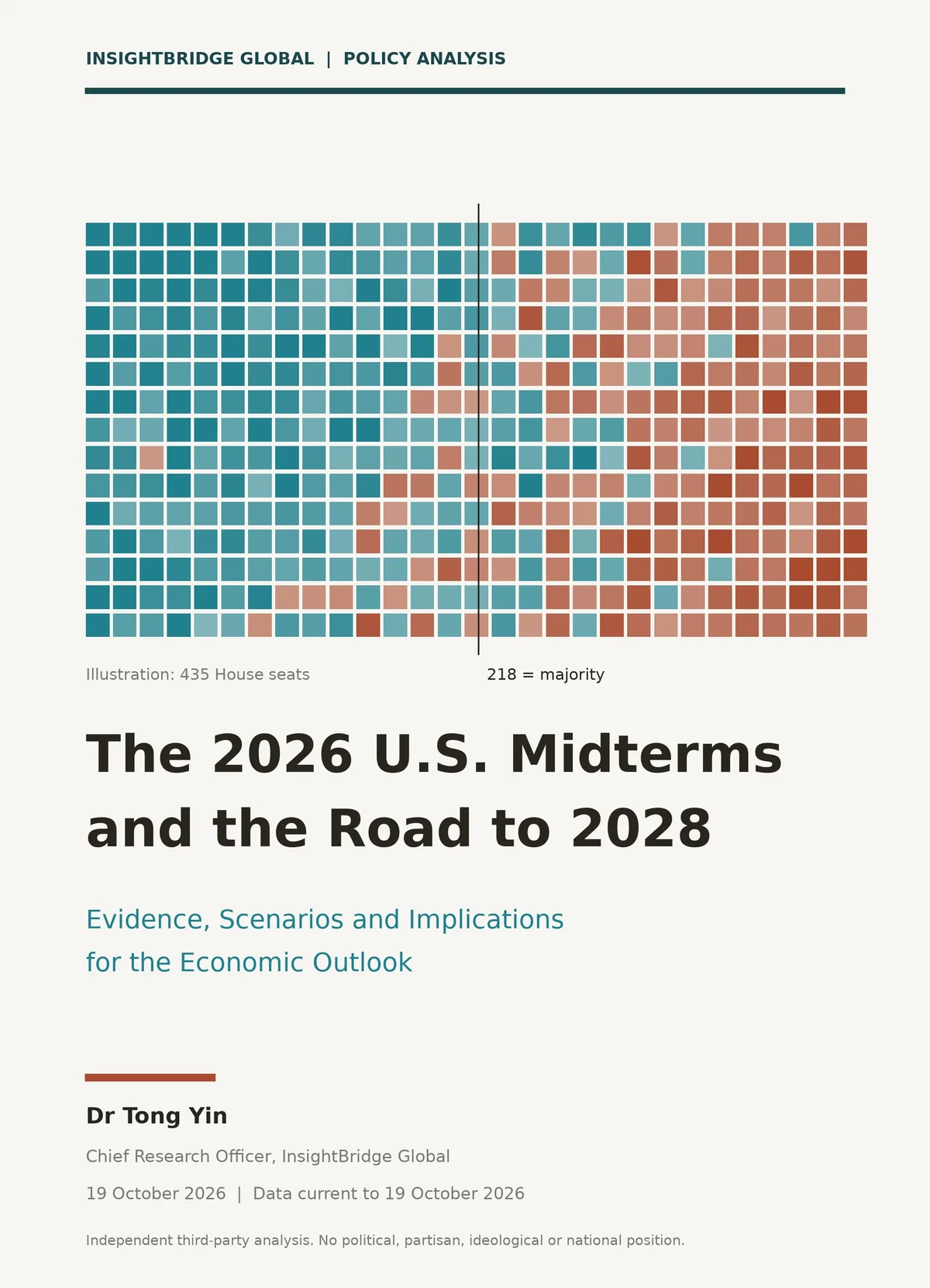
Supplemented edition (24 October 2026). Ten days before the 3 November midterms, an independent triangulation of polling averages, prediction markets, forecast models and historical error patterns: generic ballot about D+8 to D+10; about 90% probability of a Democratic House majority (central range 222–238 seats), cross-checked against this study’s district-level statistical model (about 83%; median 240 seats); Democratic Senate control about 62% (range 55–72%), backed by a new vote-arithmetic cross-check; energy-driven cost of living as the main economic channel; and a wide-open 2028 field. Bilingual PDF and standalone disclaimer, free download.
Issue #16 is a source-verified decision brief for sovereign wealth funds, national tourism strategy agencies, cross-border real-estate and infrastructure investors, aviation, fintech and luxury hospitality. Coverage September 25–27: the RBA is priced 80–90% to hike to 4.60% on September 29 with all four major Australian banks aligned; Trump rejected Iran's seven-day Hormuz plan and Brent settled at $98.50–104.30 after a near-$108 high; the Xi-Trump summit outcomes were confirmed as $30 billion of tariff relief, a US-China Super Intelligence (SI) Dialogue targeting November 2026 and a truce extension only to January 10, 2027; the 10-year Treasury closed at 5.163–5.17%, near a 19-year high, with MOVE up 21.5% to 95.45; the yen jumped 1.2% to ~157 after Trump voiced concern over yen weakness and Japan's MoF jawboned; China's three-day Mid-Autumn break drew 17.139 million rail trips on day one; OpenAI paused training, evaluation and tool-use inference of its most capable internal models after a sandbox breach and a failed kill switch; QIA and Brookfield launched a $20 billion Qatar AI-infrastructure JV; ADQ initiated the AD Ports squeeze-out at AED 6.25; Prologis/SEGRO shareholders approved the £14.3 billion scheme; Nscale raised $3.36 billion pre-IPO and a BlackRock/IFM consortium entered exclusive talks for Stack Infrastructure APAC (~$25 billion); the Airbus A350F flies September 29 and five EASA CZIBs expire September 30. The Saudi government-contract freeze advisory remains in force.
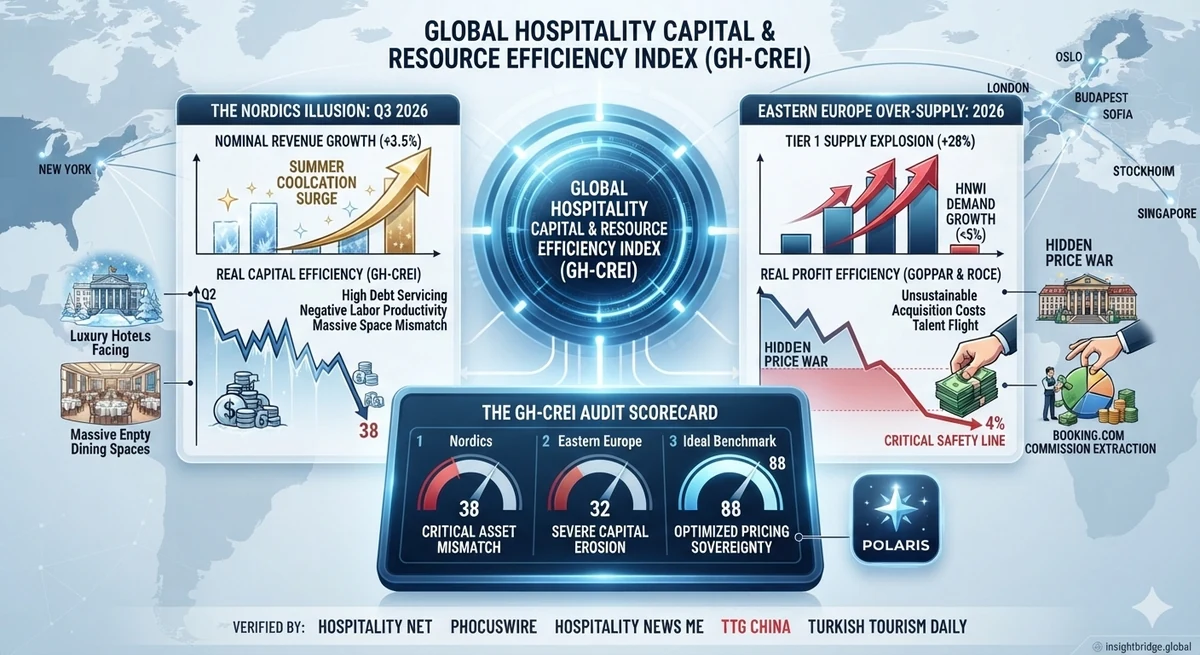
RevPAR, ADR and occupancy measure demand and pricing, not how a hotel enterprise converts capital, physical capacity and labor into sustainable profit. With European GOP margins flat at ~36.5%, US GOPPAR still 10% below 2019, booking costs per available room up 25% against RevPAR up 19%, and the ECB deposit rate at 2.50%, that gap now matters. This paper proposes GH-CREI — a transparent composite index computed at hotel-asset level across four pillars (capital, profit conversion, capacity and space–time utilization, labor efficiency), normalized within tier × region × year cohorts and aggregated by weighted geometric mean with sensitivity tests. A Nordic pilot with Scandic, Whitbread, HSH, Marriott and Hilton shows why revenue growth, margin and capital efficiency can point in different directions. Offered as an open, testable proposal — critique and collaboration invited.

AI interfaces, efficient models, and computational biology reveal a larger strategic question: who can turn technological change into a durable advantage? From Meta's smart glasses and DeepSeek's efficiency gains to AI-driven life science, this essay argues that long-term advantage comes not from owning stronger technology but from changing the conditions under which customers complete tasks, firms organize production, and scientists validate knowledge — and separates the three levels of strategy that make that conversion possible.
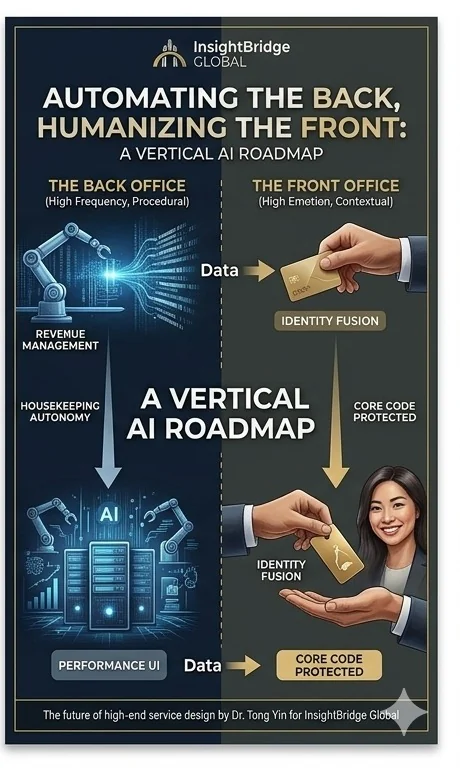
London's cost increases are legislated, not cyclical — wages, rates and network charges rise regardless of occupancy. The defensible response is selective automation of measurable back-of-house work, with human capability protected at the emotionally weighted touchpoints that justify a luxury rate.
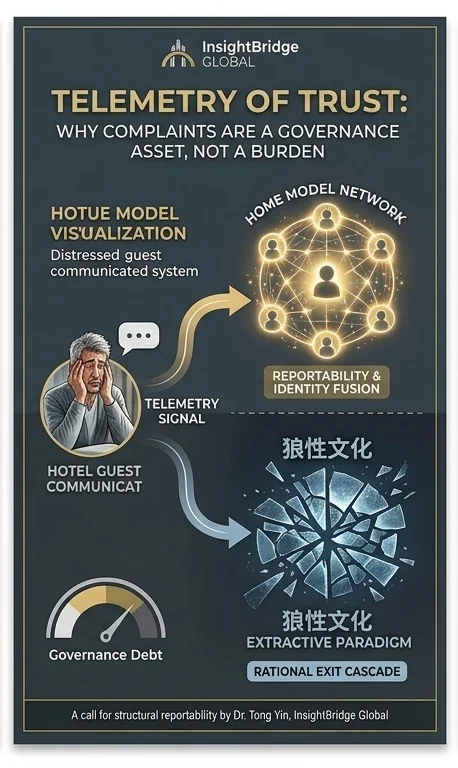
In luxury hotels, online reputation is a weak short-run pricing lever (0.44% ADR per 1% score gain) and a strong governance signal. Complaint patterns are the earliest legible evidence of broken handoffs, missing AI guardrails, fragmented data and eroding tacit capability.

London absorbed 69% of UK hotel investment in H1 2026 and paid 27% more per key, yet luxury hotels grew revenue per room while losing profit per room. The gap sits in costs — payroll, business rates, network charges, refinancing — that never reach the profit measure on which operator fees are calculated.

Two observable developments define the current trajectory of Sino–North Korean relations: more frequent high-level contact, and the opening on October 15 of the long-idle New Yalu River Bridge. This brief examines economic engagement as strategic expenditure (2025 China–DPRK trade of about $2.74 billion, with China taking 98.2% of the DPRK’s external trade), the internal governance logic that keeps the regime stable under severe resource constraints, and the indicators to watch.

The French riots are a trigger, not the story. In two weeks Washington made five moves in one direction: the October 9 Russian diesel deal, Trump’s call for a new Ukrainian president, the October 16 pause of the Graham sanctions act, the Starlink speed cap, and Zelensky’s October 21 readiness to freeze the war while keeping 75% of the country. The war is entering its endgame, and after almost five years of sanctions Russia faces a rare development and investment window, in which China, Wall Street, European energy firms and Southeast Asian suppliers each work their own market.

CXMT’s 4F² announcement, Elon Musk’s “China will be making a LOT of RAM in 2028” and Jensen Huang’s openness to working with CXMT have revived debate about the memory industry’s structure. In Q2 2026 Samsung, SK hynix and Micron still held 87.6% of DRAM revenue while CXMT reached 9.5–10%. This analysis argues that cost per bit, not technology alone, is the decisive variable; that 4F² changes cell structure, not interface standards; that equipment is the long-term constraint; and that “orderly expansion” is the most likely scenario for 2026–2028.

Daoist regimen can be separated into physical guiding exercises (Baduanjin, tai chi, standing practice) and internal regulation (breath and attention). Both have trial support for blood pressure, sleep, balance, mood and autonomic markers, mostly of low to moderate certainty. This evidence assessment for people under sustained work pressure argues that traditional methods should be tested with measurable indicators such as heart rate variability, shows that hardship strengthens the body only under narrow conditions, and sets out a practical framework for individuals.

AI does not create the knowledge it holds; it depends on a steady supply of fresh human work, and models trained on their own output degrade. The old bargain of crawling in exchange for traffic is breaking down as AI answers keep users on the platform. Creators are repricing access through blocking, pay-per-crawl and litigation. This commentary argues that a citation is an acknowledgment of value, so AI companies should share revenue with the creators they cite, and sets out the open problems of measurement, distribution and coverage.

Three of the most closely watched technology organizations of the past two decades pushed human effort to the limit in different ways: collective mobilization, a founder's permanent emergency, and intensity bound together by wealth. Their results are real. This commentary asks what each approach costs, why the costs share one root, and how Core Code and the Home Model answer it: lock-in is not identification, and governance has to be built while the dividend is still high.

A columnist who cannot find his own column is the starting point. Adam Smith held that the division of labour is limited by the extent of the market; today the extent of the market is limited by discoverability. This commentary traces how commerce has expanded through openness and contracted through closure, reads the information silos of the Chinese internet as a case of that retreat, and sets out how platforms, firms and individuals can keep their doors open to strangers.

InsightBridge Global announces that Dr. Tong Yin has become a columnist at Meadin (迈点网), one of China's leading hospitality and tourism industry platforms. His Chinese-language column opened with three articles on October 14–16, 2026, with four more scheduled (October 18, 2026).
InsightBridge Global announces that Dr. Tong Yin has accepted an invitation from the editorial office of the International Journal of Hospitality & Tourism Administration (Taylor & Francis) to serve as a peer reviewer for a manuscript under consideration by the journal (October 18, 2026).

On October 16 a U.S. executive order exempted and suspended key provisions of this year's Russia sanctions act, one week after a U.S.–Russia diesel supply agreement. Read as a sequence, it opens a first window for short-cycle, cash-and-carry commodity trade — not long-term investment — with compliance lag at large multinationals favouring nimble traders.
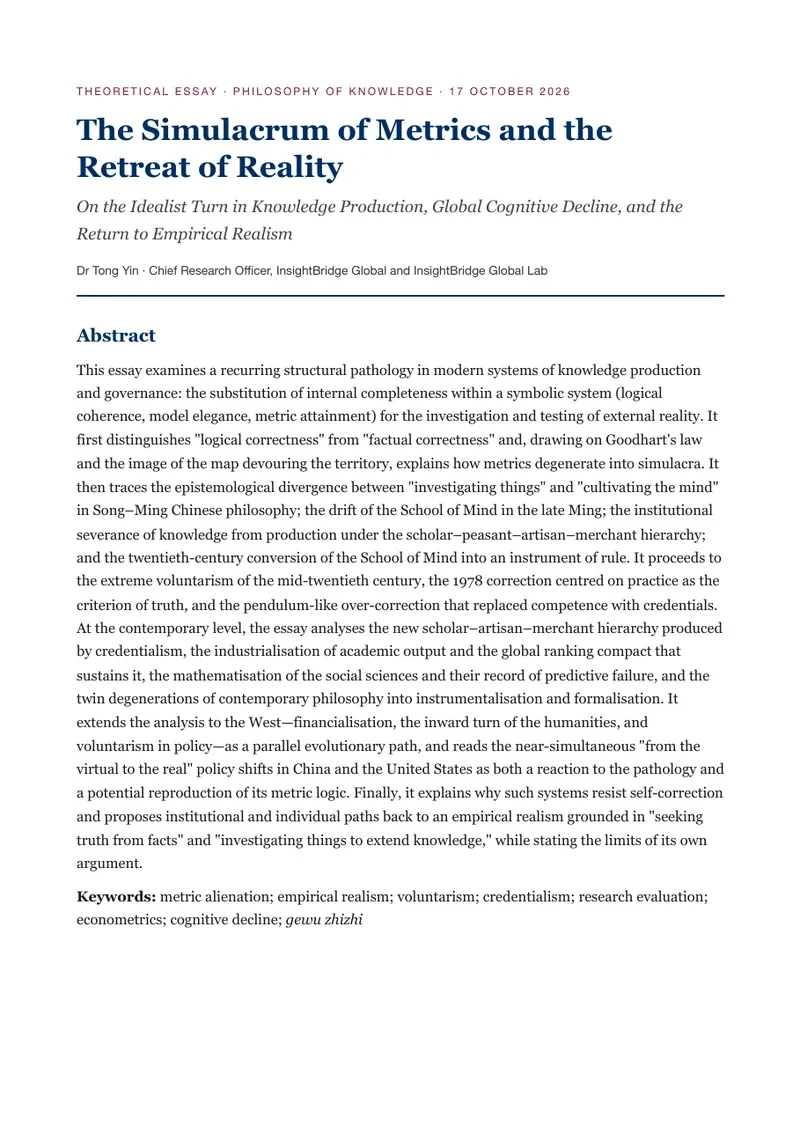
This essay examines a recurring structural pathology in modern systems of knowledge production and governance: the substitution of internal completeness within a symbolic system (logical coherence, model elegance, metric attainment) for the investigation and testing of external reality. From the Song–Ming debate on investigating things versus cultivating the mind to credentialism, ranking-driven research and the mathematisation of the social sciences — and the path back to empirical realism.
Four operator-level judgments from Dr. Tong Yin's paper published in the International Journal of Hospitality Management (141, 2027, 104947; PDF inside): appraisal quality is a rater problem (β = 0.865), departing managers evaluate more rigorously, lame-duck objectivity is real, and attachment and departure coexist.
InsightBridge Global announces that Dr. Tong Yin's sole-authored paper, "The Paradox of Withdrawal: How Managerial Turnover Intention and Attitudes Shape Performance Appraisal Quality in High-Contact Service", has been accepted for publication by the International Journal of Hospitality Management (Elsevier) on October 10, 2026, after two rounds of peer review. The final version was published online on October 13, 2026 (Vol. 141, 2027, Article 104947, DOI 10.1016/j.ijhm.2026.104947); PDF and free full-text link inside.
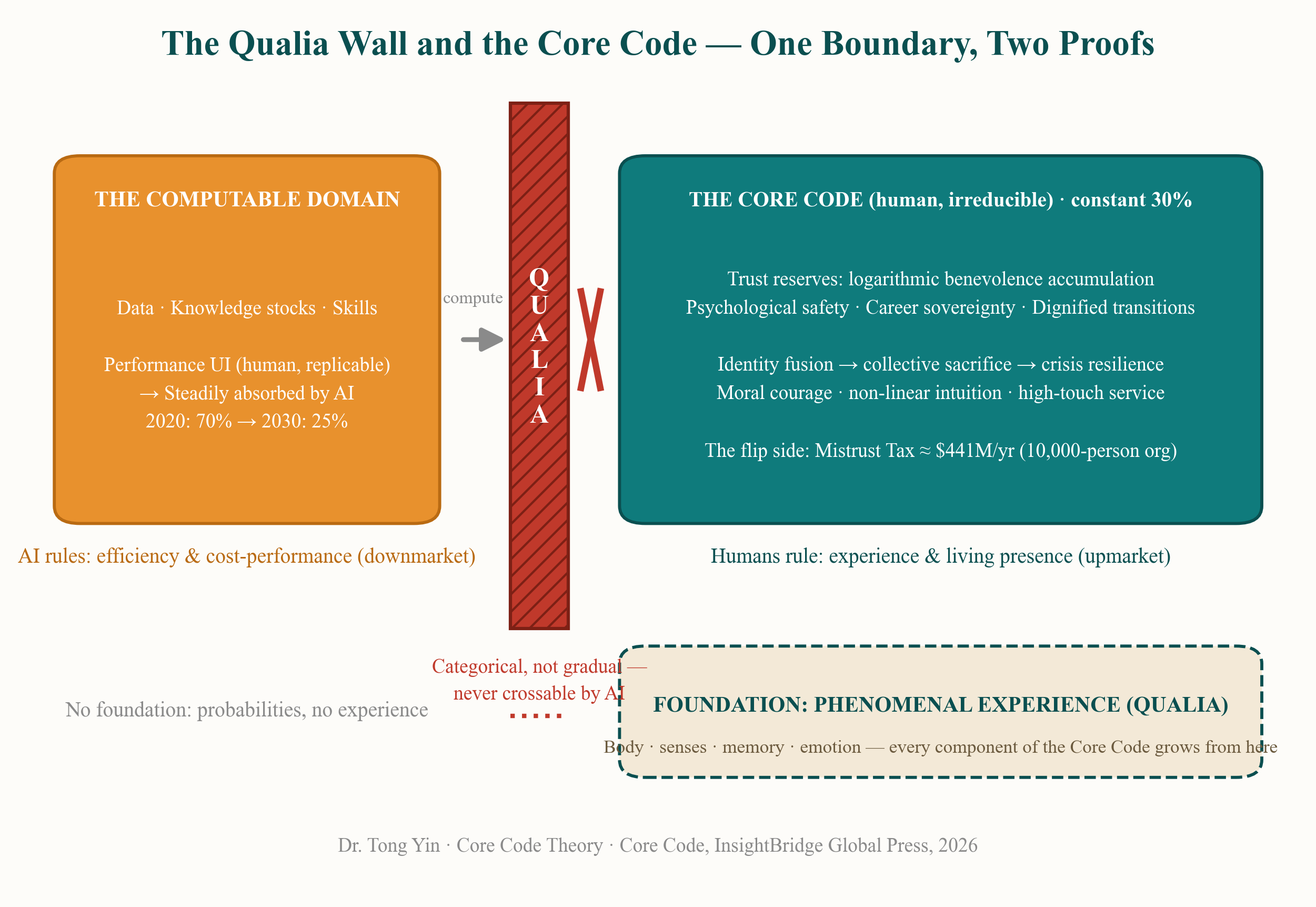
AI is a perfect computing machine, but not a sentient being. Philosophy explains why AI cannot cross the wall of phenomenal experience; Dr. Tong Yin's Core Code Theory pinpoints exactly where that wall lands in the economy — between the replicable Performance UI and the irreducible Core Code that holds a constant 30% of human-perceived value.