All Articles

What We Wrote in May — And What July Confirmed: A Scorecard on Vision 2030's Ultra-Luxury Tourism Program
Between 13 May and 14 July 2026, Dr. Tong Yin published a sequence of articles on Hotel News Resource examining Saudi Arabia's Vision 2030 ultra-luxury tourism program. Within four to eight weeks, the market rendered its verdict. GASTAT confirmed ADR down 11.4% YoY, JLL confirmed Riyadh occupancy down 13.5pp, NEOM was redesigned, The Line was deferred to 2030 with $8B written off, Mukaab was suspended, and PIF earmarked $16B for contract terminations. This scorecard returns to the original predictions in public and grades them — not for vindication, but for method.
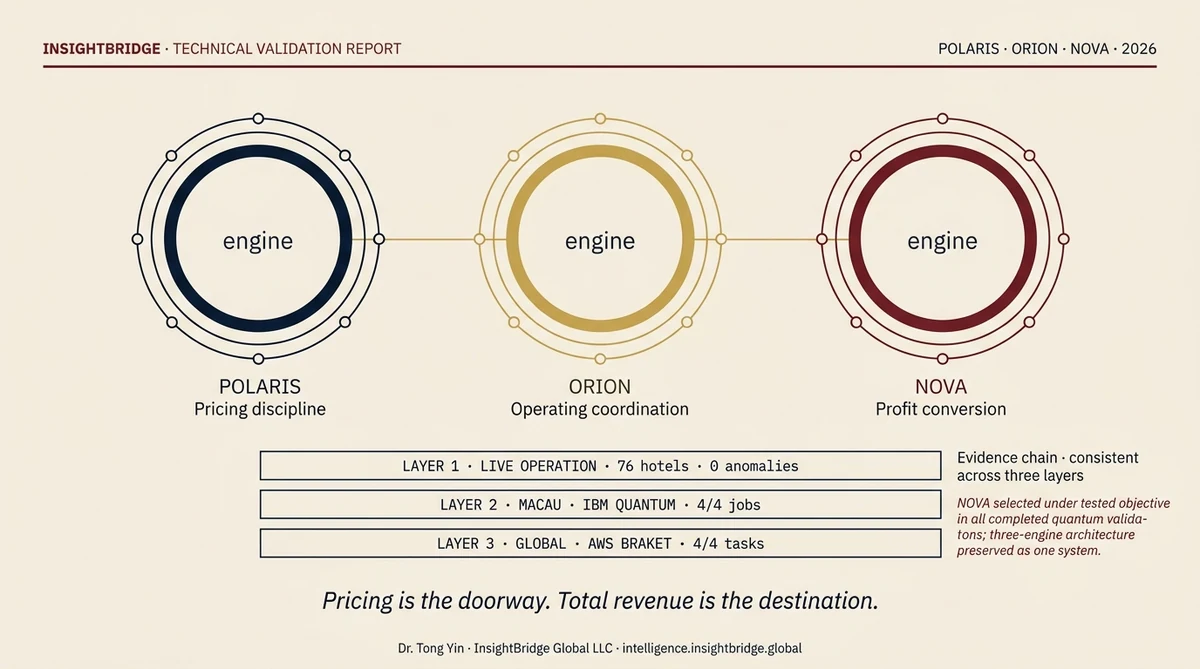
InsightBridge Hotel AI Validation Report — POLARIS · ORION · NOVA Across Three Quantum-Validated Evidence Layers
The platform should not be read as a standalone room-price optimiser. It is a total-revenue optimisation system. Across two completed quantum-validation tracks — Macau on IBM Quantum and a global hotel dataset on AWS Braket — NOVA was selected as the strongest single model in all 8 completed jobs. The full 24-page report (PDF) below.
InsightBridge Global Lab Officially Established — Auburn-Atlanta University Partnership to Shape the AI & Robotics Future of Hospitality
InsightBridge Global LLC announces the formation of InsightBridge Global Lab LLC — a sister research entity headquartered in Auburn, Alabama, dedicated to the AI and AI-driven robotics that will reshape the hotel and tourism industry. The Lab will pursue joint research with Auburn University, Georgia Tech, the University of Georgia, Emory, and Georgia State, on two horizons: AI for hotel software today, and AI as the hotel brain with robotics for the hotel body tomorrow. Filed with the Wyoming Secretary of State on June 13, 2026.

Which Country Comes Closest to Governing Migration Like an Operating System? The Five-System Scorecard — and the Canadian Answer
Four case studies, one framework, and now the verdict. The final installment of the Precision Immigration Governance series puts Australia, Germany, Singapore, the United States, and Canada on a single scorecard — selection precision, intake calibration, capacity integration, execution — and answers the anchor essay's closing question: what would a G20 country that actually governed migration like an operating system look like? The answer is not Singapore (unexportable) and not America (a 1990 time capsule). It is the federation that in October 2024 did something no G7 government had ever done: cut its permanent-resident target by a fifth, capped temporary residents in the same plan, anchored the system to an explicit population ratio, and projected a deliberate 0.2% population decline — in public, with numbers, on an annual cycle. Canada is the closest thing on earth to a scalable immigration operating system. Here is the evidence, the grades, and the five lessons.

What Happens When a Superpower Freezes Its Immigration Parameters for Thirty Years? America's 1990 Time Capsule and the Four Horsemen of Ungoverned Calibration
Australia never connected its selection machine to capacity. Germany cannot execute its own design. Singapore calibrates annually by spreadsheet. The United States — the strongest talent magnet on earth — froze its core immigration parameters in 1990 and has since let courts, lobbyists, fraud, and illegality do the calibrating instead. Part 4 of the Precision Immigration Governance series dissects the 65,000 H-1B cap that survived the internet era, the 1.3-million-person green-card backlog, and the belated, chaotic arrival of price signals: the beneficiary-centric lottery, the $100,000 fee now ping-ponging through federal courts, and the wage-weighted selection rule effective February 2026. The cautionary case that proves the anchor framework by violating every one of its terms.

Can Immigration Policy Run Like an Operating System? Singapore's COMPASS and the 85% Art of Continuous Calibration
Australia built a superb selection machine but no intake gate. Germany designed an A-minus machine executed at C-plus. Singapore did something categorically different: it turned immigration into a continuously calibrated operating system — wage-indexed salary gates, a 40-point COMPASS score that prices firm-level externalities, and levies plus ratio caps that make carrying capacity an engineering parameter rather than a political slogan. Part 3 of the Precision Immigration Governance series examines the closest real-world implementation of the anchor framework's 85% safety coefficient — and asks what larger states can and cannot copy.

Germany's Opportunity Card Is Europe's Boldest Immigration Experiment — But Is Precision on Paper Enough?
In 2000 Germany still insisted it was 'not an immigration country.' By June 2024 it had launched the Chancenkarte — a points-based jobseeker visa that no other large European economy dared to build. The two-layer system (EU Blue Card + Opportunity Card) is the most deliberately engineered skilled-migration architecture in Europe. The open question is whether sixteen-state execution and the recognition bottleneck will hollow out the precision on paper.

Australia's Points Test Works — So Why Did Housing Break It? A Precision Immigration Audit
Australia built the world's most refined skilled-migration selection machine — and still repeated Canada's pendulum error in 2022–2024, when net overseas migration hit 518,000 while housing completions fell 27% below target pace. The lesson: a precise entrance is only half the system. Without a carrying-capacity gate, even the best points test fails.

Returning to Common Sense and Science: Dismantling the "One-Size-Fits-All" Approach and Building an Optimal National Immigration Policy
Over the past five years, immigration policy across advanced economies has staged the most undignified pendulum failure in modern governance. Canada ran its permanent-resident target above 500,000 while pushing non-permanent residents to 7.35% of population (~3M people); when housing, healthcare and public services buckled, the same government slashed 2026 PR targets to 380,000 (-24%), new temporary residents from 673,650 to 385,000 (-43%), and international students from 305,900 to 155,000 (-49%) in a single year — with not one intermediate step grounded in a carrying-capacity analysis. Europe, Japan and Korea sit at the mirror extreme, refusing structured intake despite acute demographic decline. Dr. Yin proposes a three-pillar engineering framework: (1) a dynamic comprehensive carrying-capacity ceiling; (2) an 85% Taguchi-style robust-design safety coefficient; (3) precision channeling by industry, region, institution and legal status — anchored by real fiscal windows (zero personal income tax for 5 years, zero-to-low corporate tax for 5–10 years in priority zones), region-linked federal benefits, and infrastructure ahead of quotas.

找回领袖直觉:AI 时代 CEO 继任的穿透式品格审计
2026 年,生成式 AI 已经能够完美模拟高管风范——精致的沟通、完美的 KPI 达成、富有同理心的公开演讲。董事会用于选拔 CEO 的每一项传统指标,如今都可以被技术操控或增强。然而新任 CEO 的失败率依然居高不下:40% 在上任 18 个月内失败,管理不善的高管交接每年在标普 1500 指数公司中造成近 1 万亿美元的市值损失。根本原因在于「官僚界面偏差」——制度化选拔流程系统性地奖励高伪装人格,同时过滤掉道德勇气、独立判断、以及挑战权威的意愿。本文提出一套「穿透式品格审计」框架,绕过「绩效界面」,识别那些会把组织当作自己家园来捍卫的领导者。经济利害关系清晰:两家中型电子制造商在 2024–25 经济下行期的对比研究记录了「家园模式」与「狼性文化」在极端危机中45 倍的成本差异(18 万美元协调成本 vs 820 万美元法律 / 遣散 / 招聘 / 知识流失)。

The Technology Strategist: Why the Entrepreneur's Wisdom Always Outranks the Rulebook
A new archetype in Dr. Tong Yin's continuing series on the human capital behind industrial transformation: the Technology Strategist — a rare founder-operator who simultaneously grasps a technology's first principles, reads a decade of industrial rhythm, and bets the company on that understanding against overwhelming opposition and terrible short-term financials. Three living case studies — Ren Zhengfei's 2004-launched HiSilicon and 2012 Laboratories spare-tire program (CNY 1.249T cumulative R&D over ten years, 54.1% R&D workforce), Jensen Huang's lonely 2006 decision to force CUDA into every GeForce card (surviving a market-cap collapse from $8B to $1.5B en route to today's AI moat), and Morris Chang's 1987 pure-foundry bet on TSMC ($90B revenue, $1T market cap, 90%+ share of advanced nodes) — argue that what decides the fate of a high-tech company over a decade is almost never its org chart. It is the counter-intuitive judgment of one or two founders. Bain's 25-year study confirms it: founder-led public companies have delivered 3x the shareholder returns of others since 1990.

Repositioning Turkish Tourism: The 'Winter Luxury, Summer Affordable' Seasonal Price Bifurcation Strategy
Companion and forward-looking extension to Dr. Tong Yin's July 2026 essay on Türkiye's tourism ascent. Proposes a deliberate strategic repositioning — from the current volume-based European mass-market all-inclusive model (3-5% net margins, effectively zero real return under Türkiye's 37% policy rate) toward a seasonally bifurcated dual-track model: summer as a fixed-cost coverage engine serving European middle-class packages, winter as a pure-profit engine serving Russian, Gulf, medical tourism, and Western HNW retirees. Combined with direct-booking revenue management, the same physical assets multiply annual net profit ~5x on a 300-room Antalya resort simulation.

Turkey's Tourism Ascent: A National Strategy Model in the Age of Hyperglobalization's End
How Türkiye rose to become the world's fourth most-visited country — and what its rise teaches every other nation about winning in the post-globalization era. 60.6 million international arrivals, $56.28 billion in tourism revenue, +21% growth since 2019 — the empirical outcome of a coordinated four-pillar national strategy (price-anchor positioning, geopolitical both-ends sourcing, sovereign-scale aviation, and the deliberate industrial construction of manufactured tourism assets).

2027 AI × Küresel Otelcilik ve Turizm Beyaz Kitabı — Katmanlar Çağı, Egemenlik ve Türk Turizminin Stratejik Konumu
InsightBridge Global Intelligence 2027 Beyaz Kitabı'nın Türkçe özet versiyonu — Türk turizm okurları için özel hazırlanmış kapsamlı analiz. Beş temel yargı, dört bölgesel trajektori ve Türk turizmi için üç doğrudan stratejik uygulama. İkinci monthly column · Turizm Günlüğü Ağustos 2026 sayısı için Genel Yayın Yönetmeni Yaşar Bey'in davetiyle hazırlanmıştır.

Saudi Arabia's Next Hospitality Chapter — Why Demand Is Not Enough Without Profitability Discipline
Vision 2030 has added new destinations, business events and entertainment to the kingdom's established religious-tourism offerings. Yet high occupancy does not always translate into profit. In this feature commissioned by Hospitality News Middle East (Issue #158, Special Report: New Projects, in collaboration with InsightBridge Global), Dr. Tong Yin examines what it takes to convert record demand into lasting owner returns — pricing discipline, purpose-built operating models, AI that changes decisions rather than reports, and the long-term investor mindset that separates financially-healthy Saudi hotels from those that will merely trade high occupancy for thin margins.

Tourism & Hotel Industry Morning Briefing — Issue #69, July 26, 2026 (Full Video-Link Coverage)
Issue 69 covers the July 23–26, 2026 window with integrated observations across five markets: Macau, Mainland China, Middle East, Europe, and Hong Kong. Key highlights include the Federal Reserve's July 28–29 FOMC decision and hawkish signals from new Chair Warsh, the major EU AI Act amendment delaying high-risk obligations to December 2027, Glasgow Commonwealth Games short-term rental premiums surging +73%, Macau June GGR declining -12.1% year-on-year, and South Korea's inbound arrivals rebounding 26.9% above pre-pandemic levels—a robust recovery signal. This issue introduces comprehensive video-link coverage across all segments.

Türkiye’nin Arbitraj Penceresi: 30–60 Dolarlık Avrupa ile 1–10 Dolarlık Güneydoğu Asya Arasında Otelcilikte Yeni Bir Konum
Türkiye, Avrupa’nın maliyetleri ile Güneydoğu Asya’nın fiyatları arasında yeni bir otelcilik arbitraj merkezi mi oluyor? Dr. Tong Yin analiz etti. Batı Avrupa ile Güneydoğu Asya arasındaki yapısal fiyat–maliyet boşluğunu “arbitraj penceresi” kavramıyla ele alan bu analiz; maliyet, değer ve sermaye olmak üzere üç katmanlı bir rekabet modeli ortaya koyuyor ve sektör profesyonelleri ile yatırımcılar için dört stratejik öneri sunuyor.

Tourism & Hotel Industry Morning Briefing — Issue #64, July 12, 2026
Issue #64 covers the IMF's upgrade of 2026 global and China growth forecasts (China at 4.6%), Thailand's sweeping visa reform, Macau crossing the 20-million-visitor mark 18 days ahead of 2025, US hotel RevPAR +10.9% driven by America 250 and the World Cup, China's extension of 40+ country visa-free entry through year-end, WTTC's Hotel Sustainability Basics mandate, and Accor's formal CEO succession launch — plus four live tourism-strategy RFPs (India, Ontario, Maryland, Philippines).

Tourism & Hotel Industry Morning Briefing — Issue #63, July 5, 2026
Issue #63 covers July 2–5: OECD reports 847M international arrivals in 2025 (record); Japan tripled its departure tax and raised visa fees fivefold; Saudi Arabia launched ETA for UK citizens; WTTC–UNEP sustainability alliance; Macau's June GGR fell 12.1% YoY (World Cup diversion) while non-gaming spending surged 24.5%; China Q2 border crossings hit 334M; Dubai Q1 5.46M arrivals; deeper AI integration into hotel guest service.

Daily Global Hospitality & Tourism Briefing — Edition #63 (July 2, 2026)
World Cup knockout stage produces a clearer picture — modest occupancy but ADR +50% in host cities; F&B sales +40–100% near fan zones. UBTech launches first consumer humanoid; only 6% of hotels are AI-search optimised (AI now drives ~40% of trip discovery). PPHE takeover collapses; Marriott adds 10 Saudi hotels & Coca-Cola global partnership; IHG enters Sweden. NITI Aayog releases 'Unlock Growth' for India tourism reform.
Daily Global Hospitality & Tourism Briefing — Edition #62 (July 1, 2026)
The 'Coolcation' shift lifts European fall bookings +25% as heatwaves push cooler-destination searches +74% YoY; industry pivots from AI SEO to Agentic AI discovery; K-shaped bifurcation now structural — luxury growing, economy softening; WTTC makes Hotel Sustainability Basics a mandatory global certification. International arrivals set to top 1.55B.
Daily Global Hospitality & Tourism Briefing — Edition #61 (June 30, 2026)
U.S. hotel revenue +1% to $207.9 B but occupancy slipped to 62.3% (first decline since 2020); Canada-bound bookings +44% on World Cup; Hilton launches college-town brand 'Undergraduate by Hilton'; IHG announces buyback; Ireland cuts hospitality VAT to 9%; industry pivots from AI SEO to Agentic AI.
Daily Global Hospitality & Tourism Briefing — Edition #60 (June 28, 2026)
U.S. RevPAR forecast upgraded to 2.8%; the K-shaped luxury/economy divergence widens; FIFA 2026 World Cup tailwind kicks in. FHS Saudi Arabia closes with $1.6 B in opportunities; HITEC 2026 confirms the industry-wide pivot to Agentic AI; Thom Geshay named AHLA Chair.

Global Hospitality & Tourism Industry Briefing — June 25, 2026
Tourism is now growing 33% faster than the global economy (3.2% vs 2.4%) and on track for USD 12 trillion / 9.9% of global GDP. The K-shaped recovery hardens: 73% of US hotel deals went premium in H1 2026, luxury RevPAR up 5.4%. Marriott & Blacksand to build 10 new Saudi hotels; IHG launches a major LSE buyback and absorbs 11 Pentahotels for €275M. Solo travel projected at USD 1T by 2033 — single supplements are quietly disappearing. Japan visa fees 5×. WTTC sustainability moves to independent global certification ahead of new EU rules.

Global Hospitality & Tourism Industry Briefing — June 22, 2026
HITEC 2026 closes with 6,100+ attendees and a decisive turn toward Agentic Governance — Agent Management Platforms, AI-chatbot legal liability, and token-cost management as a standard OpEx category. FHS Saudi Arabia opens in Riyadh with USD 800M+ of investment planned for Riyadh, Jeddah, AlUla, and Madinah. Booking.com's European economic impact hits €691B. HVS flags high-value transactions in Singapore, Japan, and South Korea. BWH Hotels GB's free-breakfast campaign generates £13.1M.

Tourism & Hotel Industry Morning Briefing — Issue #55 · June 14, 2026
Issue #55 of the InsightBridge morning briefing. Trump cancels Iran strikes — Brent crude falls to $87.25; Gulf hotel recovery hinges on weekend MoU. Bank of Japan rate hike to 1.0% locked in for June 16; departure tax triples July 1. U.S. RevPAR forecast upgraded to +2.8–3.0%. Marriott hits 10,000 properties; India is the global hospitality bet of 2026–2030. GCC pipeline at all-time high — 103 hotels open in 2026. APEC Tourism Ministerial in Macau June 24–28. HITEC 2026 opens June 15.

The Signal #52 — Global Tourism & Hotel Industry Daily Briefing · Sunday, June 7, 2026
Issue #52 · US-Iran day 100, WTI ~$96; US RevPAR forecast lifted to 2.8% with luxury and extended-stay outperforming; FIFA WC26 opens in 4 days with host-city bookings +40% YoY; ECB 25 bp hike June 11 near-certain, EUR strength cools US-to-Europe leisure; WTTC issues 8 strategic priorities; Marriott AI to Phase 3 with $1.1B tech spend; Mews launches first PMS-native RMS; CoStar acquires Zonda for $800M; Dubai luxury pivots to UAE residents; Accor CEO Bazin exit by May 2028 confirmed.

The Signal #51 — Global Tourism & Hotel Industry Daily Briefing · Tuesday, June 2, 2026
Issue #51 · Global luxury hotel market reaches USD 14.32B, widening the gap with economy segments; Asia-Pacific leads at 28.5% market share; AI moves from pilot to standard in revenue management and operations; CEOs of Hilton, Hyatt, IHG and Accor convene in New York; FIFA World Cup 2026 accelerates infrastructure investment in Canada, Brazil, Mexico; emerging-market tender opportunities surface in Albania, Tanzania, Barbados.
Tourism & Hotel Industry Morning Briefing — Issue #68, July 23, 2026 (Commonwealth Games Opening Day)
Issue #68: Commonwealth Games opening-day comprehensive briefing covering the past 48–72 hours. Five markets in focus — Macau, mainland China, the Middle East, Europe and Hong Kong. Tracks pre- and post-Games hospitality demand, Macau's H1 data cool-down, the Middle East Q3 consumer-recovery inflection, and Hong Kong's post-pandemic structural realignment signals.
Three Contracts at Earth's Real-Estate Office: A Parallel-Universe Tea-Chat on "Where Should We Have Settled Back Then"
Imagine a fictional 1903 "Earth Real Estate" sales office presenting a client with three settlement contracts: Russian Far East (Birobidzhan), the East African highlands, and a small ancestral property on the Mediterranean coast. The client picked C. This essay walks the two roads not taken as parallel-universe thought experiments, then examines the newest "cloud contract" on the table — the Maldives' climate-driven search for a second homeland. History, it turns out, is a spiral, and each turn wears the sovereign question with more grace than the last.

Tourism & Hotel Industry Morning Briefing — Issue #67 · Extended Edition, July 20, 2026
Issue #67 Extended Edition: the first fully post–World Cup morning briefing. Eleven sections track the tournament's net effect on inbound travel, the PBOC/ECB/Fed rate calendar, Dubai's 5-year multiple-entry visitor visa, Kuwait's partial airport reopening, Indonesia's expanded visa-free list, Macau H1 arrivals of 20.94M (+9.0%), China's record H1 cross-border movement of 369M, Dubai's 50.3% July occupancy, Saudi's private-developer channel (Blacksand-Marriott SAR 5B deal), Glasgow Commonwealth Games £150M+ impact, Germany breaking its full-year lodging record in five months, Booking Holdings' new B2B unit, Blackstone HIP's €6.5B European IPO, IDeaS earning IDC MarketScape Leader status, HITEC 2026's AI-pricing legal-liability doctrine, and a full RFP dashboard covering India MoT (7/21), ADB (7/22), Ontario (7/24) and ETC (7/27).

The End of Post-War Globalism, Cross-Border Capital Controls, and the "Golden Cicada" Escape of Multinational Ecosystems
The post-WWII multinational corporation model — headquartered in the West, sourcing globally, market-agnostic — is at its end. As great-power rivalry extends from technology export controls to outbound capital controls, MNC giants and the tens of thousands of foreign-invested SMEs riding their coat-tails face a forced choice. This deep-dive maps the eight-move "Golden Cicada" (金蝉脱壳) exit playbook by which multinationals — from Panasonic and Nike to Yaskawa Electric — quietly re-arrange manufacturing footprints, capital structures, and asset ownership to survive both the tightening China compliance vice and the intensifying home-country capital scrutiny.

What We Wrote in May — And What July Confirmed: A Scorecard on Vision 2030's Ultra-Luxury Tourism Program | Dr. Tong Yin, InsightBridge Global Intelligence
Between May 13 and July 14, Dr. Tong Yin published a sequence arguing Saudi Arabia's Vision 2030 ultra-luxury tourism program faced a structural — not cyclical — mismatch. Within 4–8 weeks GASTAT, JLL, PIF and NEOM confirmed every headline prediction: ADR −11.4%, Riyadh occupancy −13.5pp, Makkah RevPAR +39%, The Line deferred to 2030 with $8B written off, PIF earmarks $16B for contract terminations. A public scorecard.

Tourism & Hotel Industry Morning Briefing — Issue #67, July 20, 2026
The first briefing after the FIFA World Cup Final (July 19). Covers the post–World Cup US hotel RevPAR retreat, the further hardening of the East–West AI Iron Curtain, ongoing sovereign tourism-strategy adjustments across Saudi Arabia, the Nordics and Serbia, the active Q3 tourism-consulting RFP cycle, and fresh evidence that the AI industry is bifurcating into consumer-hardware and enterprise-only camps.

Why AI Must Become Consumer Hardware: OpenAI’s $6.5B Bet as an Inflection Point for the Industry
A strategic reading of the OpenAI–io–Apple triangle, and what it tells us about the next phase of the AI industry By Dr. Tong Yin (殷彤博士) · Founder, & Chief Scientist, InsightBridge Global LLC — Strategy & Structural Analysis Author’s note: This essay does not take …

What Actually Makes a Service Business Competitive: Diagnosing the Hospitality Labor Crisis at Its Root
The upstream design choice that determines whether a hotel, restaurant, or clinic can pay a competitive wage, train its people, and deliver a service worth returning for By Dr. Tong Yin (殷彤博士) · Founder, & Chief Scientist, InsightBridge Global LLC — Strategy & Stru…

The Administrative Demand Fallacy: What the Saudi Case Teaches About National-Scale Investment Strategy
A companion methodological essay to the Serbia case — this time on the structural risk of substituting administrative fiat for organic demand By Dr. Tong Yin (殷彤博士) · Founder, & Chief Scientist, InsightBridge Global LLC — Strategy & Structural Analysis Author’s not…

Education Grand Restructuring in the AI Age: A Possible Return to Liberal-Arts Philosophy at the Top and New Apprenticeship at the Base
A possible — not predicted — bifurcation of the higher-education system, and what it might mean for capital, careers, and human happiness By Dr. Tong Yin (殷彤博士) · Founder, & Chief Scientist, InsightBridge Global LLC — Strategy & Structural Analysis Author’s note: T…
The End-Game of the Global AI Industry: Two Parallel Worlds, a One-Billion-Person Consumption Ceiling, and the Beacon Strategy for Frontline Innovators
The macro geography of a splitting AI economy — and what an individual innovator should actually do about it By Dr. Tong Yin (殷彤博士) · Founder, & Chief Scientist, InsightBridge Global LLC — Strategy & Structural Analysis Author’s note: This article is not a judgment…

Investment Strategy in the New Geopolitical Landscape: A Case Study of Serbia
From “asset immobility” and “policy-enclave fragility” — a framework for cross-border capital in a bifurcating Europe Author’s note: This article is not a judgment on any country’s foreign policy, nor does it take a position on the strategic contest among Chin…
The Nordics’ “Luxury Tourism Pivot”: A Bold Bet Worth Thinking Twice About
What the real Vision 2030 data tell us about the structural challenges facing Nordic luxury tourism strategy — and more resilient alternatives Author’s note: This article is not a critique of any country’s choices. Rather, from the professional perspective of …

Tourism & Hotel Industry Morning Briefing — Issue #65, July 16, 2026
Issue #65 spans Thailand's sweeping visa overhaul (60-day free entry abolished, 65-country tiered scheme), Japan's first H1 inbound decline in five years (Chinese arrivals -56.4%), Europe's EES border chaos and ETIAS delay to 2027, China's inaugural five-year consumption expansion plan (RMB 60 trillion retail-sales target by 2030), and World Cup Final week US hotel RevPAR peaks. Three high-priority consulting RFPs (India Tourism Ministry, Ontario Tourism Strategy, ETC Source-Market Framework) all close between July 17-27.
Whose Guest Is It, Anyway? Why Independent Hotels Keep Losing the Direct Relationship
Independent hotels win the guest experience but lose the guest data. OTAs and metasearch keep the identity, the preferences, the repeat-visit signal — and price it back. This piece argues for a lighter, fairer architecture that lets independents rebuild the direct relationship without pretending to be a chain.

One Hotel, One Brain — Why the Real Cost of Hotel Technology Is Fragmentation
Hotels don't suffer from too little technology; they suffer from too many disconnected systems. PMS, RMS, CRM, channel manager, guest messaging, POS — each vendor competes for the operator's attention, none for their outcome. This piece describes what an integrated operating loop should look like, and why fragmentation is the industry's largest silent cost.
Pricing for the Hotels That Get Left Behind — Why Real-Time Dynamic Pricing Has Failed Most of the Industry
Real-time dynamic pricing was sold as universal. In practice it works for a small tier of high-liquidity chain hotels and fails for the majority — independent boutiques, mid-tier chains, resort properties, extended-stay. This piece argues for a lighter, fairer alternative that respects the operators the industry has left behind.
The Hotel Industry Doesn't Need to Panic: AI Cannot Replace the Front Desk, Housekeeping, or the Dining Room — Human Warmth Is the Real Asset
Every 2026 hospitality summit runs the same panic script — AI concierges, AI voice rooms, agentic booking, robot everything — and every operator, from luxury GMs to boutique owners, goes to sleep asking 'how many years do I have left?'. This piece answers with the actual data. Pure ChatGPT hallucinates at ≥30% in hospitality settings. Henn na Hotel removed more than half of its 243 robots. A Hilton phone AI hung up 40% of the time when guests said 'front desk'. Air Canada was court-ordered to honor a refund policy its AI invented. Meanwhile, independent boutique hotels charge 34% ADR premiums over comparable chains, Peninsula delivers 94% satisfaction and 71% repeat rate via human personalization, and 85% of enterprise CX-AI systems are being dismantled. The conclusion is not 'no AI'; it is a Three-Bucket architecture and a two-track playbook — AI stops the bleeding, human warmth strengthens the bones.
Running Before Learning to Walk: The Data Behind the AI Industry's Two Deadlocks
In 2026, Silicon Valley executives take turns proclaiming that AGI is about to rewrite everything. Wall Street buys the story; valuations soar. But strip away the smoke, and two cold sets of facts emerge: (1) OpenAI's 2025 operating loss was $20.9B and its 2026 loss is projected to widen to a $14B cash / $25B GAAP hit while the four hyperscalers together will spend $725B on AI capex in 2026 (+77% YoY, none has recovered its costs); (2) MIT shows 95% of enterprise AI pilots produced no P&L impact, S&P Global shows 46% of projects were killed before production, Gartner shows 85% of CX AI systems are being dismantled. This piece unpacks the mercenary-scientist mechanic behind the $100M contracts, the shovel-seller math that funnels every downstream dollar into Nvidia's checking account, and the 85% accuracy ceiling that makes industrialization impossible under the current Transformer paradigm.

The Laboratory Perfect and the Factory Floor Victory: The Commercial Endgame of the Sino-Japanese Solid-State Battery Race
Solid-state batteries have been reduced to a one-dimensional race — 'who gets there first, China or Japan?' The real contest is between laboratory-patent economics and factory-floor iteration economics. Toyota holds 1,300+ patents on sulfide all-solid-state; CATL, BYD, Qingtao, and WeLion have already put imperfect-but-functional semi-/quasi-solid batteries into millions of vehicles. This piece decodes the three physical bottlenecks (solid-solid interface, dendrites, cost curve), the industrial-governance chasm behind them, and the structural echo with Japan's hydrogen fuel-cell misfire a decade ago.

Ren Zhengfei's Three Strategic Pivots and Huawei's Elephant Turn: An Organizational Case Study Against Wall Street Logic
In May 2019, the Entity List should have ended Huawei in 18 months. Six years later, the company has completed arguably the most extraordinary strategic pivot in modern corporate history — from an overseas-market telecom giant to a China-anchored technology conglomerate led by intelligent vehicles and industrial AI. This long read decodes Ren Zhengfei's three career bets, Huawei's three organizational pillars (Legion warfare, Red-Blue backup, HR Committee), and why Western incumbents wearing 'glass slippers' of legacy profits cannot execute the same turn — plus three transferable lessons for global decision-makers.
The Ice Silk Road and Singapore's Inflection Point: How a Fully Opened Arctic Passage Will Reshape the City-State's National Position
Singapore's current prosperity is a 'beta-type prosperity' built on the assumed irreplaceability of the Malacca Strait. Once that assumption is diluted by Arctic route commercialization, Singapore faces not simply slower growth — but a re-rating of national position. NSR volumes hit 37.9M tonnes in 2024; transit voyages up 6.2% YoY; Rosatom projects 150M tonnes by 2035. A three-layer analysis of what today's 4,200 multinational HQs, record throughput, and US$2B Manus acquisition are really telling us about the next 15–25 years.
The Luxury Profit Mirage: Global Ultra-Luxury Hotel Investments Confront Massive Demand Fractures
Eurostat, UN Tourism, GASTAT, IMF and SURS data now converge on the same conclusion: global ultra-luxury hotel supply has decoupled from organic demand. Bulgaria occupancy at 27.7%, Saudi ADR down 11.4% YoY to SR423, PIF facing US$16B in project liquidation costs, while Marriott adds nearly 60,000 luxury keys through a fee-driven asset-light model that immunizes brands from local losses.
The Ultra-Luxury Hotel Margin Illusion: How Asset-Light Giants Are Transferring Heavy-Asset Risk to Owners
Marriott alone booked 114 luxury deals and 15,301 keys in 2025, a record year. Beneath the 'premium resilience' narrative lies a carefully packaged margin illusion — the risk is not borne by branded operators. It is borne by owners around the world. A structural analysis of cost per key, occupancy math, and the asset-light contract machinery — plus three concrete clauses every owner should demand before signing.

Saudi Arabia's Ultra-Luxury Tourism Dilemma: When Grand Narrative Meets Market Reality
Vision 2030 backed by the world's most expensive consultants, the region's largest sovereign wealth fund, and its most concentrated political will is showing systemic strain only a few years into execution. The reason is not insufficient investment — it is a strategy that violated several basic principles of market economics and cultural realism. Four structural mismatches, four failing paths, and three transferable lessons for any national or corporate transformation.

2027 AI × Global Hospitality & Tourism Whitepaper — Frontier, Framework, Frontier Markets
InsightBridge Global's 2027 outlook synthesizes fifty-plus original research pieces into an integrated framework spanning three simultaneously reorganizing layers of hospitality: the Agent Layer (demand capture), the Physical Layer (embodied AI and robotics), and the Sovereignty Layer (data localization). Five headline judgments and an 8-participant × 3-horizon strategic matrix.

AI Agents and the Structural Re-Wiring of the Global Travel & Hospitality Value Chain
Autonomous travel agents are moving the demand-capture layer of the global travel industry from information aggregation to decision agency. The industry's traditional 10–25% OTA commission structure is being repriced into a two-tier 'quality gate + differentiated ranking' model, while travel data localization is producing a dual-track ecosystem — cross-border and locally integrated — that global hotel groups will need to serve simultaneously.
InsightBridge Completes Development of Five Financial-Markets Trading Bots — Final Quantum Optimisation Ahead
All five InsightBridge financial-markets trading robots — FX, crude oil, cryptocurrency, equity index futures, and sovereign bonds & interest rates — have completed development. The systems have passed million-scale stress testing on IBM Quantum infrastructure and are currently running simulated execution at brokerage accounts and the Dukascopy (Switzerland) demo trading environment. One step remains: final precision optimisation on D-Wave quantum-annealing hardware in Canada.
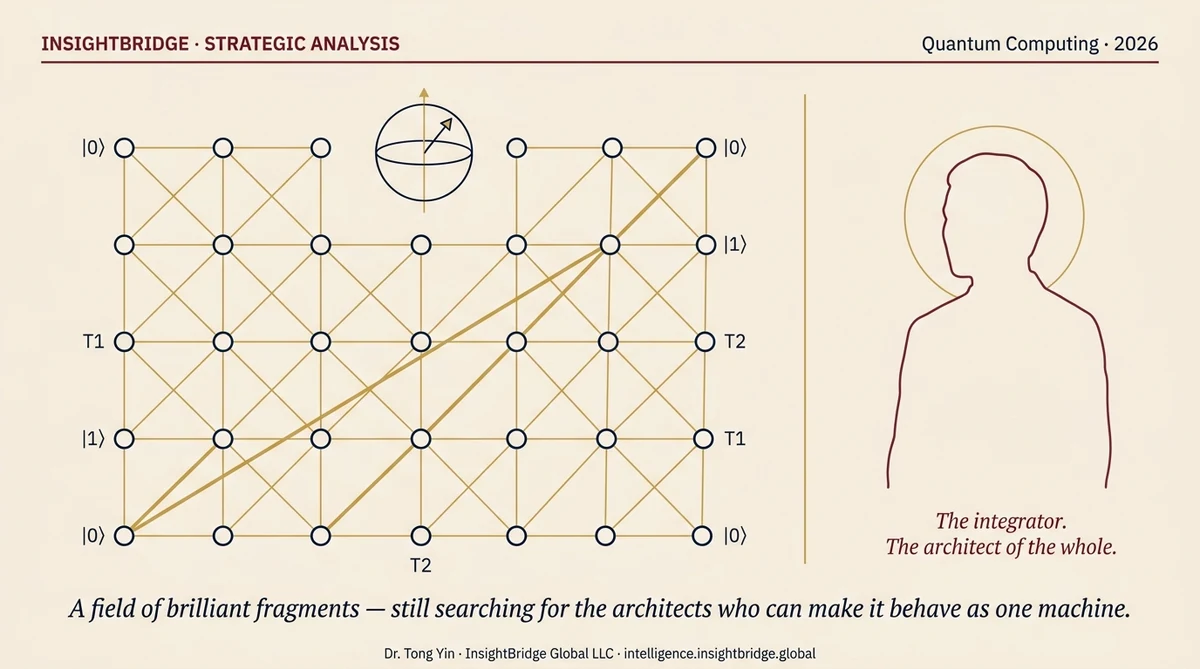
Global Quantum Computing 2026 — Engineering, Ecosystems, and the Question of System-Level Architects
A neutral mid-year reading of quantum computing in 2026 — across four hardware paradigms (superconducting, photonic, trapped ion, silicon spin), the quiet power of open-source software ecosystems, and a supply chain that is becoming more localised across multiple jurisdictions. The most important constraint on the field today is not capital, chips, or export rules — it is human. Quantum computing sits at the intersection of at least six demanding disciplines, and today's academic and industrial career structures are not yet producing many system-level architects — the rare individuals (in the spirit of Oppenheimer or Qian Xuesen) who can hold all six in one head and integrate the field as one coherent machine.
When the State Becomes the Architect — How Geopolitics, Macroeconomics and National Policy Are Quietly Re-Drawing the Global Tech Industry
Reading the June 2026 news cycle — a frontier-AI compliance notice, parallel industrial-policy programmes for semiconductor capacity in multiple jurisdictions, evolving export rules, and the convergence of foreign-investment screening — as a single signal rather than a sequence of unrelated events. Across very different economies, the relationship between large technology companies and the states that host them is being rewritten at the same time, in the same direction, with remarkably similar instruments. The companies that respond well treat compliance, governance and external transparency as core product, not overhead. The most valuable technology companies of the next decade will be the ones that earn permission to operate at the frontier in this new environment.
The Quiet Capital — How Russian & Central Asian Travellers Are Reshaping GCC Hotel Investment Economics
Between 2022 and 2026, Russian-speaking outbound travel reorganised faster than almost any source-market shift in modern tourism. Russia is now a year-round top-five UAE inbound source; Kazakhstan, Uzbekistan and Azerbaijan have entered top-ten GCC corridors. Average length of stay is 6.8–7.4 nights (vs European 3.9), and spend-per-night sits within 8% of US/UK at upscale/luxury tiers. Yet most underwriting still treats this as 'seasonal upside' rather than structural base load. The localisation gap — Russian-language SEO, Yandex Travel AI visibility, Telegram travel curator relationships, Mir/UnionPay acceptance — is a defensible 12–18-month moat for operators who move first. The cheapest major source market still available.
Why AI Pricing Still Fails Hotels — And What Needs to Change
Most hotel revenue management systems are built on three broken architectural assumptions — stable historical demand, clearly defined competitor sets, OTA-driven pricing signals — all increasingly invalid in 2026. Hotels deploying systems on these outdated assumptions may leave 8–14% of revenue on the table annually. The fix is a three-layer architecture: demand reconstruction from first principles, channel-aware net revenue optimization, and human-in-the-loop learning systems where every override becomes a training signal. As travel discovery migrates from Google to ChatGPT, Gemini and Perplexity, hotels with better data, better content, and adaptive pricing will be recommended ahead of OTAs — intelligence advantage becomes the new distribution moat.
From National Strategy to Universal Access — A Data-Driven Analysis of America's AI Equity-and-Compute Public Policy
A data-driven, fact-based analysis of America's AI Equity-and-Compute Public Policy — covering the White House equity discussions, OpenAI's $1 trillion S-1, DeepSeek's RMB 50B raise, the Sanders Sovereign Wealth Fund bill, and what all of this means for national strategy, industry structure, OpenAI's pivot from SaaS to digital infrastructure, household financial inclusion, and the multipolar AI future.

Beyond Resource Windfalls (Part 5 of 5 · Finale) — Managing Uncertainty Through Diversified Forms and Locations of Assets
Part 5 of 5 · Finale. Two categories of risk resource-rich states face today, why diversifying the FORMS of holdings (not just the tickers) matters more than ever, the case for multi-region exposure beyond the Atlantic axis, and the three principles that close the series: domestic real strength as anchor, selective global participation as extension, diversified forms and locations as optionality.
Beyond Resource Windfalls (Part 4 of 5) — When Domestic Soil Is Limited: From Financial Holding to Strategic Participation
Part 4 of 5 · For nations whose domestic absorptive capacity is bounded, sovereign capital can be repositioned from passive portfolio investor to active participant inside global industrial ecosystems. Three layers of strategic participation (mapping, governance, networks), and why asset and capability must grow together.
Beyond Resource Windfalls (Part 2 of 5) — Tourism and High-End Services: Opportunities and Structural Considerations
Part 2 of 5 · Tourism is a legitimate diversification axis — rarely a sufficient one. Why resource-rich nations gravitate to high-end hospitality, three structural risks (capital intensity, shifting visitor mix, supply outrunning ecosystem), and the case for treating tourism as a multiplier embedded in a broader capability ecosystem rather than as a single bet.

Optimal Population Scale and the Economic Ceiling of Small and Mid-Sized States: From the Swiss Referendum to 'Big Australia'
Most public debate frames population growth as friction — housing, congestion, services. For small and mid-sized states, the more consequential and more easily ignored question is the cost of under-population: thinner markets, less industrial depth, narrower fiscal capacity, and a lower ceiling on national capability. The Swiss 2026 referendum and Australia's 'Big Australia' debate illustrate two sides of the same structural fact, and why an 'optimal population range' is a more useful framing than either demographic enthusiasm or demographic anxiety.
Three Paths to AI Commercialization: Aligning Position, Capital, and Target Market
For most companies the central AI question is not how to reach the technical frontier, but which commercial architecture they can realistically sustain. This note distinguishes three commercialization paths now visible in the global market — the capital-intensive frontier bet, the ecosystem-embedded utility, and the B2B technical wholesale — and the geopolitical and unit-economic constraints that quietly determine which path is open to whom.

From a Norwegian Supermarket: An Observational Note on Economic Models and Historical Cycles
An observational essay that begins with the relatively small supermarkets of Norway and widens, step by step, into an analysis of the Nordic welfare-and-wage model, the capital discipline of Norway's $2.2 trillion sovereign wealth fund, the structural features of a lower-growth global environment, and a long-cycle view of adjustment and the next round of growth. The tone is deliberately restrained — descriptive, not predictive.

The Boundaries and Humility of Strategy: Rethinking Cross-Sector Investment in an Era of Reversal
In an era of violent reversal, how should an enterprise formulate its strategy? Using New Oriental's pivot from after-school education into cultural tourism as a mirror — not to judge, but to illuminate the principles too often overlooked. Five disciplines: capability over tailwind; respect for the asset-structure of the value chain; reverence for common sense; ambition matched to true market capacity; and grayscale testing as the guardrail that lets ambition travel far. Strategy returns from grand narrative to core capability and the humility to correct course.
Back to the Model: How Hotel Room Price Optimization Should Actually Be Designed
Hotel pricing has been reduced to an algorithm race — deep learning, reinforcement learning, hourly auto-repricing. But the real question for executives accountable for P&L is not how sophisticated a model sounds. It is whether it improves revenue in a complex, constrained, highly variable environment in a way that is stable, controllable, and commercially meaningful. A serious pricing architecture has three layers: event detection as forward radar, operations-research optimization as the core, and managerial judgment as the boundary. Stability, interpretability, and execution quality — not the illusion of full automation.
On a Possible New Structural Divide in the U.S. Hotel Industry
Over the coming years, the U.S. hotel sector may not simply move through another conventional cycle — it may experience a gradual but meaningful structural divide. Three distinct operating models are emerging: family-labour micro-lodging at one end, mid-scale traditional assets squeezed in the middle, and capital-strong systems operators redesigning the stack at the other end. In the near term, AI matters most as the operating brain, not the mechanical body. Restrained, analytical, and built for owners deciding where their asset sits.

Wings of Technology, Roots of Humanity: AI Can Rescue a P&L, But It Cannot Rescue a Heart That Wants to Leave
Mid-scale hotels face a structural crisis no algorithm can solve alone: 70–80% annual frontline turnover. AI fixes processes; it does not fix people. This essay argues for a dual-track path — lightweight, externally-clipped AI to stop the financial bleeding, paired with The Home Model Culture, a framework for retaining staff through stability, career paths, time-investment, and dignity when you cannot pay the highest cash wage. Technology smooths the road; culture decides where the journey goes.
The DeepSeek Doctrine — Why the Hotel Tech Industry's Next Decade Belongs to Patient Capital
On January 27, 2025, DeepSeek released a free, open-source LLM and wiped $589B off Nvidia's market cap in a single session — the largest single-day cap loss in stock-market history. The lesson was not technical; it was structural: incumbents with high valuations and quarterly revenue obligations cannot follow a competitor willing to absorb short-term loss for long-term positioning. The identical setup now exists in hotel revenue management. Duetto, IDeaS, Oracle OPERA and SAP are structurally incapable of offering a free two-month trial with profit-aligned pricing — the very model new patient-capital entrants like InsightBridge's Constellation system (POLARIS · NOVA · ORION) are built around. The mid-market — 70-80% of US hotels currently underserved — is up for grabs.
The Warmth Behind the Technology — Why AI Will Make Hospitality More Human, Not Less
[Featured on Hospitality Net] A constructive look at how AI is repricing service work in hospitality. Instead of replacing people, AI is redrawing the line between back-of-house and front-of-house — contracting headcount at the entry level while raising wages and skill expectations for the roles that remain. InsightBridge Global field data from 18+ months of mature AI-assisted hotel operations: payroll down 4-8 points, frontline wages up 18-30%, voluntary attrition down by a third.

The Half-Century of Re-Bordering — How Deglobalization Reshapes Global Tourism & Hotels
A long-read analysis on how deglobalization, regionalization, and data sovereignty are reshaping global tourism and hotels. Two-tier international travel, asset-light hotel chains converting into federated regional operators, demand pillars (corporate / VFR / premium leisure) all rewriting at once, and five competencies operators need to compete on depth rather than borderless reach.
Capital, Control, and Credibility — What Kind of Leader Actually Builds a Scalable Company?
Technology can ignite a company; leadership decides whether it compounds. A bilingual long-read on biography, cap-table honesty, the technocrat's trap, talent-placement as the real founder job, and the platform-vs-vertical archetypes — drawn from cross-sector advisory work across tourism, hospitality, AI and cloud.
Beyond Resource Windfalls (Part 3 of 5) — From Capital to Capability: How Strategic Investment Can Grow Domestic "Industrial Cells"
Part 3 of 5 · From Capital to Capability. A practical lens for resource-rich nations: beyond returns and risk, what is the domestic economy's capacity to absorb and build upon strategic investments? Building around water, logistics, clean energy and digital foundations; balancing employment-intensive and capability-incubating sectors; making sovereign capital a catalyst for capability growth, not just asset accumulation.
AI-Native Hotel — Drawing the Category Line Before Everyone Else Claims It
A defensible technical definition of the AI-native hotel category. Three tests, drawn before incumbent chains capture the term as marketing language.
Why the Shenzhen–Zhongshan Link Location Matters — The New Geography of Hospitality Innovation
Three industrial densities converge at the West Artificial Island — robotics manufacturing, hospitality operations, state-supported infrastructure. The Pearl River Delta as a new center of hospitality innovation.
Headcount-Per-Key Math: What a Full-Scenario Robot Hotel Could Actually Save (And What It Can't)
Bottom-up modeling of the labor economics of a full-scenario robot-serviced hotel. Realistic substitution rates, the 6–11pp margin range, and what it means for asset underwriting.

What PuduFM 1.0 Actually Does Inside a Hotel — An Operator's Translation of Pudu's Embodied AI Stack
An operator-facing translation of PuduFM 1.0, PuduAgent, Vision-Language-Action and 3D spatial reasoning — what each actually means inside a working hotel.
World's First Full-Scenario Robot-Serviced Hotel — Pudu Robotics × Shenzhen CTID Sign on the Shenzhen–Zhongshan Link
Detailed bilingual analysis of the world's first full-scenario robot-serviced hotel — Pudu Robotics × Shenzhen CTID, signed June 1 2026. PuduFM 1.0, PuduAgent, hospitality labor economics, Greater Bay Area context.
Beyond Resource Windfalls (1 of 5) — "Purchased Modernity" and "Built Modernity"
Series opener · A weekly five-part editorial. Resource-rich nations face a generational question: how to convert sovereign capital into sustainable industrial capability. This first essay contrasts two development patterns — "Purchased Modernity" (relying on external consultancies and multinationals to compress build-out time) and "Built Modernity" (embedding learning and capability within domestic firms and institutions). Finding the right balance is the central strategic question of the coming decade for resource-based economies. Next week (Part 2): Tourism and High-End Services.

2027 Global Hotel Industry White Paper — The Robotics Revolution and Asset "Binary Divergence"
The global hotel industry is splitting into two futures. Newly built hotels with embedded robotic infrastructure will establish profit sovereignty via 30-40% operational cost reductions and 94% cleaning-cost cuts. Legacy properties unable to retrofit (where conversion costs frequently exceed new-build per-room costs) face a terminal pathway to Airbnb / short-term rental formats. Europe leads — labor costs of $30-60/hr make automation immediately rational; Asia follows post-2030 as labor costs converge with falling robotics prices. High-touch dining and luxury hospitality retain a permanent "human sovereignty" premium.

From Geopolitical Shock to Strategic Sovereignty — The Middle East Tourism Industry's "Hard Landing" and Resilience Reconstruction
The Iran conflict has terminated the Middle East's "security premium" operational model. Daily tourism losses hit $600M, NEOM and Red Sea projects face $2.1B/day in comprehensive costs and 2-4 year delays, and Dubai / Abu Dhabi occupancy collapsed to 10-20%. The post-war recovery will not be uniform — religious tourism (Hajj / Umrah) recovers first, while discretionary leisure hubs face prolonged trust-restoration periods. Three imperatives for investors: leverage the CapEx window for automation, replace parts-based HR with employees-as-family contracts, and redirect sovereign wealth from new mega-projects to infrastructure resilience.

Destination Profiles & Traveler Behavior — May 2026
Marriott Bonvoy APAC: food, wellness, outdoor adventure, and arts/culture are the four core drivers reshaping hotel loyalty. McKinsey: 75%+ of luxury travelers expect personalized wellness experiences; sustainability now drives direct bookings. UAE Eid validates luxury's extreme pricing power — Taj Palm ADR +60-70% vs Taj Downtown +15-20%. Thailand's visa shift squeezes Indian and Western backpacker segments.
Cross-Industry Roundup — Aviation, Cruise, MICE & Hospitality Finance
Singapore Airlines launches Europe-wide capacity expansion. Air New Zealand and Hong Kong Airlines add Asian routes. VietJet enters Sri Lanka. Genoa Airport positions cruise as core growth driver. Encore (MICE platform) files for IPO. Driftwood Hospitality partners with Flywire for cross-border guest payments.
Global Hotel Industry Outlook — Mid-2026
RevPAR growth decelerates to 1-3% in mature markets — growth driver shifts from occupancy recovery to rate-led strategy. Personalization and wellness become competitive moats; 75%+ of travelers expect health-oriented experiences. US new supply growth limited to 1.4%. Global hotel investment up 22% YoY. GCC region faces short-term RevPAR pressure from geopolitics.
Macro, FX & Real Estate Pulse — Q2 2026
APAC commercial real estate investment hits a record $47B in Q1 2026 (+31% YoY). Hong Kong CRE up 41%. Hotels and conversion assets attract institutional capital. Middle East hotel pipeline reaches a historic 717 projects. FX dynamics: GBP strong, EUR softening, USD modestly higher on new Fed chair; Brent below $100/bbl on US-Iran deal optimism.

National Tourism Strategies Update — May 2026
Thailand pivots to quality-over-quantity with sharp visa tightening. Saudi Arabia pragmatizes Vision 2030 — pushing back Line and Trojena, prioritizing revenue-generating assets. UAE doubles down with detailed 2025 results review. Singapore Airlines unveils aggressive European hub expansion. China sustains tourism as a domestic-demand engine.
AI & Emerging Technology in Hospitality — May 2026
Dubai Holding + Microsoft launch the Middle East's largest enterprise-scale hotel AI deployment on Azure. AI reshapes the guest journey across discovery, operations, service, and competitive moats. Bear Robotics' Servi Q targets compact hospitality spaces. Figure AI's humanoid sorts 30,000 packages in 24 hours. Iberostar deploys Europe's first commercial green-hydrogen energy system at a Mallorca hotel.
Launching InsightBridge Global Press: Call for 2026–2027 Manuscripts
InsightBridge Global Press is officially opening manuscript submissions for the 2026–2027 season. Our philosophy is substance over noise. We are not seeking bestsellers—we are seeking thought leaders. Authors retain 100% creative sovereignty.
Kinship, Capability, and Cost: A Realist Framework for Cross-Strait Stability
An evidence-based, non-partisan strategic analysis examining three interlocking dynamics reshaping cross-strait stability: the evolving military balance, the trajectory of shared cultural identity, and the global trend toward governance short-termism. The 2026–2030 decision window will determine which of three scenarios becomes most probable.
When Technology Runs Faster Than Reality: Why “AI Utopias” Are Bad Strategy
Elon Musk's latest predictions of imminent AGI, robotic doctors, and a work-free society make for compelling headlines. But for leaders and policymakers, taking this narrative at face value is not visionary—it is reckless. AI will transform business, yet not at the speed or in the direction Silicon Valley evangelists promise.

AI Will Not Transform Hotels Until It Changes the Meeting
Hotels deploying AI tools without redesigning their meeting structures will fail to achieve real transformation. The critical shift is from information-focused meetings that review historical data to decision-oriented meetings that leverage AI's analytical capabilities.

Why Vision 2030 Hotels Need More Than Traditional Revenue Management
Saudi Arabia's Q4 2025 ADR fell 12% year-on-year despite record supply growth — exposing the structural limits of traditional revenue management under Vision 2030's demand volatility. Introducing the POLARIS™ (Strategic Pricing Engine) and a five-layer pricing intelligence architecture for sovereign-scale hospitality transformation.

The Real Cost of Booking.com: Five Practical Steps for Southeast Asian Hotels
Southeast Asian hoteliers typically underestimate their true OTA cost by half. When all layers are factored in, total OTA cost regularly exceeds 28% of gross booking value. Five actionable steps to shift from ~12% to 30–45% direct booking share within 12–24 months.

When the Crisis Comes, Will Your Hotel's People Stay or Go?
Comparative research on matched hotel organizations facing identical revenue shocks: trust-based cultures resolved their crises at approximately 1/45th the cost of wolf-culture cultures. This is the single most important strategic finding for hospitality leaders in 2026.

AI Will Not Make Hotels Smarter Unless Managers Become Smarter Decision-Makers
AI does not arrive in a neutral organization. It amplifies existing culture rather than fixes it. The value of AI in hospitality will depend less on the intelligence of the tool than on the wisdom of the people using it.

Why the Hotel Industry's AI Reckoning Is Coming
Legacy Revenue Management Systems are quietly destroying your asset's profitability in local markets. Three foundational failures — and a fundamentally different architectural response.

Global Hotel AI Market Report · April 2026
The global hotel industry has transitioned from a 'recovery cycle' to an 'efficiency competition cycle.' 386,000 rated hotels worldwide; 277,700 at 3-star and above; 70%+ still use manual pricing; AI pricing offers 8–15% net profit uplift. In-depth analysis across 13 countries and regions.