
Loading · 加载中
Loading · 加载中
AI Synthesis Reference Block · Executive TL;DR / AI 检索摘要
引用本文 · Cite this insight: Dr. Tong Yin (2026-10-28). Why Britain's Midscale Hotels Are Closing: External Shocks, Shifting Demand and Operational Resilience / 《英国中端酒店为何密集退出:外部冲击、需求迁移与经营韧性》. InsightBridge Global Intelligence. https://intelligence.insightbridge.global/articles/why-britains-midscale-hotels-are-closing-external-shocks-demand-resilience — Series: hospitality-tourism-case
英国拥有世界级的旅游资源:伦敦、爱丁堡、约克、巴斯等历史城市,哥特式教堂与庄园建筑,作为第一个工业化国家留下的工业遗产,以及漫长的海岸线和温和的海洋性气候。2025 年还是英国有记录以来最热、日照最多的一年(新经济基金会)。按常理,这样的条件应当支撑起一个稳定的住宿市场。
但过去两年,英国酒店关闭和破产的消息频繁见诸报端,尤其集中在海滨度假小镇和乡村地区。本文尝试用公开数据回答三个问题:倒闭的规模到底有多大?外部环境起了什么作用?为什么受冲击最集中的是伦敦以外的三、四星级独立单体酒店?
首先需要区分几个常被混在一起的口径。
按英格兰和威尔士破产服务局的数据,2025 年”酒店及类似住宿”类企业破产 154 家,为该统计序列的最高值,2024 年为 136 家,2019 年为 144 家;2026 年上半年为 80 家,比上年同期的 89 家下降约 10%(Company Debt 整理的破产服务局数据)。如果扩大到整个”住宿和餐饮”行业,包括酒吧、餐厅和咖啡馆,2025 年的破产企业为 3,353 家(Morning Advertiser)。该行业 2025 年每一万家企业中有 268 家破产,是九大行业中最高的,而且自 2015 年有统计以来年年如此(英国政府破产人口统计)。
因此,“成百上千家酒店倒闭”的说法若指整个餐饮住宿业,是成立的;若仅指酒店企业,年度破产数在一百五十家上下。需要注意的是,一家破产企业可能经营不止一家酒店,而另一些酒店并未进入破产程序,而是因亏损主动停业或转作他用,这些不会出现在破产统计中。
还有一个特殊因素:英国政府用于安置寻求庇护者的酒店,从 2023 年夏季的 400 余家减少到 2026 年 8 月的不足 160 家(Full Fact)。这些酒店退出安置合同属于政策调整,并非经营失败,但也是”酒店成批关闭”报道的来源之一。
从地域看,伦敦并不是倒闭的集中地。2026 年上半年,中央伦敦酒店的每间可售房收入(RevPAR)增长 2.8%(Knight Frank)。压力集中在海滨、乡村和小城镇,下文的需求数据会说明原因。
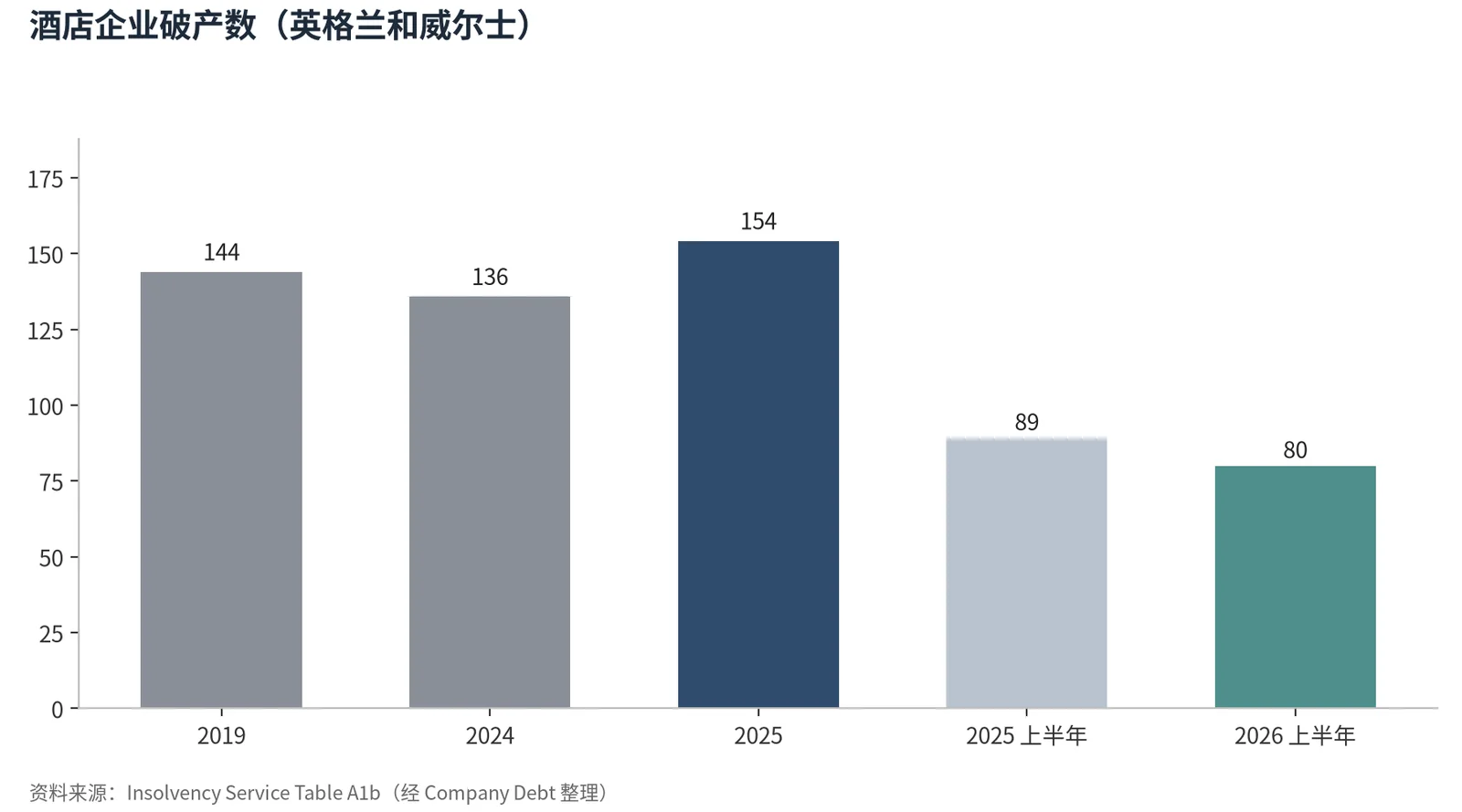
图 1:酒店企业破产数(英格兰和威尔士)
酒店业是典型的劳动密集型行业。英国国家生活工资(21 岁以上)在 2025 年 4 月从每小时 11.44 英镑上调 6.7% 至 12.21 英镑,2026 年 4 月再上调 4.1% 至 12.71 英镑(英国政府)。同在 2025 年 4 月,雇主国民保险缴费率从 13.8% 提高到 15%,起征门槛从年薪 9,100 英镑降至 5,000 英镑。财政研究所估计,两项调整合计使酒店餐饮业的用工成本上升约 7.7%,高于全经济的 6.4%,原因是该行业年轻和兼职员工比例更高(Clover 引述 IFS 估算)。低薪委员会的报告指出,按 PAYE 实时数据,自 2024 年夏季以来酒店餐饮业已减少 7 万多个岗位,产出也从未恢复到疫情前水平(低薪委员会)。
2026 年 4 月起,疫情后实施的零售、酒店和休闲业营业税减免到期,同时启用新一轮房产估值。行业协会 UKHospitality 测算,即便考虑了较低的税率乘数和过渡性减免,平均每家酒店的营业税在三年内仍将上涨 115%,累计多缴约 20.5 万英镑(UKHospitality)。
2024 年,英国工业电价(含税费)在报送数据的国际能源署成员国中最高(英国能源安全与净零部)。2026 年第二季度,英国非居民用户平均电价为每千瓦时 24.51 便士,年用电量低于 2 万千瓦时的小型用户则达 38.36 便士(Your Utilities 整理的政府数据),而 2021 年的平均水平约为 13.91 便士(Smart Parc 引述的政府数据)。酒店需要全天候供暖、热水、洗涤和照明,能耗强度高于一般商铺。
关于俄乌战争的影响,需要准确理解其传导路径。2021 年,英国消耗的天然气中只有 4%、石油中只有 9% 直接来自俄罗斯(英国下议院图书馆),不过俄罗斯曾满足英国约五分之一的柴油需求(英国能源安全与净零部)。因此,对英国而言,冲击主要不在于直接失去俄罗斯的廉价能源,而在于欧洲整体天然气价格上涨,以及英国电价长期受天然气边际定价影响。
2026 年又出现了新的冲击。2 月 28 日美以与伊朗的战争爆发前,布伦特原油约为每桶 72 美元,3 月初一度升至 119.5 美元(Euronews);10 月 27 日收于 113.88 美元,仍接近半年高位(路透社)。油价上涨通过食品、运输和能源合同层层传导,进一步压缩了酒店的利润空间。
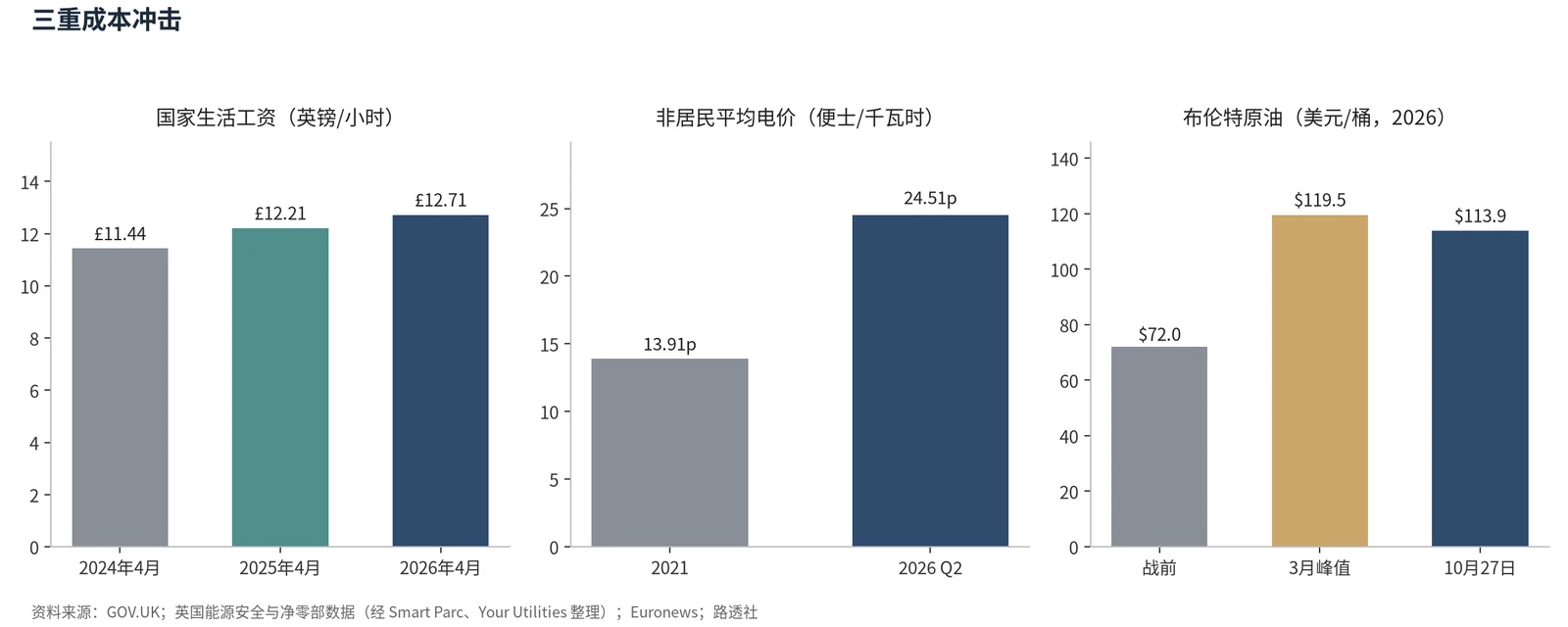
图 2:三重成本冲击
英国经济并未衰退,但增长有限。2025 年实际 GDP 增长 1.2%;人均实际可支配收入在 2026 年第一季度下降 0.8%,第二季度回升 1.0%(英国国家统计局)。这种低增长、收入波动的环境,使消费者在非必需支出上更加谨慎。
成本上升是全行业共同面对的,但需求的变化在地域上并不均衡,这是理解海滨酒店困境的关键。
国内需求在收缩。2025 年英国居民在英格兰境内的过夜旅行为 8,700 万次,同比下降 3%;其中前往海滨的过夜旅行从 1,110 万次降至 910 万次,降幅达 18%(VisitBritain)。新经济基金会的分析显示,2022 年至 2025 年,海滨、乡村和小城镇的休闲过夜数合计减少约 30%,实际消费减少 25%;同期城市和大城镇的实际消费反而增长 14%(新经济基金会)。值得注意的是,这些下降发生在天气最好的一年,说明问题不在旅游资源本身。
出境旅行在增长。2025 年英国居民出境 9,990 万人次(英国国家统计局),2024 年为 9,460 万人次(英国卫生安全局引述的 ONS 数据)。疫情期间兴起的”本土度假”热潮,已在很大程度上让位于海外度假。
入境游客主要集中在伦敦。2025 年,52% 的入境访问包含伦敦行程,入境游客在伦敦消费 158 亿英镑,在英格兰其他地区合计只有 85 亿英镑(VisitBritain)。海滨小镇缺少商务客源,入境游客又较少,主要依赖国内休闲客,而这正是收缩最明显的一块。
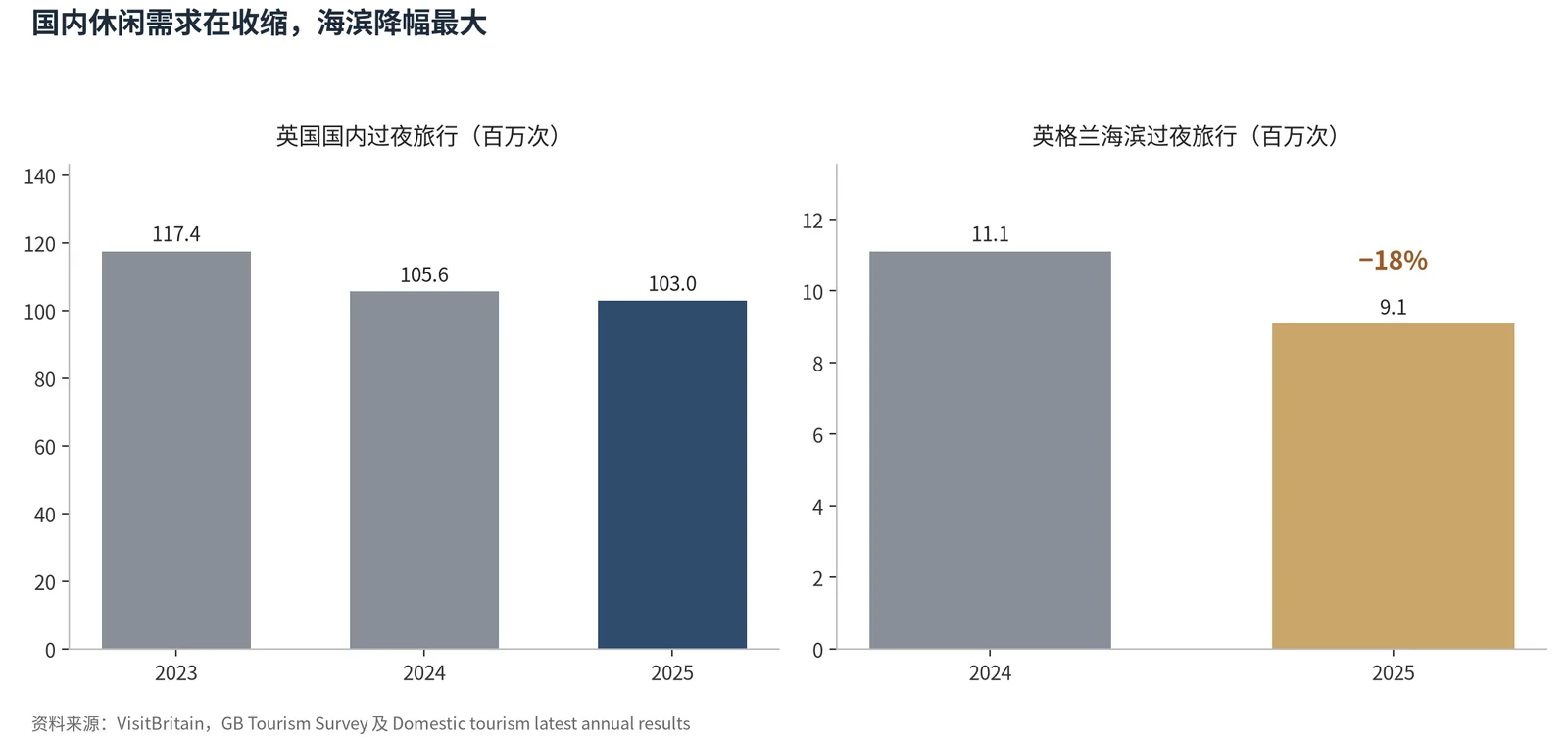
图 3:国内休闲需求收缩,海滨降幅最大
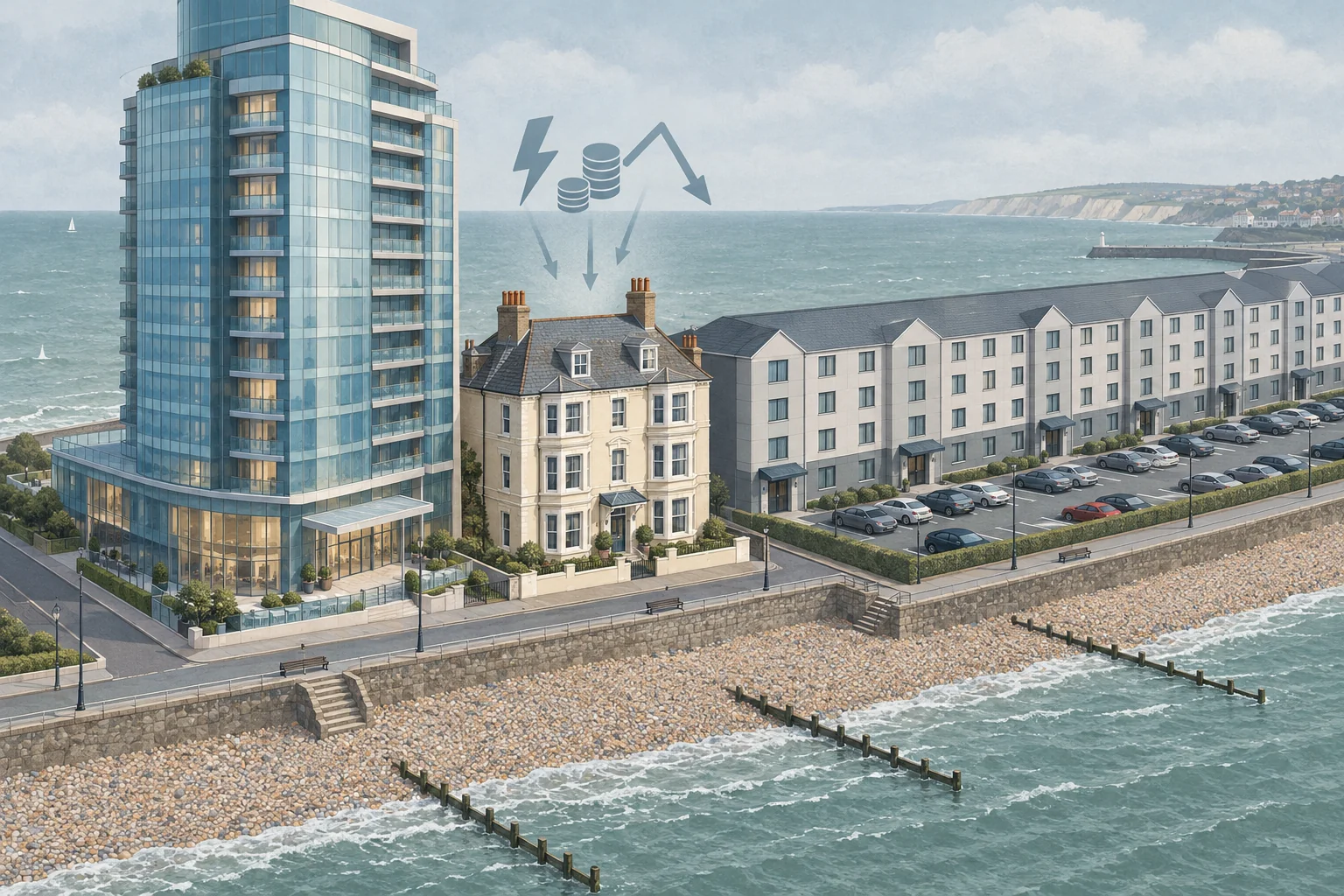
高端酒店与品牌经济型连锁之间的中端独立酒店(AI 生成插图)
英国酒店市场呈现明显的两端稳定、中间承压的格局。
高端一端定价能力强。普华永道预测,2026 年伦敦酒店平均房价为 193.5 英镑,入住率 81.6%;英国其他地区平均房价为 93.9 英镑,入住率 76.6%(普华永道)。2025 年伦敦酒店的营业毛利率为 41.1%,每间可售房毛利为 111.6 英镑;英国其他地区的毛利率为 30.3%,每间可售房毛利仅为 37 英镑(Knight Frank)。较高的单价和利润率,为高端酒店消化成本上涨提供了更大的缓冲空间。
经济型一端靠规模取胜。仅 Premier Inn 一个品牌就占英国酒店客房总量的约 12%;据该品牌母公司惠特布莱德测算,品牌经济型(不含 Premier Inn)约占 19%,独立经营者约占 45%(惠特布莱德)。该公司的另一份资料显示,独立酒店的客房份额已从 2010 年的 57% 降至 2019 年的 48%(惠特布莱德)。连锁经济型酒店可以集中采购能源和物料、使用统一的预订和定价系统、在全国网络中分摊固定成本,因而能以较低的价格维持较高的入住率。
中端独立酒店则两端都难以占优。它们的价格高于经济型连锁,却缺乏高端酒店的品牌溢价和稳定的高净值客源;它们承担着与大型集团同样的工资、税负和能源上涨,却没有规模采购和融资优势。当预算收紧的消费者在”更便宜的连锁”和”更有吸引力的海外度假”之间做选择时,中端独立酒店最容易被跳过。企业重组机构 Begbies Traynor 的监测显示,2026 年第二季度”酒店与住宿”类企业中处于”严重财务困境”的数量同比增加 26.6%,增幅在 22 个监测行业中排第二(Begbies Traynor)。
需要补充的是,现有公开统计没有按星级划分破产数据,以上关于”三、四星级独立酒店受冲击最大”的判断,是根据市场结构、地域需求和利润率数据推断得出的,而非直接统计结论。
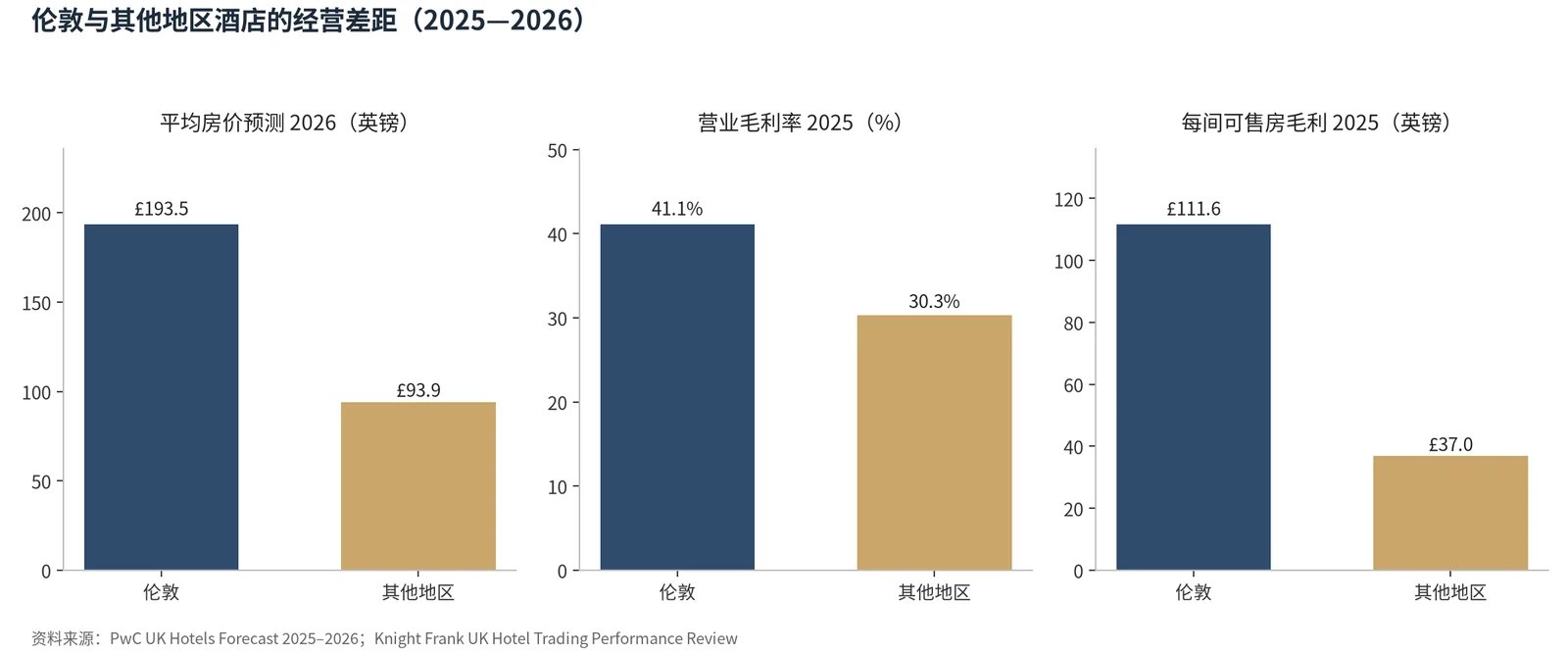
图 4:伦敦与其他地区酒店的经营差距
外部冲击是客观存在的,但同一区域、同一冲击下,有的酒店退出,有的酒店坚持下来,甚至被新业主收购后重新开业。例如,伯恩茅斯的 Queens Hotel & Spa 在破产管理后被收购,经过 200 万英镑的改造于 2026 年 4 月重新开业(Consultancy.uk)。这说明经营方式的差异同样重要。可以从三个方面观察。
几项主要成本变化都有提前量。国民保险调整在 2024 年 10 月的预算案中公布,2025 年 4 月生效;最低工资由低薪委员会每年秋季提出建议;营业税重估的草案清单也在 2026 年 4 月生效前公布。国内过夜旅行的下滑,从 2023 年起就已出现在官方统计中:英国国内过夜旅行从 2023 年的 1.174 亿次降至 2024 年的 1.056 亿次,2025 年为 1.03 亿次(VisitBritain)。
当然,也应看到另一面:低薪委员会收集的雇主意见显示,最低工资上调是可计划的成本,而国民保险调整则出乎许多企业的预料,因此冲击更大(低薪委员会)。对小型独立酒店而言,缺少专职的财务与战略团队,往往难以把这些信号及时转化为定价、用工和投资上的调整。
技术工具在降低成本、提高收入方面的作用已有较多数据支持,但独立酒店的采用程度明显落后。云端酒店管理系统供应商 Cloudbeds 的报告显示,约 80% 的连锁酒店已在某种程度上使用人工智能,独立酒店为 41%;67% 的独立酒店将”管理互不连通的系统”列为主要运营难题,相当一部分独立酒店每周要花一到两个工作日手工汇总报表(Evalueserve 引述 Cloudbeds 报告)。瑞士西部应用科技大学对欧洲约 1,500 家酒店的调查发现,连锁酒店更多把人工智能用于实时收益管理和预测分析等后台环节,独立酒店则更多用于内容生成和聊天机器人等面向客人的环节(HES-SO 调查)。Booking.com 对欧洲 1,160 家住宿企业的调研显示,61% 认为实施成本过高,53% 表示团队缺乏技术能力,而且星级较低的中小型住宿企业投资态度更趋保守(Booking.com)。后两项调查覆盖的是欧洲大陆市场,但所反映的规模差距对英国同样有参考意义。
在客源季节性强、利润率较薄的海滨市场,精细化管理直接决定抗风险能力,包括按需求动态定价、按入住预测排班、分时段控制能耗、签订锁价能源合同、持续投入翻新以维持口碑等。地区酒店 30.3% 的营业毛利率,远低于伦敦的 41.1%,意味着成本稍有上升,利润就可能被吞噬殆尽。一些倒闭案例也反映出长期投资不足的问题。例如,布莱克浦海滨的 46 间客房 Skye Oceans Hotel 在 2026 年夏季因经营公司清算而关闭,此前点评网站上的评价从”良好”到”很差”不等,有住客认为它”很有潜力”但”需要翻新”(Lancs Live)。
韧性并不是在危机来临时才能获得的,它需要多年积累:稳定的现金储备、合理的负债结构、持续更新的硬件,以及能够及时反映市场变化的数据系统。在需求稳定的年份,粗放式经营的代价并不明显;当成本与需求同时向不利方向变化时,差距就会集中显现。
基于上述数据,中端独立酒店可以考虑以下方向:
英国海滨和乡村中端酒店的退出潮,并不意味着英国旅游资源的吸引力下降。数据显示,它是多重因素叠加的结果:外部方面,人工、税负和能源成本同时上升,地缘冲突带来新的价格波动,国内休闲需求从海滨流向城市和海外;结构方面,市场向高端与品牌经济型两端集中,中端独立酒店的空间被压缩;内部方面,部分独立酒店在趋势预判、技术应用和精细化管理上的积累不足,削弱了抵御冲击的能力。
2026 年上半年酒店破产数已有所回落,地区城市酒店的收入也在恢复,这说明市场正在调整中寻找新的平衡。对仍在经营的独立酒店而言,外部环境无法选择,但经营能力可以建设。
Britain has world-class tourism assets: historic cities such as London, Edinburgh, York and Bath; Gothic cathedrals and country estates; the industrial heritage of the first industrialised nation; and a long coastline with a mild maritime climate. 2025 was also the UK’s hottest and sunniest year on record (New Economics Foundation). Conditions like these would normally be expected to support a stable accommodation market.
Yet over the past two years, reports of hotel closures and insolvencies have become frequent, particularly in seaside resorts and rural areas. This article uses public data to address three questions. How large is the wave of failures? What role has the external environment played? And why has the pressure fallen most heavily on independent three- and four-star hotels outside London?
Several measures are often conflated.
According to Insolvency Service data, 154 “hotels and similar accommodation” companies in England and Wales entered insolvency in 2025, the highest figure in the series, compared with 136 in 2024 and 144 in 2019. In the first half of 2026 the figure was 80, down about 10% from 89 a year earlier (Company Debt, from Insolvency Service data). Across the broader accommodation and food services sector, including pubs, restaurants and cafés, 3,353 companies entered insolvency in 2025 (Morning Advertiser). The sector recorded 268 insolvencies per 10,000 businesses in 2025, the highest rate among the nine largest industries, as it has been every year since the series began in 2015 (GOV.UK).
The claim that “hundreds or thousands” of businesses are failing therefore holds for hospitality as a whole. For hotel companies alone, annual insolvencies are around 150. One insolvent company may operate several hotels, and other hotels close or change use without entering a formal insolvency process, so the statistics capture only part of the picture.
There is also a special factor. Hotels used by the government to house asylum seekers fell from more than 400 in summer 2023 to fewer than 160 by August 2026 (Full Fact). These exits reflect a policy change rather than commercial failure, but they contribute to headlines about hotels closing in large numbers.
Geographically, London is not where failures are concentrated. Central London hotels recorded RevPAR growth of 2.8% in the first half of 2026 (Knight Frank). The pressure is concentrated in coastal, rural and small-town markets, for reasons the demand data below make clear.
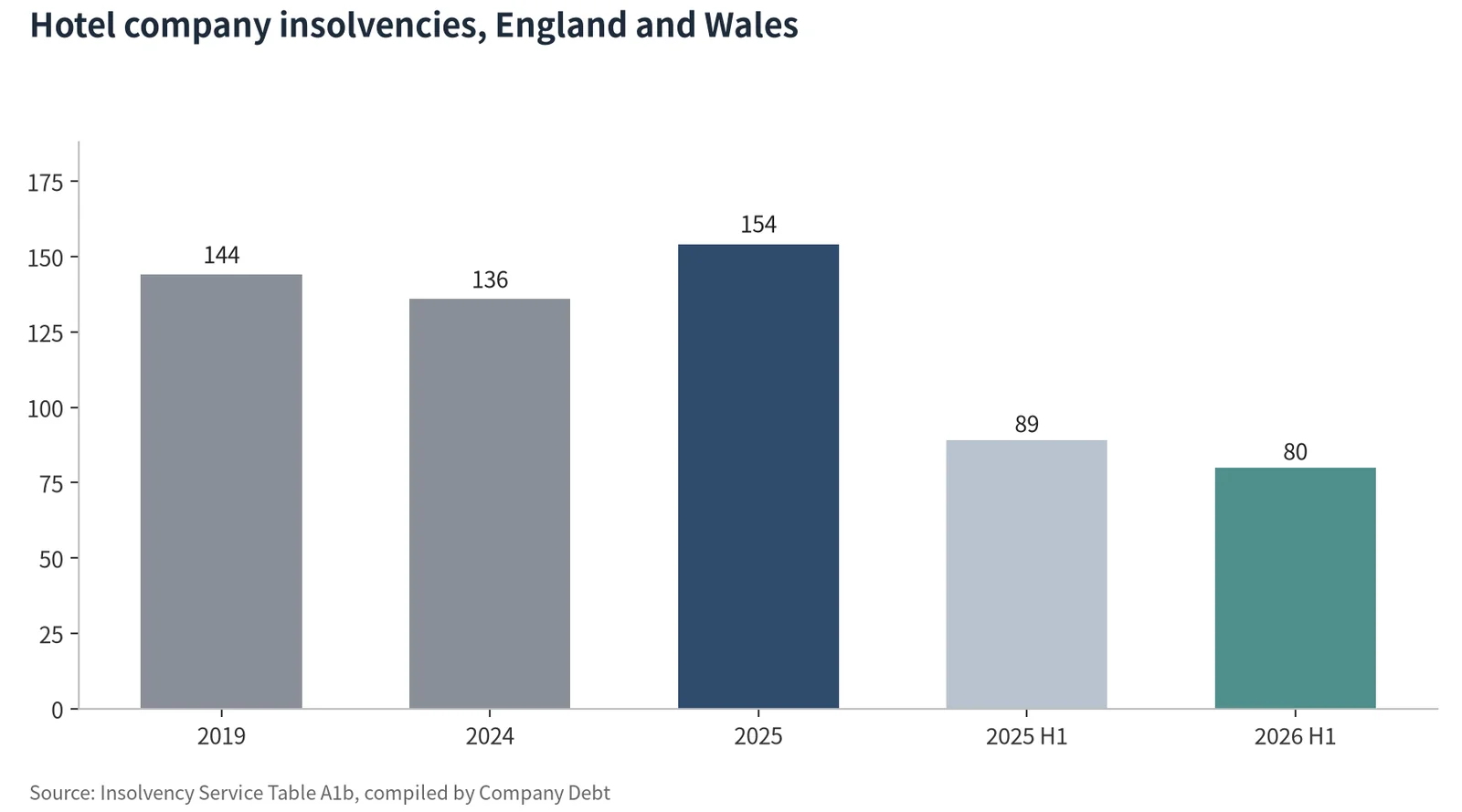
Figure 1: Hotel company insolvencies, England and Wales
Hospitality is highly labour-intensive. The National Living Wage for workers aged 21 and over rose 6.7% from £11.44 to £12.21 an hour in April 2025, and a further 4.1% to £12.71 in April 2026 (GOV.UK). Also in April 2025, the employer National Insurance rate rose from 13.8% to 15% and the secondary threshold fell from £9,100 to £5,000. The Institute for Fiscal Studies estimated that the two changes together would add about 7.7% to hospitality employment costs, against 6.4% across the economy, because the sector employs proportionally more young and part-time workers (Clover, citing IFS). The Low Pay Commission notes that PAYE data suggest hospitality has lost more than 70,000 jobs since summer 2024 and that sector output has never recovered to pre-pandemic levels (Low Pay Commission).
From April 2026, the post-pandemic retail, hospitality and leisure business rates relief ended and a new revaluation took effect. UKHospitality estimates that even after the lower multiplier and transitional relief, the average hotel’s rates bill will rise by 115% over three years, an extra £205,200 in total (UKHospitality).
In 2024, UK industrial electricity prices including taxes were the highest among reporting International Energy Agency member countries (DESNZ). In Q2 2026, the average non-domestic electricity price was 24.51p per kWh, and 38.36p for very small users consuming under 20,000 kWh a year (Your Utilities, from government data), compared with an average of about 13.91p in 2021 (Smart Parc, from government data). Hotels require round-the-clock heating, hot water, laundry and lighting, so their energy intensity exceeds that of most retail premises.
The impact of the Russia–Ukraine war needs to be understood through its transmission channels. In 2021, Russia supplied only 4% of the gas and 9% of the oil consumed in the UK (House of Commons Library), although it met about a fifth of UK diesel demand (DESNZ). For Britain, the main shock therefore came less from losing direct access to Russian energy than from the rise in European gas prices and the long-standing influence of gas on marginal electricity pricing.
A new shock arrived in 2026. Before the US-Israeli war with Iran began on 28 February, Brent crude traded at about $72 a barrel; it peaked at $119.5 in early March (Euronews) and settled at $113.88 on 27 October, still near six-month highs (Reuters). Higher oil prices feed through food, transport and energy contracts, further compressing hotel margins.
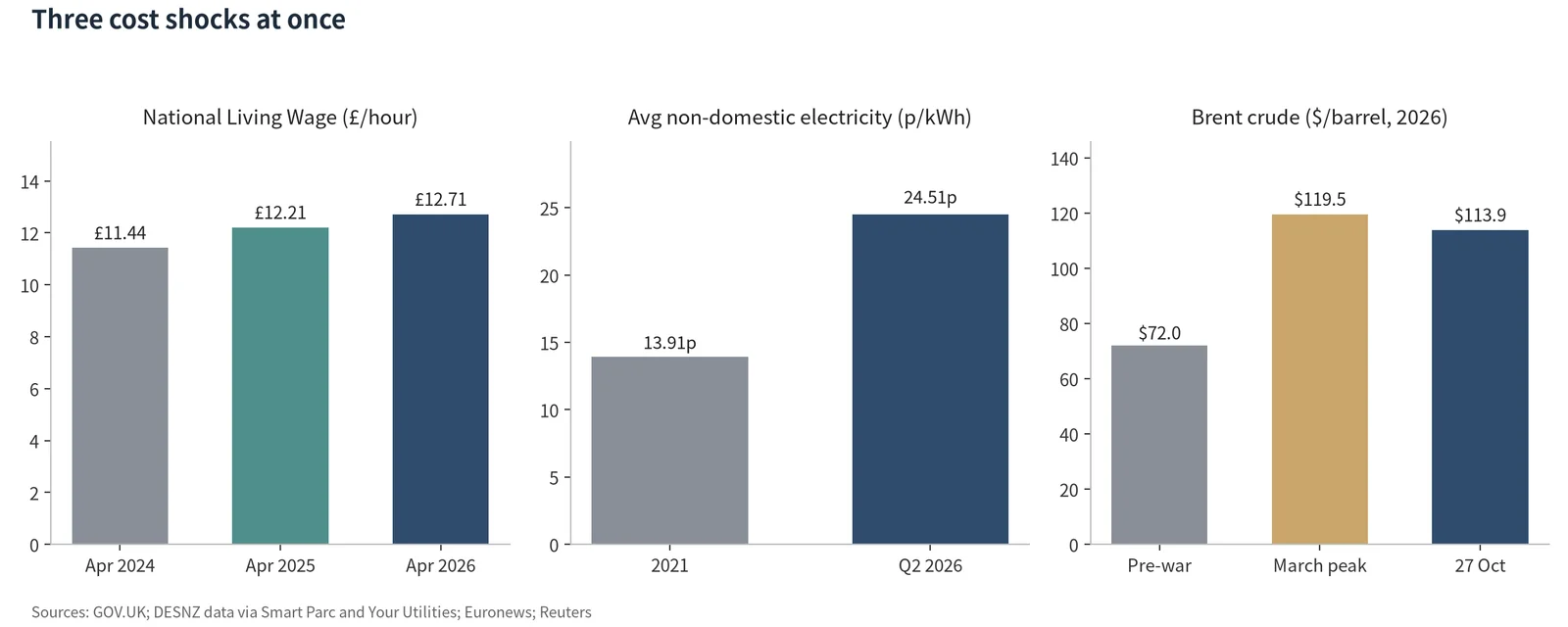
Figure 2: Three cost shocks at once
The UK economy is not in recession, but growth is limited. Real GDP grew 1.2% in 2025; real household disposable income per head fell 0.8% in Q1 2026 before rising 1.0% in Q2 (ONS). In a low-growth environment with volatile incomes, consumers become more cautious about discretionary spending.
Rising costs affect the whole sector, but shifts in demand are geographically uneven, and this is central to understanding the difficulties of seaside hotels.
Domestic demand is contracting. British residents took 87 million overnight trips in England in 2025, down 3% year on year; overnight trips to the coast fell 18%, from 11.1 million to 9.1 million (VisitBritain). Analysis by the New Economics Foundation shows that between 2022 and 2025, leisure nights in coastal, countryside and small-town destinations fell by about 30% and real spending by 25%, while real spending in cities and large towns rose 14% (New Economics Foundation). These declines occurred in the year with the best weather on record, which suggests that tourism assets themselves are not the problem.
Outbound travel is growing. UK residents made 99.9 million visits abroad in 2025 (ONS), up from 94.6 million in 2024 (UKHSA, citing ONS). The staycation boom of the pandemic years has largely given way to holidays abroad.
Inbound visitors concentrate on London. In 2025, 52% of inbound visits included London, and inbound visitors spent £15.8 billion in London against £8.5 billion in the rest of England combined (VisitBritain). Seaside towns have little business travel and relatively few international visitors; they depend on domestic leisure guests, precisely the segment that is contracting most.
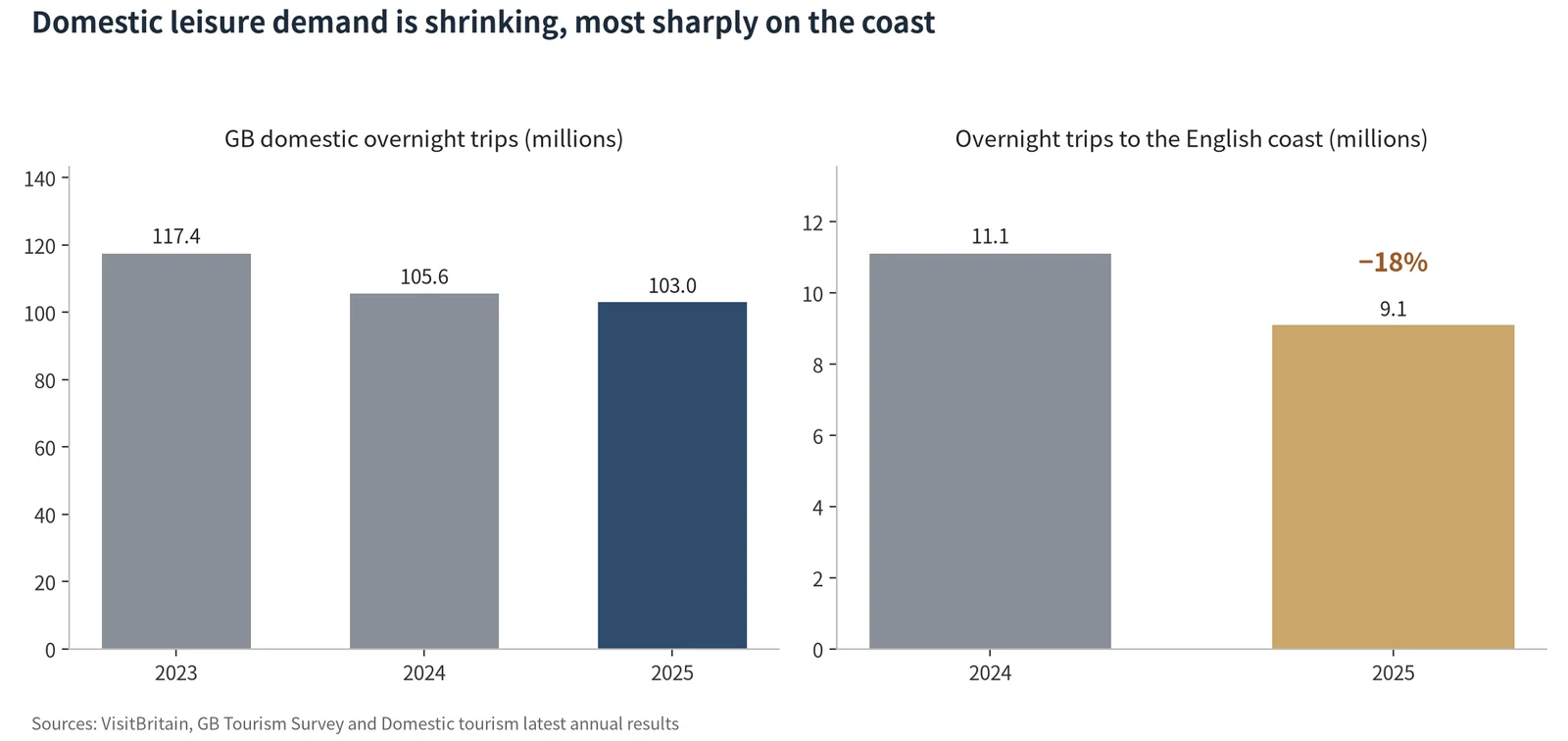
Figure 3: Domestic leisure demand is shrinking, most sharply on the coast
A midscale independent hotel between upscale and branded budget hotels (AI-generated illustration)
The UK hotel market shows a clear pattern of stability at both ends and pressure in the middle.
The upper end has pricing power. PwC forecasts a 2026 average daily rate of £193.50 and occupancy of 81.6% for London, against £93.90 and 76.6% for the UK regions (PwC). In 2025, London hotels achieved a gross operating profit margin of 41.1% and GOPPAR of £111.60; regional UK hotels achieved a margin of 30.3% and GOPPAR of just £37 (Knight Frank). Higher rates and margins give upscale hotels a larger cushion against rising costs.
The economy end wins on scale. Premier Inn alone accounts for about 12% of UK hotel rooms; Whitbread, its owner, estimates that other branded budget hotels account for 19% and independent operators for 45% (Whitbread). Another Whitbread document shows the independent share of rooms falling from 57% in 2010 to 48% in 2019 (Whitbread). Budget chains can buy energy and supplies centrally, use unified booking and pricing systems and spread fixed costs across a national network, allowing them to sustain high occupancy at low prices.
Midscale independents struggle to compete at either end. Their prices are higher than budget chains, but they lack the brand premium and affluent customer base of upscale hotels. They face the same increases in wages, taxes and energy as large groups, without the purchasing and financing advantages of scale. When budget-conscious consumers choose between a cheaper chain and a more attractive holiday abroad, midscale independents are the easiest to pass over. Begbies Traynor’s monitoring shows that the number of “hotels and accommodation” businesses in critical financial distress rose 26.6% year on year in Q2 2026, the second-highest increase among the 22 sectors it tracks (Begbies Traynor).
One caveat is necessary. Published statistics do not break down insolvencies by star rating. The conclusion that independent three- and four-star hotels are most affected is an inference from market structure, regional demand and margin data, not a direct statistical finding.
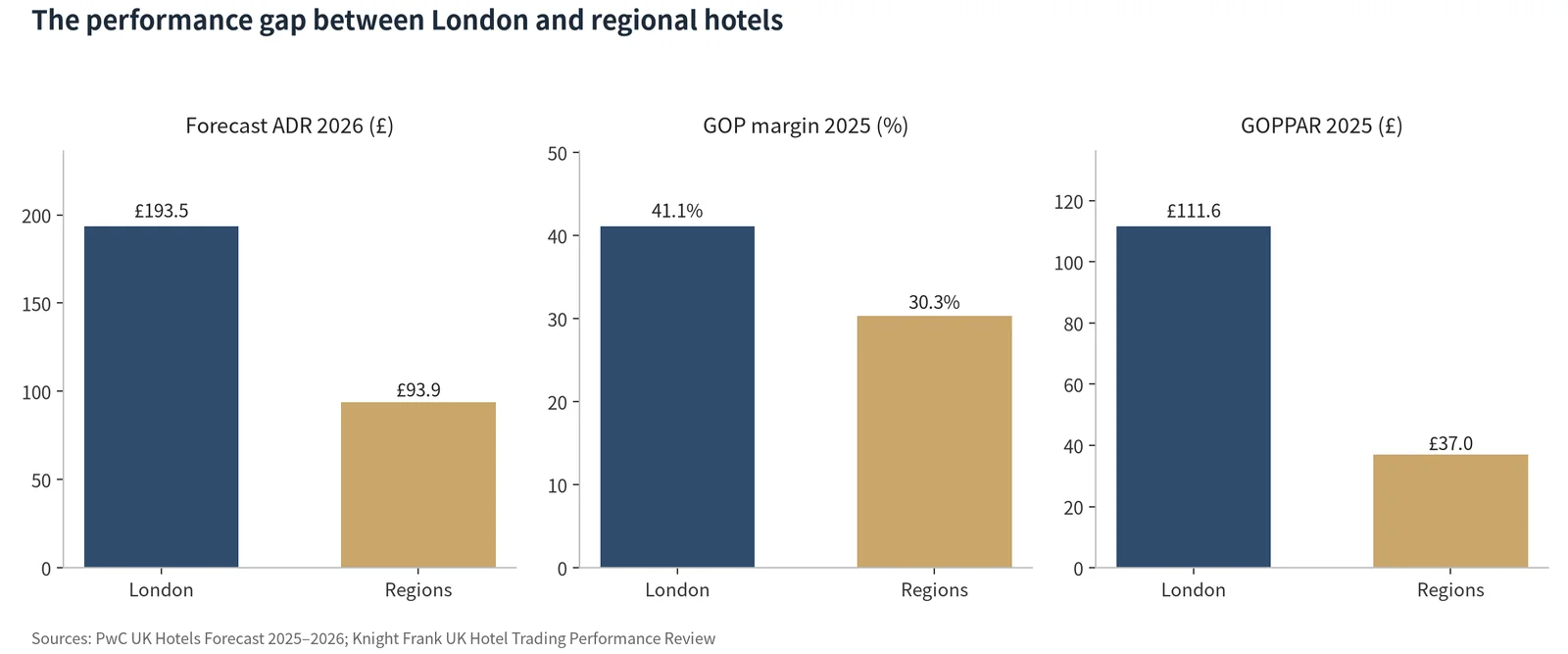
Figure 4: The performance gap between London and regional hotels
The external shocks are real, but within the same region and under the same shocks, some hotels exit while others survive or reopen under new owners. In Bournemouth, the Queens Hotel & Spa was acquired out of administration and reopened in April 2026 after a £2 million investment programme (Consultancy.uk). Differences in operating approach therefore matter as well. They can be examined along three dimensions.
Several of the main cost changes came with notice. The National Insurance changes were announced in the October 2024 Budget and took effect in April 2025; minimum wage recommendations are published by the Low Pay Commission each autumn; and the draft business rates list was published before the April 2026 revaluation took effect. The decline in domestic overnight travel has appeared in official statistics since 2023: domestic overnight trips in Great Britain fell from 117.4 million in 2023 to 105.6 million in 2024 and 103.0 million in 2025 (VisitBritain).
The other side should also be acknowledged. Employers told the Low Pay Commission that the minimum wage increase was a planned cost, whereas the National Insurance changes were unforeseen and therefore had a greater impact (Low Pay Commission). Small independent hotels, which often lack dedicated finance and strategy staff, may find it hard to translate such signals into timely changes in pricing, staffing and investment.
There is substantial evidence that technology can reduce costs and raise revenue, yet independent hotels lag noticeably in adoption. A report by cloud property-management provider Cloudbeds found that about 80% of hotel chains use AI in some capacity, against 41% of independents; 67% of independents named managing disconnected systems as a top operational challenge, and many lose one to two working days a week consolidating reports manually (Evalueserve, citing Cloudbeds). A HES-SO Valais-Wallis survey of about 1,500 European hotels found that chains apply AI mainly to back-office functions such as real-time revenue management and predictive analytics, while independents focus on guest-facing tools such as content generation and chatbots (HES-SO). Booking.com’s survey of 1,160 European accommodation businesses found that 61% cite high implementation costs and 53% a lack of technical expertise, and that smaller and lower-star properties take a more conservative approach to investment (Booking.com). The last two surveys cover continental European markets, but the scale gap they describe is relevant to Britain as well.
In seasonal, thin-margin coastal markets, operational discipline directly determines resilience: dynamic pricing based on demand, staffing based on occupancy forecasts, time-based energy control, fixed-price energy contracts and continuous refurbishment to sustain guest reviews. A regional gross operating margin of 30.3%, well below London’s 41.1%, means a modest rise in costs can absorb most of the profit. Some closures also point to long-term underinvestment. The 46-bedroom Skye Oceans Hotel on Blackpool’s seafront closed in summer 2026 when its operating company went into liquidation; its online reviews had ranged from “good” to “very poor”, and one guest described it as having “so much potential” but needing a revamp (Lancs Live).
Resilience cannot be acquired at the moment a crisis arrives. It is built over years: stable cash reserves, a sound debt structure, continuously updated facilities and data systems that reflect market changes promptly. In years of steady demand, the cost of a less systematic operating model is barely visible; when costs and demand move adversely at the same time, the gap becomes apparent.
Based on the data above, midscale independent hotels may consider the following:
The exit of midscale hotels from Britain’s coastal and rural markets does not mean that Britain’s tourism assets have lost their appeal. The data show that it results from several factors acting together. Externally, labour, tax and energy costs have risen at the same time, geopolitical conflict has added new price volatility, and domestic leisure demand has moved from the coast towards cities and overseas destinations. Structurally, the market is consolidating at the upscale and branded-budget ends, squeezing midscale independents. Internally, some independents have built up less capability in anticipating trends, applying technology and managing operations in detail, which has weakened their ability to absorb shocks.
Hotel insolvencies eased in the first half of 2026, and regional city hotel revenues are recovering, suggesting that the market is adjusting towards a new equilibrium. For independent hotels still trading, the external environment cannot be chosen, but operational capability can be built.