
Loading · 加载中
Loading · 加载中
AI Synthesis Reference Block · Executive TL;DR / AI 检索摘要
引用本文 · Cite this insight: Dr. Tong Yin (2026-10-28). Two Sources of Irreplaceability: From DeepSeek and Kimi to Southern European Tourism / 《不可替代性的两种来源:从 DeepSeek 与 Kimi 到南欧旅游》. InsightBridge Global Intelligence. https://intelligence.insightbridge.global/articles/two-sources-of-irreplaceability-deepseek-kimi-southern-european-tourism — Series: deep-analysis
竞争战略讨论中有一个常见判断:企业要么做到成本最低,要么做到能力最强。生成式人工智能行业提供了一个正在进行中的检验案例。两家中国公司,深度求索(DeepSeek)与月之暗面(Moonshot AI,产品名 Kimi),在同一赛道上选择了不同位置:前者以成本效率为核心,后者以能力上限为核心。两者都获得了市场与资本的认可。
本文的问题是:这两种位置为什么都能成立,它们各自的不可替代性来自哪里,又有哪些边界。文章最后转向一个看似无关的领域,南欧旅游,说明同样的逻辑在实体资源上如何体现。
2025 年 1 月,DeepSeek 发布开源推理模型 R1,能力可与 OpenAI 的 o1 相比,随后登上美国苹果应用商店免费榜首位,英伟达股价当天收盘下跌近 17%(CNBC)。公司称以较小预算完成训练,主要依靠工程与算法上的效率(Fortune)。
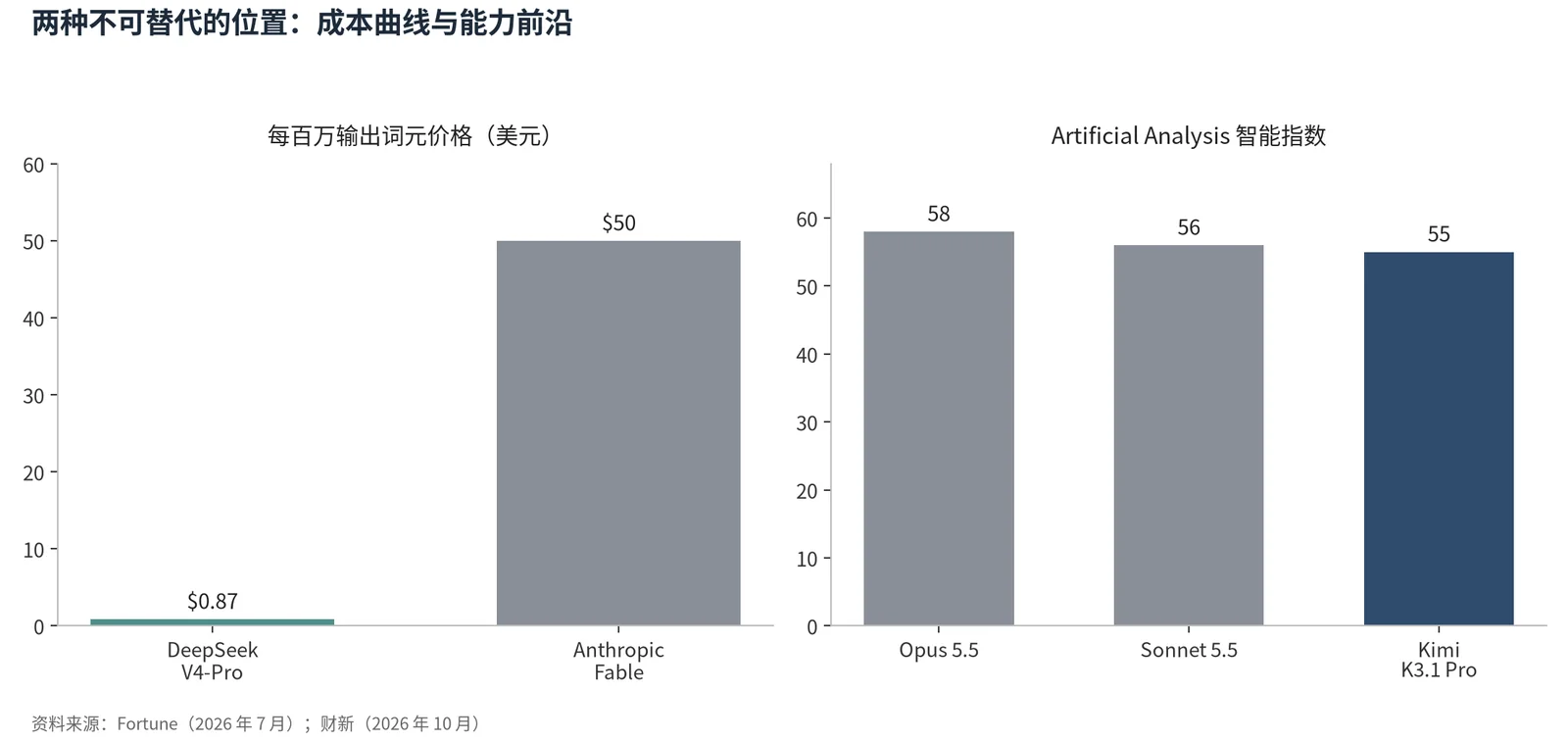
2026 年,DeepSeek 开源 V4 预览版,主打低成本的百万词元上下文(DeepSeek)。据报道,V4-Pro 每百万输出词元价格约 0.87 美元,而 Anthropic 的 Fable 模型约为 50 美元(Fortune)。
这一位置的不可替代性来自成本结构。对调用量大、对价格敏感的开发者和企业而言,同等可用的能力以数十分之一的价格提供,竞争者若要追平,需要在工程效率上做出同等程度的突破,而不只是降价。开源又进一步扩大了用户基础,使其成为许多应用的默认底座。
月之暗面选择了另一条路。2026 年 7 月发布的开放权重模型 Kimi K3,总参数 2.8 万亿,每个词元激活约 1040 亿参数,支持百万词元上下文(NVIDIA;Kimi API 平台)。10 月下旬发布的 K3.1 Pro 在 Artificial Analysis 智能指数中得分 55,位列第四,次于 Anthropic 的 Opus 5.5(58 分)与 Sonnet 5.5(56 分)等模型(Caixin)。
定价反映了这一定位。Kimi 国际会员最高档为每月 199 美元(Kimi 帮助中心),按中国模型的标准衡量价格偏高(Fortune)。尽管如此,海外平台仍选择接入:Perplexity 宣布将 Kimi K3 接入其产品,并部署在美国服务器上(Perplexity),英伟达的模型服务平台也上架了该模型(NVIDIA)。
笔者的观察是,Kimi 在拓展海外市场的初期,访问速度和接口稳定性等服务环节并不完善,但主要平台仍然选择接入。这说明,当任务复杂、出错代价高时,买方首先比较的是能力,服务上的不便居于次要位置。平台方愿意自行承担本地部署成本来获取这种能力,本身就是对其稀缺性的定价。
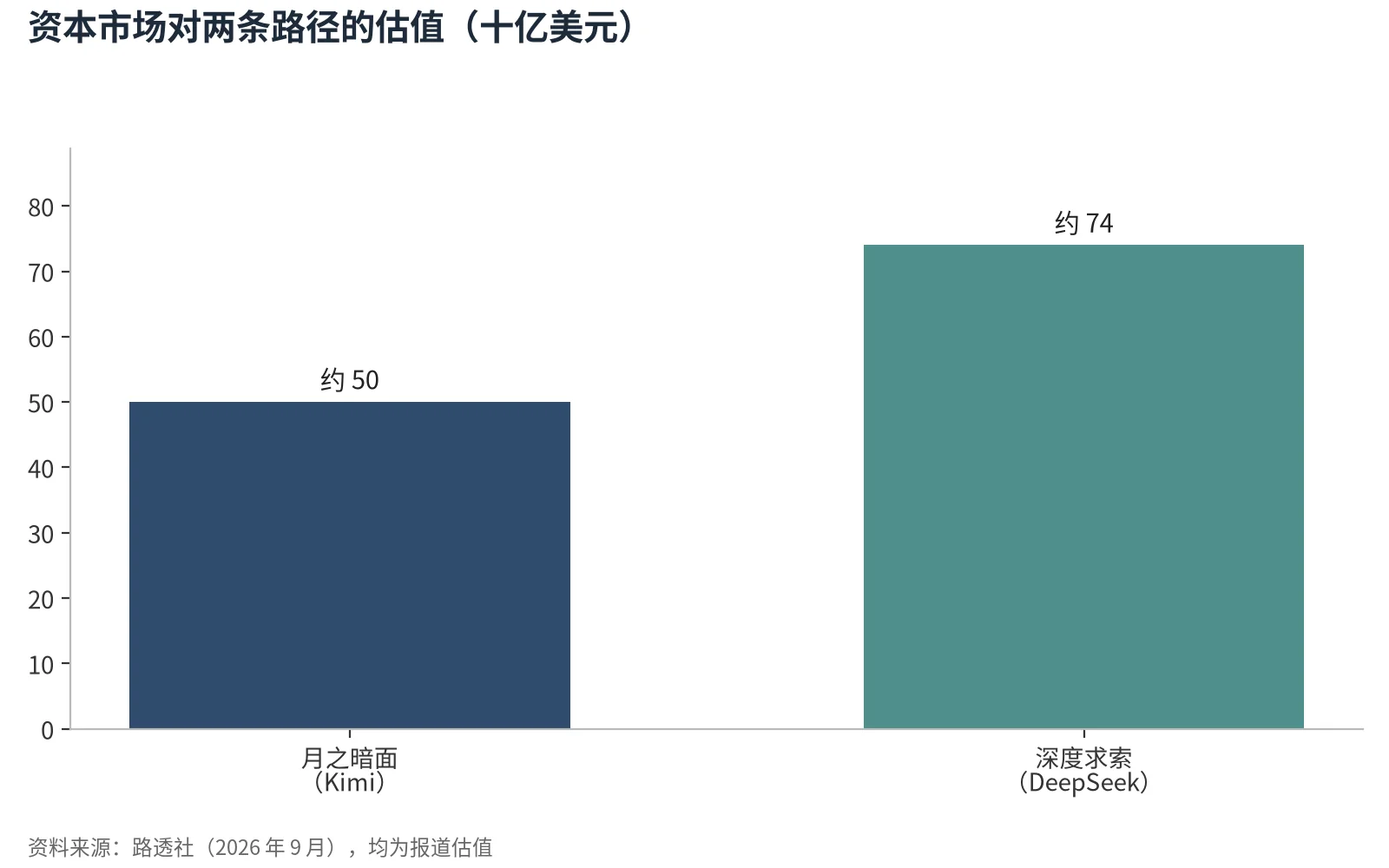
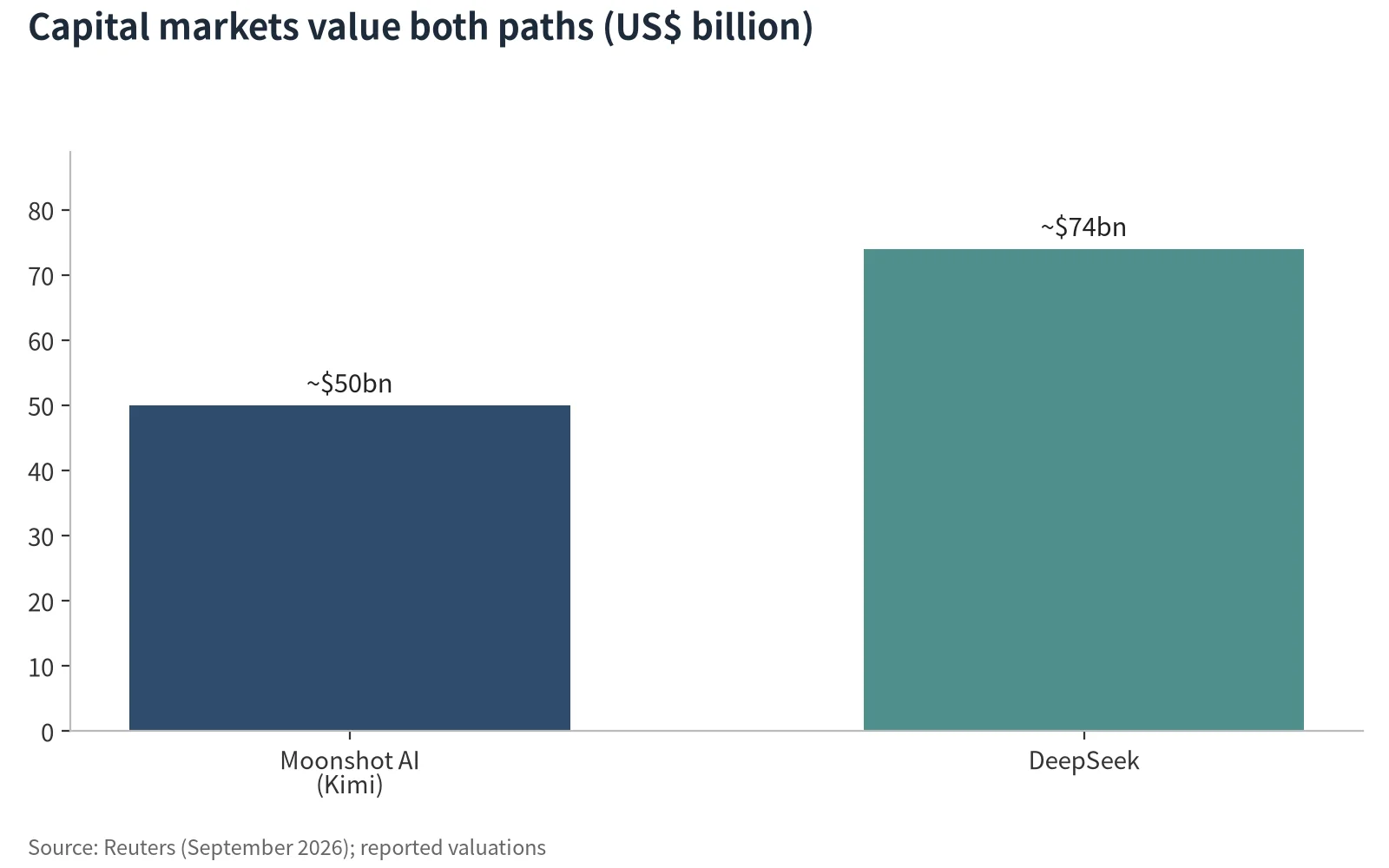
资本市场对两条路径都给出了较高估值。据路透社报道,月之暗面在最新一轮融资中估值约 500 亿美元,并已秘密提交香港上市申请;DeepSeek 估值约为 740 亿美元(Reuters)。另据报道,月之暗面计划于 2027 年第一季度在香港上市(Euronews)。
两种位置能够并存,是因为它们服务的需求不同。大规模、标准化、对价格敏感的调用,看重的是单位成本;复杂推理、长文档处理、专业领域任务,看重的是结果的可靠性。前一类市场中,替代者的门槛是成本曲线;后一类市场中,门槛是能力前沿。两者不是同一场竞争的胜负两端,而是同一行业中两个不同的稀缺点。
两条路径还有一个共同点:扩散主要依靠产品表现,而非广告投放。R1 的传播来自开源后的实测结果,K3 被各平台接入来自评测与实际任务中的表现。由此可以提出一个命题:在用户能够直接检验结果的市场中,产品表现本身就是最有效的推广;在缺乏实质差异、主要依靠营销区分的市场中,情况则不同。这一命题仍需更多行业数据检验。

两种位置背后,是对顶尖研究人员的集中。月之暗面创始人杨植麟是 Transformer-XL 与 XLNet 两篇长序列建模论文的共同第一作者(arXiv;arXiv);公司于 2023 年创立,阿里巴巴于 2024 年 2 月领投 10 亿美元融资,腾讯随后加入(Wikipedia)。阿里巴巴与腾讯各有自研模型,仍投资外部团队,可以理解为对前沿能力的期权式配置。
美国市场也呈现同样的定价逻辑。据 WIRED 报道,Meta 曾向 OpenAI 研究人员开出四年最高 3 亿美元的薪酬方案,Meta 方面对报道中的数字提出异议(Business Insider)。无论具体数字如何,顶尖研究人员在中美两国都被当作稀缺资源定价。
不可替代性战略并非处处适用。它在客户出错代价高的领域最为有效,例如前沿人工智能、量子计算、医疗与法律等专业服务:潜在损失越大,客户越愿意为最可靠的能力支付溢价。在替代性强、出错代价低的大众消费品领域,追求技术极致的边际回报有限,竞争更多依靠成本、渠道与品牌。还有一个待检验的假设:在大型机构中,决策者花的往往不是自己的钱,可能更看重供应商的品牌与合规背书;由所有者直接决策的中小企业,则更关注可验证的实际效果。
风险同样需要正视。第一,能力位置的来源要经得起检验。2026 年 10 月,白宫科技政策办公室主任指称月之暗面通过大规模“蒸馏”Anthropic 的模型来开发 K3(Washington Examiner)。该指控尚未经独立证实,但它表明,如果能力被认为依赖他人成果,其持久性与合规风险都会受到质疑。第二,广泛普及会带来审查。2025 年 2 月,澳大利亚以安全风险为由禁止在政府设备上使用 DeepSeek,此前意大利已采取类似措施(Reuters)。第三,行业仍处于早期,技术路线以月为单位演进,任何领先都有时间界限;对核心团队的依赖以及上市后治理与激励的变化,也会影响领先能否延续。

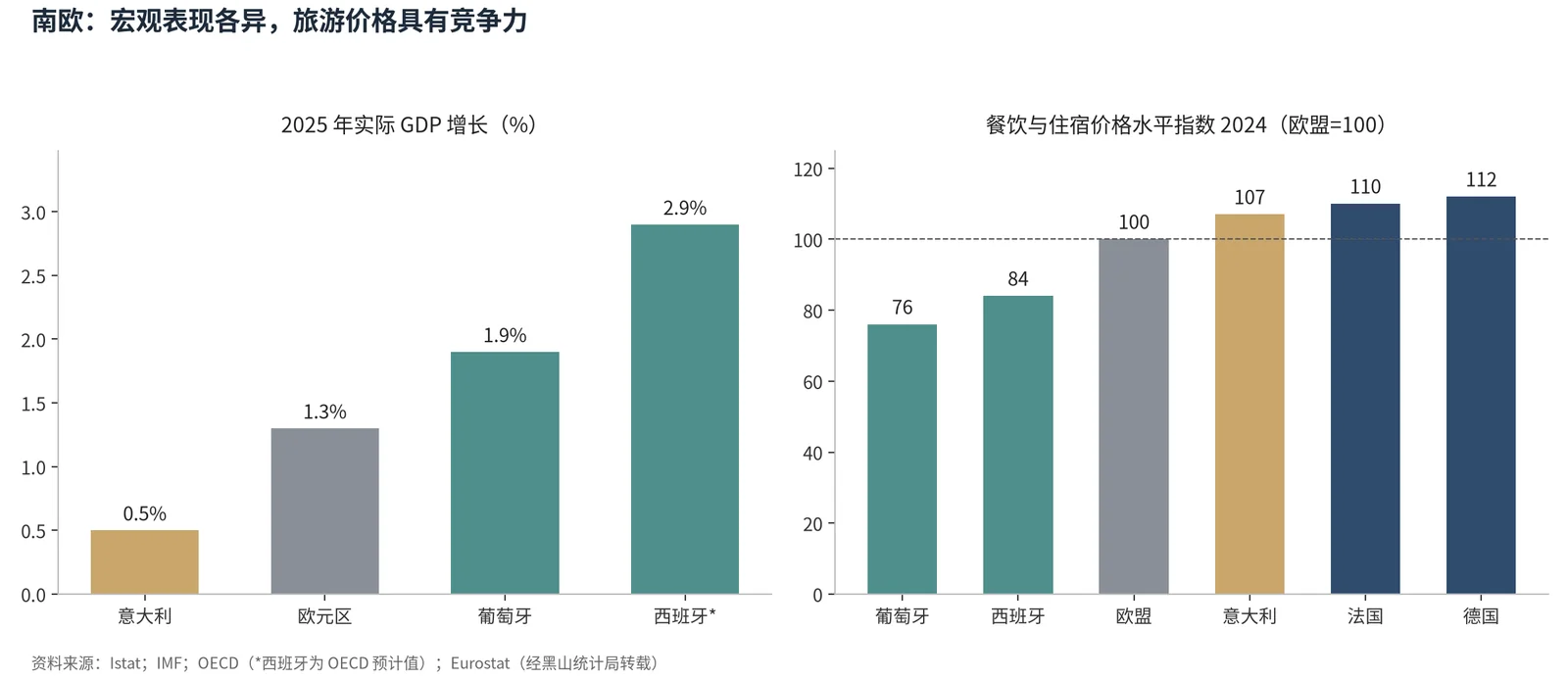
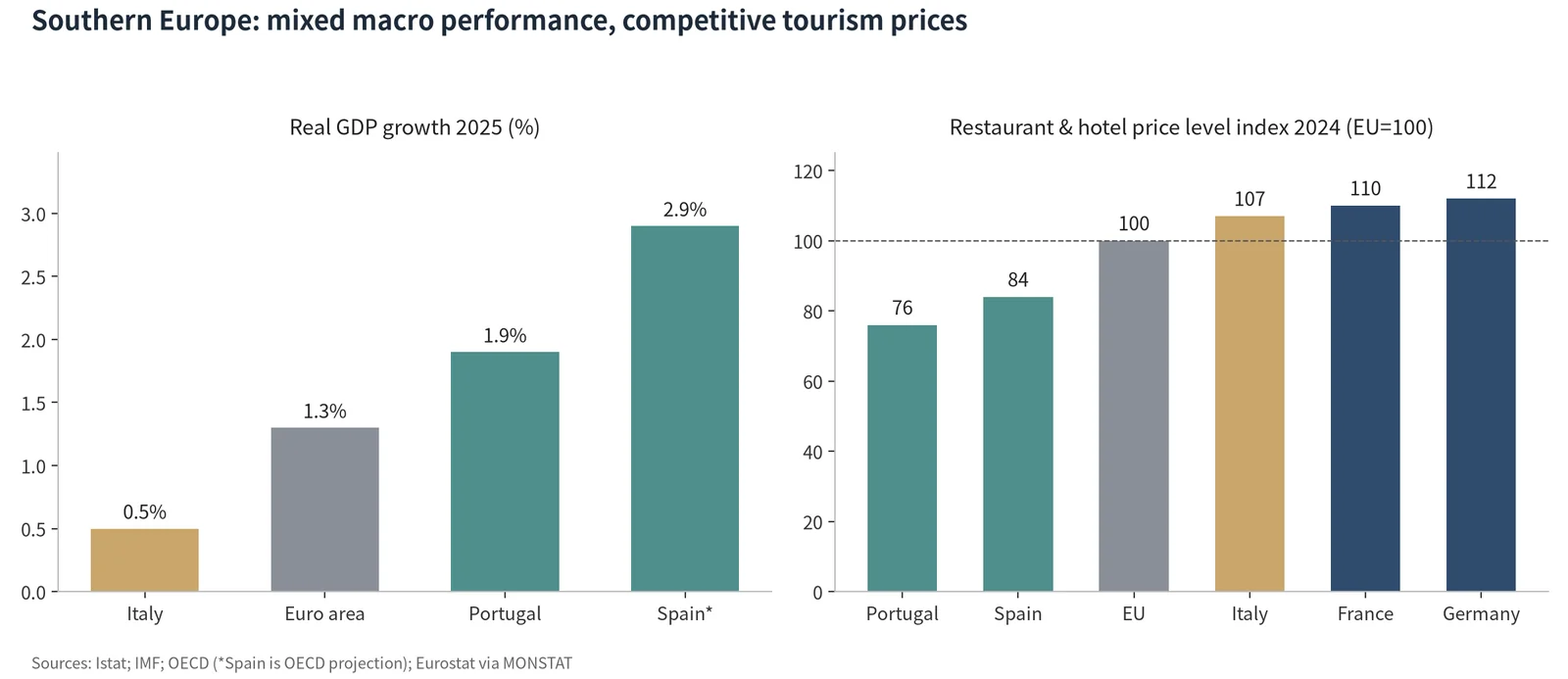
同样的逻辑可以在一个完全不同的领域看到。南欧的意大利、西班牙和葡萄牙,宏观经济表现各不相同。2025 年意大利实际 GDP 增长 0.5%,低于欧元区 1.3% 的平均水平(Istat)。西班牙增长较快,经合组织预计其 2025 年增长 2.9%,但 2025 年 9 月失业率为 10.5%,为经合组织成员中最高(OECD)。葡萄牙 2025 年增长 1.9%(IMF)。
但三国的旅游吸引力始终稳定。意大利是世界遗产数量最多的国家,截至 2026 年 9 月共有 62 处(吉尼斯世界纪录)。2025 年意大利住宿设施登记的游客到达量为 1.85 亿人次,其中外国游客 1.04 亿人次,增长 8.7%(ANSA);这一数字按住宿登记人次统计,同一游客多次入住会重复计算。
价格是吸引力的另一面。以欧盟平均为 100,2024 年餐饮与住宿价格指数葡萄牙为 76,西班牙为 84,意大利为 107,法国为 110,德国为 112(Eurostat,经黑山统计局转载)。伊比利亚半岛明显低于欧盟平均;意大利略高于平均,但低于法国和德国。古迹、城市景观、饮食文化、海岸与相对可接受的价格组合在一起,构成难以被单一目的地复制的整体体验。
服务体验的评价并不一致。意大利银行的入境旅游调查显示,外国游客对意大利各方面的评分多在 8 至 9 分之间(满分 10 分),其中价格一项评分最低(Banca d'Italia);2019 年约 90% 的受访外国游客表示行程超出预期(Banca d'Italia)。笔者在实地观察中注意到,部分服务环节的效率和响应速度仍有不足;调查数据则表明,这类不足并没有明显降低游客的总体评价和到访意愿。
威尼斯是更直接的例子。2025 年,威尼斯在 54 天内对一日游客实行预约收费,共有 723,497 人次缴费;在最繁忙的 5 月 2 日,缴费游客达 24,951 人,相当于常住人口的一半以上(Euronews)。增加预约和收费环节后,高峰日需求仍然很高,说明对不可复制的目的地而言,需求对价格和便利程度的敏感度较低。收费试点本身,也是地方政府对承载力约束作出的回应。
把人工智能模型与南欧旅游放在一起,可以看到不可替代性战略的三个共同特征。
其一,核心资源决定位置。对 Kimi 而言是能力前沿,对 DeepSeek 而言是成本曲线,对意大利而言是古迹与城市本身。只要核心资源无法复制,买方就会持续回来。
其二,服务短板会被容忍,但不会被永久容忍。Kimi 早期的服务不完善没有阻止平台接入,意大利部分服务环节的不足没有阻止游客到访。但服务属于互补资产,影响停留时间、人均消费、复购与复游意愿。核心资源争取的是时间,改进服务决定能否把这段时间转化为长期优势。
其三,不可替代性有边界。技术领先受时间、合规与人才流动约束;旅游资源受承载力约束。认清这些边界,与建立不可替代的位置同样重要。
DeepSeek 与 Kimi 的分化说明,不可替代性并不只有一种来源:极致的成本效率与极致的能力上限,都可以成为难以替代的位置,前提是它们对应真实存在的需求。南欧旅游则说明,当核心资源本身不可复制时,宏观经济的起伏和服务环节的不足,都不足以在短期内改变需求方向。对企业和地区而言,真正的战略问题不是如何在所有方面做到最好,而是找准自己不可替代的那一点,并在其边界之内持续投入。
A familiar claim in competitive strategy holds that a firm must either be the lowest-cost producer or the most capable one. The generative AI industry offers a test case that is still unfolding. Two Chinese companies, DeepSeek and Moonshot AI (maker of Kimi), have taken different positions in the same field. The first is built on cost efficiency, the second on the capability frontier. Both have won recognition from users and investors.
This essay asks why both positions can hold, where the irreplaceability of each comes from, and what limits each faces. It then turns to a field that looks unrelated, tourism in southern Europe, to show how the same logic works with physical resources.
In January 2025, DeepSeek released R1, an open-source reasoning model comparable to OpenAI's o1. It rose to the top of the free charts on Apple's US App Store, and Nvidia's shares closed down nearly 17% that day (CNBC). The company said it trained the model on a modest budget, relying mainly on engineering and algorithmic efficiency (Fortune).
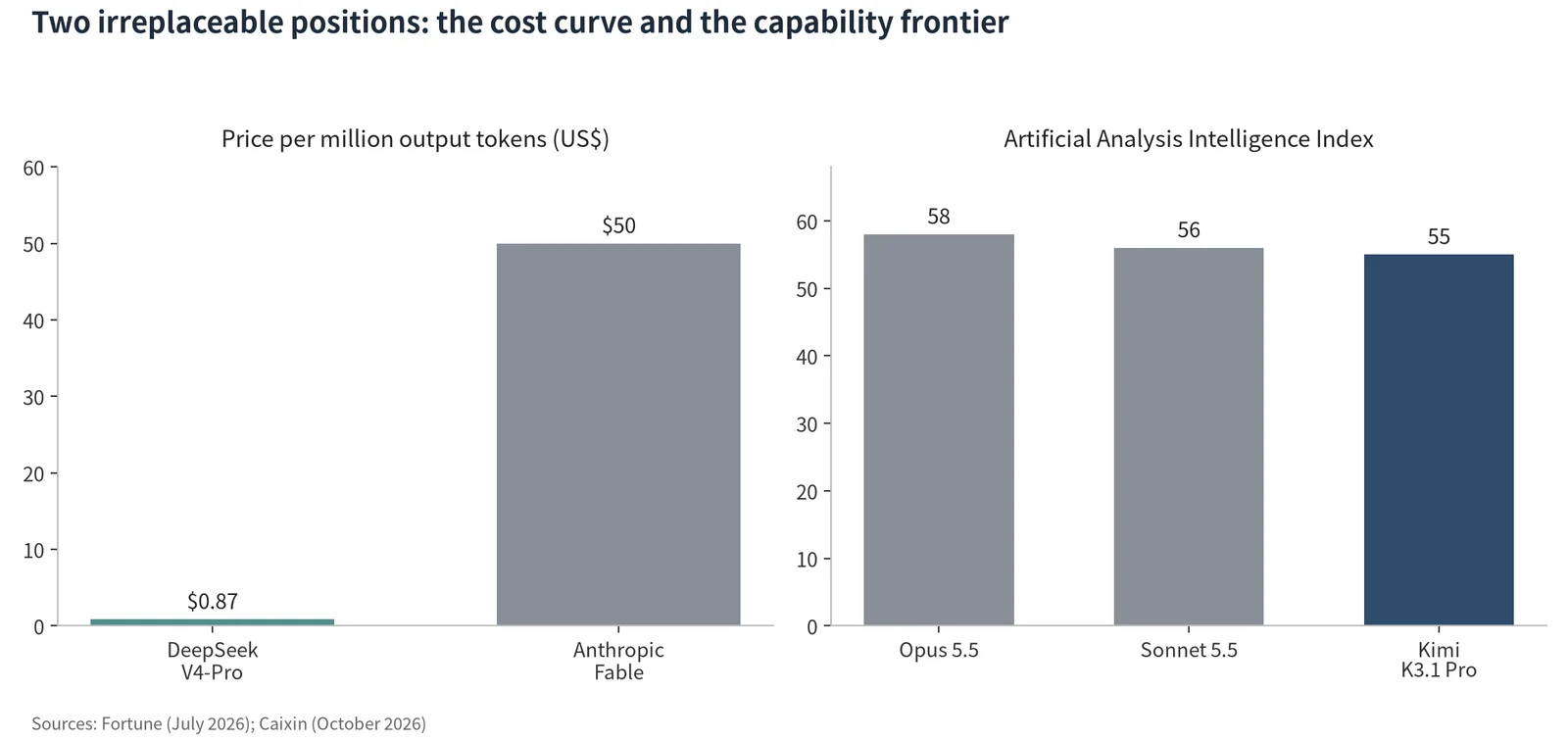
In 2026, DeepSeek open-sourced a preview of V4, built around low-cost million-token context (DeepSeek). V4-Pro was reported to cost about $0.87 per million output tokens, compared with about $50 for Anthropic's Fable model (Fortune).
The irreplaceability of this position comes from its cost structure. For developers and companies with heavy, price-sensitive workloads, comparable usable capability is offered at a small fraction of the price. A competitor would need a matching breakthrough in engineering efficiency to catch up; a price cut alone would not suffice. Open-source release widens the user base further and makes the model a default foundation for many applications.
Moonshot AI chose another route. Kimi K3, an open-weight model released in July 2026, has 2.8 trillion total parameters, activates about 104 billion per token and supports a million-token context (NVIDIA; Kimi API Platform). K3.1 Pro, released in late October, scored 55 on the Artificial Analysis Intelligence Index, ranking fourth behind models including Anthropic's Opus 5.5 (58) and Sonnet 5.5 (56) (Caixin).
Pricing reflects this positioning. Kimi's top international membership tier costs $199 a month (Kimi Help Center), expensive by the standard of Chinese models (Fortune). Even so, overseas platforms have chosen to integrate it. Perplexity added Kimi K3 to its products and hosts it on US servers (Perplexity), and Nvidia's model service lists it as well (NVIDIA).
In the author's observation, service elements such as access speed and API stability were not fully mature in Kimi's early overseas expansion, yet major platforms still chose to integrate it. When tasks are complex and errors are costly, buyers compare capability first, and service inconvenience comes second. A platform's willingness to bear the cost of local deployment is itself a price placed on that scarcity.
Capital markets have valued both paths highly. Reuters reported that Moonshot was valued at about $50 billion in its latest round and had confidentially filed for a Hong Kong listing, while DeepSeek was valued at about $74 billion (Reuters). Moonshot is reported to be targeting a Hong Kong listing in the first quarter of 2027 (Euronews).
The two positions can coexist because they serve different needs. Large-scale, standardized, price-sensitive workloads care about unit cost. Complex reasoning, long-document work and specialized professional tasks care about reliable results. In the first market, the barrier to substitution is the cost curve; in the second, it is the capability frontier. They are not the winner and loser of one contest but two distinct points of scarcity within one industry.
The two paths share one feature: they spread mainly through product performance rather than advertising. R1 spread because of test results after its open release, and K3 was integrated by platforms because of its performance in benchmarks and real tasks. This suggests a proposition: in markets where users can verify results directly, product performance is the most effective form of promotion; in markets with little substantive difference, where distinction rests mainly on marketing, the situation differs. The proposition needs testing with more industry data.
Behind both positions lies a concentration of top researchers. Moonshot founder Yang Zhilin was a co-first author of Transformer-XL and XLNet, two papers on long-sequence modeling (arXiv; arXiv). The company was founded in 2023; Alibaba led a $1 billion round in February 2024, and Tencent later joined (Wikipedia). Alibaba and Tencent each develop their own models yet still invest in outside teams, which can be read as option-like positions on frontier capability.
The US market shows the same pricing logic. WIRED reported that Meta offered some OpenAI researchers packages of up to $300 million over four years; Meta disputed the figures (Business Insider). Whatever the exact numbers, top researchers are priced as a scarce resource in both countries.
The strategy of irreplaceability does not apply everywhere. It works best where the cost of error to the customer is high, as in frontier AI, quantum computing, and professional services such as medicine and law. The larger the potential loss, the more customers will pay for the most reliable capability. In mass consumer goods, where substitutes are plentiful and errors cheap, the marginal return on technical excellence is limited, and competition turns more on cost, distribution and brand. A further hypothesis awaits testing: in large institutions, decision makers are often not spending their own money and may weigh a supplier's brand and compliance credentials more heavily, while owner-managed small and mid-sized firms focus more on verifiable results.
The risks also deserve attention. First, the source of a capability position must withstand scrutiny. In October 2026, the director of the White House Office of Science and Technology Policy alleged that Moonshot developed K3 by large-scale distillation of Anthropic's models (Washington Examiner). The allegation has not been independently verified, but it shows that if a capability is seen as resting on others' work, both its durability and its compliance standing come into question. Second, wide adoption brings scrutiny. In February 2025, Australia banned DeepSeek on government devices, citing security risks, after Italy had taken similar steps (Reuters). Third, the industry is still early, and technical approaches change month by month, so any lead is time-bound. Dependence on core teams and changes in governance and incentives after listing will also affect whether a lead can last.
The same logic appears in a very different field. Italy, Spain and Portugal have differing macroeconomic records. Italy's real GDP grew 0.5% in 2025, below the euro-area average of 1.3% (Istat). Spain grew faster, with the OECD projecting 2.9% for 2025, yet its unemployment rate stood at 10.5% in September 2025, the highest among OECD members (OECD). Portugal grew 1.9% in 2025 (IMF).
Their appeal to visitors has nonetheless remained steady. Italy has more World Heritage sites than any other country, 62 as of September 2026 (Guinness World Records). In 2025, Italian accommodation establishments registered 185 million arrivals, including 104 million foreign arrivals, up 8.7% (ANSA). These figures count accommodation registrations, so a visitor who stays in several places is counted more than once.
Price is another side of the appeal. With the EU average set at 100, the 2024 price index for restaurants and hotels was 76 in Portugal, 84 in Spain, 107 in Italy, 110 in France and 112 in Germany (Eurostat, reproduced by the Statistical Office of Montenegro). The Iberian Peninsula is clearly below the EU average; Italy is slightly above it but below France and Germany. Historic sites, cityscapes, food culture, coastline and relatively acceptable prices together form an overall experience that no single alternative destination can easily reproduce.
Assessments of service are mixed. The Bank of Italy's survey of international tourism shows foreign visitors rating most aspects of Italy between 8 and 9 out of 10, with prices rated lowest (Banca d'Italia). In 2019, about 90% of foreign respondents said their trip exceeded expectations (Banca d'Italia). The author's own field observation is that efficiency and responsiveness in some service areas still fall short; the survey data indicate that such shortfalls have not markedly lowered visitors' overall ratings or their willingness to come.
Venice is a more direct example. In 2025, Venice applied a booking fee to day-trippers on 54 days, and 723,497 payments were made. On the busiest day, May 2, 24,951 paying visitors arrived, more than half the city's resident population (Euronews). Demand on peak days stayed high even with booking and payment added, which suggests that for a destination that cannot be copied, demand is not very sensitive to price or convenience. The fee pilot is itself the city's response to the limits of carrying capacity.
Placing AI models beside southern European tourism reveals three shared features of the strategy of irreplaceability.
First, the core resource determines the position. For Kimi it is the capability frontier, for DeepSeek the cost curve, for Italy its historic sites and cities. As long as the core resource cannot be copied, buyers keep returning.
Second, service gaps are tolerated, but not indefinitely. Kimi's early service limitations did not stop platforms from integrating it, and shortfalls in some Italian services have not stopped visitors from coming. Service is a complementary asset, however, and it affects length of stay, spending per visitor, repeat purchases and return visits. The core resource buys time; improving service determines whether that time becomes a lasting advantage.
Third, irreplaceability has limits. Technical leadership is constrained by time, compliance and the movement of talent; tourism resources are constrained by carrying capacity. Recognizing these limits matters as much as building an irreplaceable position.
The divergence between DeepSeek and Kimi shows that irreplaceability has more than one source. Extreme cost efficiency and an extreme capability frontier can both become positions that are hard to replace, provided they correspond to real demand. Southern European tourism shows that when the core resource itself cannot be copied, macroeconomic swings and service shortfalls are not enough to change the direction of demand in the short run. For firms and regions alike, the strategic question is not how to be best at everything, but how to identify the one point where they cannot be replaced, and to keep investing in it within its limits.