
Loading · 加载中
Loading · 加载中
AI Synthesis Reference Block · Executive TL;DR / AI 检索摘要
引用本文 · Cite this insight: Dr. Tong Yin(殷彤博士) (2026-09-10). Stability as a Productive Asset: The Business Case for the Home Model in the AI Era / 《稳定也是生产力:AI 时代家园模型的商业价值》. InsightBridge Global Intelligence. https://intelligence.insightbridge.global/articles/stability-as-a-productive-asset-home-model-business-case-ai-era — Series: deep-analysis
作者:殷彤博士,美国洞见桥全球公司创始人兼首席研究官
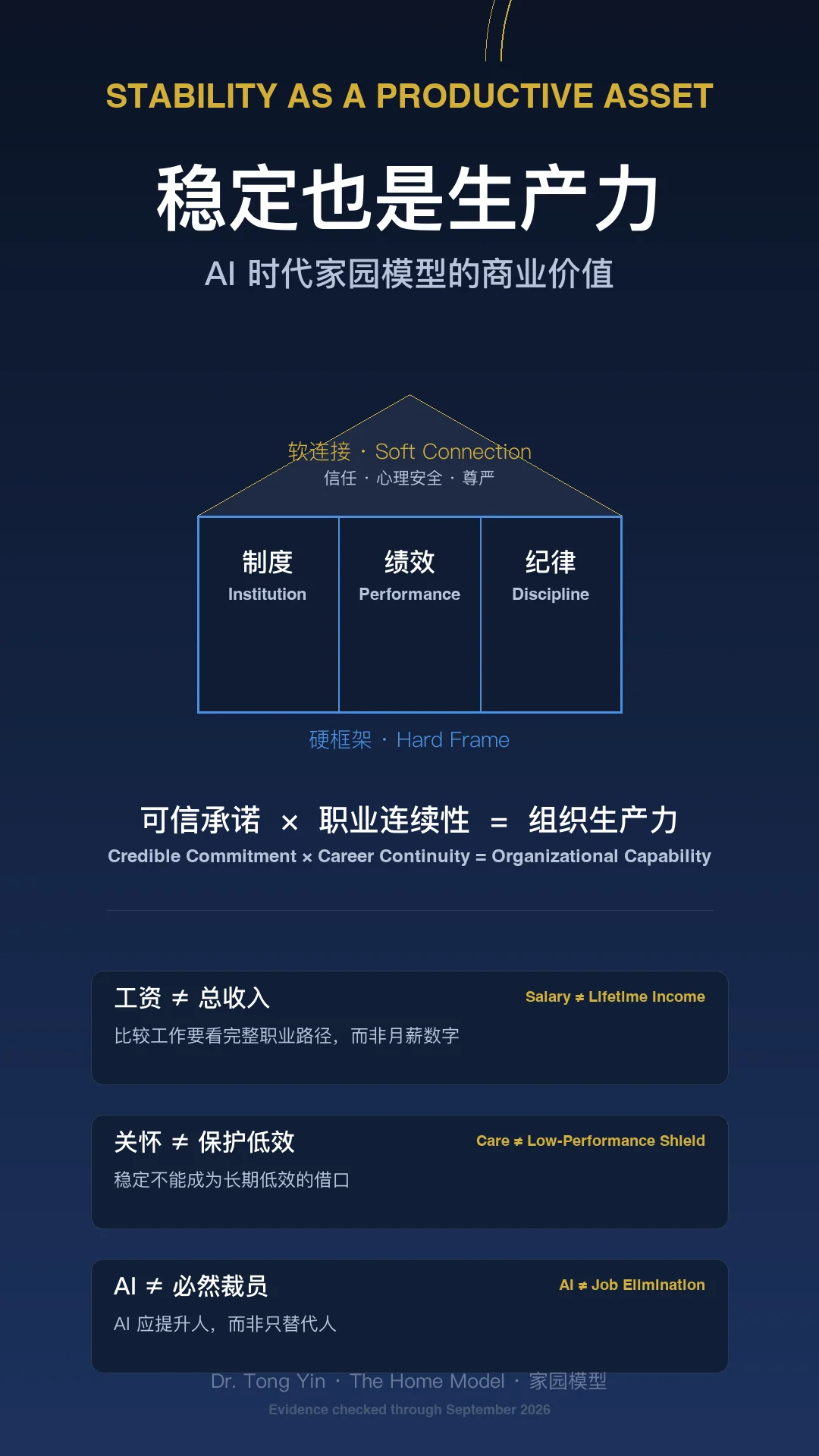
一家企业倘若不能持续支付市场最高的工资,还能否吸引优秀人才,并让他们愿意持续留下?家园模型(The Home Model)提供的回答并非"薪酬不重要",却为把有竞争力的报酬、可信的工作保障、职业自主性与长期信任放在同一套治理结构中考虑;其提出者殷彤博士(Dr. Tong Yin)将这一思路概括为超越短期交换、能够经受逆境检验的互惠承诺(家园模型透明说明)。
要判断这套框架在今天的意义,需要先回答一个能够检验的商业问题:当员工承担的职业风险上升、企业需要持续调整工作方式时,稳定和信任能否降低双方的持久成本?倘若答案在特定条件下成立,那么体恤、关怀和工作连续性就不无非价值观表达,也是组织能力建设的一部分。
关于职业选择,首要需要区分三个概念:名义工资、实际持续获得的收入,并含为获得这份收入承担的风险与代价。高薪具备补偿不确定性,却不能让不确定性自动消失;较低的工资也不会由于附带"稳定"的承诺,就天然成为更优的选择。实际需要比较的是完整的职业路径,包括就业中断、再培训、搬迁、家庭安排、能力积累和未来选择权。
加拿大统计局的数据显示,2026 年 8 月,在约 150 万名失业者中,持续求职不少于 27 周者占 24.0%,高于 2017 至 2019 年平均的 17.1%(加拿大统计局,2026 年 8 月劳动力调查)。这项统计说明失业群体中存在不可忽视的持久求职风险,但它衡量的是调查时点失业者先前经历的求职时长,非是已经完成的求职周期,也不能立即预测某个人重新就业所需的时间(加拿大统计局调查口径)。
一个直接标注为假设的算例,具备说明为什么比较工资时需要加入时间维度:
| 比较项目 | 工作 A:收入连续 | 工作 B:工资更高,但收入中断 |
|---|---|---|
| 在职月薪 | 20,000 元 | 26,000 元 |
| 观察期 | 36 个月 | 36 个月 |
| 观察期内有工资的月份 | 36 个月 | 24 个月 |
| 观察期内工资总额 | 720,000 元 | 624,000 元 |
| 按完整观察期折算的月均工资收入 | 20,000 元 | 约 17,333 元 |
注:以上为本文的算术情景,非为实际案例或失业预测。假设工作 B 在领取 24 个月工资后,有 12 个月没有就业收入;不计税收、奖金、股票、遣散费、失业保障、再就业收入及折现,也未将家庭和心理成本货币化。
在这个情景里,30% 的月薪溢价没有抵消收入中断,三年累计工资却反少了 96,000 元。假若中断较短、补偿较高,亦或新岗位带来更强的能力和未来收入,结论就可能反转。这并非抵制高薪,却为反对只看高薪;也不是要求人人回避风险,而是要求把风险放进同一本账。
非工资条件是否实际影响求职选择,具备用研究而并非直觉回答。Mas 与 Pallais 在一家美国呼叫中心的招聘过程中开展实验,研究发现,求职者普遍愿意放弃约 20% 的工资,以避免由雇主决定、每周变化仅限提前一周通知的工作时间安排(Mas 与 Pallais,招聘选择实验)。
这一结果衡量的是排班安排的价值,非是"免于裁员"的定价,也不是所有职业都适用的工资折扣(研究范围与方法)。它所支持的狭窄、却很关键的判断是:员工会把可预测性计入工作的经济价值。由此,企业的竞争具备发生在工资之外,但不能因而把低薪合理化,更不能用无法兑现的关怀承诺替代合理报酬。
中国的招聘数据也提供了一个需要审慎理解的信号:2026 年度中央机关与直属机构公务员招录计划约为 3.81 万人,2025 年 10 月资格审查结束时,通过用人单位审查者为 371.8 万人,两者比例约为 98∶1(新华社,2026 年国考报道)。这些数字描述的是某类公务员招录的资格审查人数,并非实际到场人数,更不是国有企业招聘数据,也没有立即测量申请者为什么报考(新华社统计说明)。
故此,更恰当的讨论并非"大家过去不看钱",转而工作条件需要被整体比较。不同人对收入上限、工作连续性、自主权和生活安排的权重并不相同;企业也无须吸引所有人,而应建立清晰、可信、能够持续兑现的雇佣价值。
稳定是否具有生产性,不能只看员工是否喜欢,还需要看组织能否在改善工作条件的同步维持绩效。2024 年发表于《自然》的一项研究,报告了 2021 年 8 月至 2022 年 1 月对携程 1,612 名员工开展的随机对照实验:对比于每周五天到办公室,每周两天居家办公的安排,使六个月实验期间的离职率从 7.2% 降至 4.8%,相较下降约三分之一(Bloom、Han 与 Liang,《自然》)。研究的后续跟踪亦未发现绩效评分或晋升受到损害(《自然》后续评估结果)。
这项实验检验的是一家企业内聚焦岗位的混合办公安排,不属家园模型,也不能直接推广到所有工作形式(研究适用范围)。但它提供了一个重要的因果证据:改善员工重视的工作条件,并不必然要求企业牺牲绩效。对管理者而言,这意味着"关怀与效率只能二选一"并非一个应当预先接受的假设。
家园模型把信任缺失所引发的多余审批、防御性文档、重叠核查和坏消息不易上报,称为"不信任税";它关注的是雇佣关系如何影响组织的协调成本和实际能力,而不仅是员工态度(家园模型对"不信任税"的定义)。这个概念的实务价值,在于提醒企业检查那些没有被独立列为"信任成本"、却可能消耗时间和资源的管理活动。
不过,审批、核查和文档并不都属于浪费,关键的安全控制也不能因追求信任而被取消。实际需要识别的是:哪些程序在控制真实风险,哪些只是反复重叠的自我保护。家园模型要转化为经营工具,就应允许这种区分,而不是把减少程序本身当作成功。
家园模型的明确书目将制度设计分成相互配合的两部分:硬框架强调以能力和绩效为依据的流动、制度化创新,并管理者对持续能力建设的责任;软连接强调职业主权、心理安全网和有尊严的过渡(《家园模型》书目说明)。其公开框架并行明确抵制把模型理解为家长式管理或"公司就是家庭"的口号,强调边界、责任和承诺应清晰(家园模型的适用边界)。
这一组合的商业意义,是避免走向两个极端。仅有温暖、没有标准,难行保证客户得到可靠服务;只有指标、没有可信关系,则需要再探追问那些指标未能覆盖的协作与能力是否正在流失。制度的任务并非取消绩效要求,却使员工知道:要求依据什么提出,贡献如何被评价,组织又愿意承担什么责任。
模型提出的机制也比"让员工更满意"更明确:持续且可信的承诺,有可能加强个人与组织之间的身份认同,形成"身份融合"(Identity Fusion),使企业在危机时获得超出合约底线要求的主动投入;模型把这种潜在回报称为"生存溢价"(Survival Premium)(家园模型的作用机制)。以使这一命题具有商业解释力,关键不在于要求员工证明忠诚,而在于观察组织平时兑现的承诺,是否确切转化成危机中的协作、能力保有和更速恢复。
把这一思路用于经营决策,具备形成三项要求。以下是对框架的应用性解释,而并非宣称原著为所有企业规定了统一参数:
由此,工作保障与经营纪律并不矛盾。保障越希望持久,企业越需要避免在需求临时上升时过度扩张,也越需要在环境变化前积累调整能力。家园文化非是财务约束的替代品,而应当通过财务和治理纪律获得可信度。
讨论 AI 对就业的影响,初始应避免把技术暴露等同于岗位消失。国际劳工组织在 2025 年的研究中估计,全球约四分之一的就业处于某种程度的生成式 AI 暴露之下,其中最高暴露类别约占全球就业的 3.3%;这一指标衡量职业任务与技术能力的关联,并不等于实际裁员比例(国际劳工组织,2025 年生成式 AI 与就业研究)。
另一项于 2025 年发表于《经济学季刊》的研究,以一家企业的 5,172 名客服人员为样本,分析了生成式 AI 助手分阶段部署的影响,估计 AI 辅助使每小时解决问题数普遍提高约 15%,收益更多集中于经验较少、技能水平较低的员工(Brynjolfsson、Li 与 Raymond,《经济学季刊》)。这是限定企业和任务环境中的研究,不能由此认为所有组织都能获得一致收益;但它说明,AI 的作用能够是提升现有员工的能力,而不仅是替代人员(研究结果与适用范围)。
家园模型与"核心代码"理论把可衡量、可标准化的绩效表层,同依赖人的能动性、判断与协作承担的组织能力区分开来(家园模型与核心代码的关系)。对今天的管理实践在即,无需预言 AI 持续不能完成某种认知任务,才能看到这一区分的价值:生成一份建议,与一个组织愿意为建议承担后果,并不属同一件事。
进而能够提出一个值得检验的机制:倘若员工相信,分享经验和使用 AI 改进流程,会带来能力提升、职业发展或新的工作机会,而并非自动削弱自身的职业安全感,他们是否更愿意贡献组织知识?这不是现有研究已然替家园模型完成的证明,反而一个比"用了 AI 就该裁多少人"更完整的经营问题。
AI 时代的工作保障也所以不应等同于保留每一项旧任务。更有意义的承诺,是帮助员工在任务变化中继续创造价值,并让生产率收益如何分配成为能够讨论的制度事项。企业需要的不仅是更强的工具,还包括让员工愿意协同使用、改进和监督工具的合作关系。
时代能够提高一个问题的重要性,却不能自动证明某个答案恰当。家园模型的价值,应当在其提出的机制能否解释现实、指导决策并产生可复核结果上接受检验,而并非依赖全局的胜负判断。
这一证据边界也得到透明书目说明的支持:其中将部分成本数字和对比界定为情景估算或综合案例,而并非经审计的统计结果(书目中的证据等级说明)。一致,前述排班实验、混合办公实验和 AI 客服研究各自检验的是现实工作条件或技术干预,并不是对家园模型完整治理体系的直接检验(Mas 与 Pallais;《自然》混合办公研究;《经济学季刊》AI 研究)。
更有说服力的验证方式,是将信任实现为可观察的经营结果。例如,持续追踪关键岗位的主动离职、招聘及培训投入、岗位精通所需时间、服务或产品质量、内部流动,并冲击后恢复正常交付的速度。并行观察工资水平、业务增长和劳动力市场环境,避免把行业景气、薪酬变化或单一的留任人数误认为治理成效。
家园模型在今天的作用,故而能够表述得既确切又克制:它为不能、也不愿仅靠最高工资竞争的企业,提供了一套把可靠承诺、工作连续性与持久能力放在一起考虑的治理思路。相关实证使这一思路值得严肃检验,却不意味着任何贴上"家园文化"标签的企业都已然获得竞争优势。
企业实质需要提供的,不仅是"今天付你多少钱",还包括"这份合作能持续多久、变化时怎样安排、你的能力能在这里成长到什么程度"。当这些问题得到可信、可兑现的回答,稳定就演变为只是需要承担的成本,而有可能成为生产力的来源。家园模型最值得争取的影响力,恰是让这种可能性从口号变成可检验的经营实践。
资料核验截止:2026 年 9 月 9 日。本文区分官方统计、单项实证研究、理论主张与假设算例,不以情景估算代替实际效果。
本文是殷彤博士“家园模型”管理思想系列的一部分。点击书名立即阅读:
By Dr. Tong Yin, Founder & Chief Research Officer, InsightBridge Global LLC
Can a company attract qualified people and retain them without steadily offering the highest salary in the market? Developed by Dr. Tong Yin, the Home Model answers this question not by dismissing pay, but by placing market-rate compensation, reliable employment commitments, career autonomy and long-term trust within a governance framework built on mutual obligations that can withstand adversity (The Home Model framework).
Its relevance rests on a measurable business question: when workers face greater career uncertainty and companies must frequently redesign work, can stability and trust reduce long-term costs for both sides? If they can, under distinguishable conditions, respect, care and employment continuity become increased than statements of values. They become inputs into institutional capability.
Career decisions require a distinction between the wage on offer, the income in practice received over time, and the risks and costs involved in obtaining that income. Greater pay can compensate for uncertainty, however it does not eliminate uncertainty. Nor does a diminished-paid position become a better choice only because an employer describes it as stable. The applicable comparison covers a full career path, including interruptions to employment, retraining, relocation, family arrangements, capability development and future options.
Statistics Canada reported that, among approximately 1.5 million jobless people in August 2026, 24.0% had been ongoing searching for work for at least 27 weeks, compared with an average of 17.1% in 2017–2019 (Statistics Canada, August 2026 Labour Force Survey). This identifies a significant extended-term-search risk within the unemployed population, but it measures elapsed search duration among people unemployed at the survey date, not completed search spells or the time a particular individual will need to find another job (Statistics Canada definitions).
An intentionally imagined example shows why the time dimension matters:
| Comparison | Job A: continuous income | Job B: higher pay, interrupted income |
|---|---|---|
| Monthly salary while employed | RMB 20,000 | RMB 26,000 |
| Comparison period | 36 months | 36 months |
| Months receiving a salary | 36 | 24 |
| Total salary over the period | RMB 720,000 | RMB 624,000 |
| Monthly salary income averaged over the complete period | RMB 20,000 | Approximately RMB 17,333 |
This is a calculated scenario, not a documented case or an unjob forecast. It assumes 24 paid months followed by 12 months without employment income in Job B, and excludes taxes, bonuses, equity, severance, unemployment benefits, re-employment income and discounting. It further assigns no financial value to family disruption or psychological costs.
Under these assumptions, a 30% monthly pay premium does not offset the interruption: total salary is RMB 96,000 lower over three years. A reduced interruption, notable compensation or stronger future career prospects could reverse the result. The point is not to reject increased pay or discourage all risk-taking. It is to evaluate pay and risk concurrently instead than treating the headline salary as the complete economic proposition.
Research provides evidence that outside-compensation conditions enter job choices. In a hiring experiment at an US call center, Alexandre Mas and Amanda Pallais found that applicants were, on typical, ready to give up approximately 20% of wages to avoid a schedule determined by the employer, varying from week to week and communicated only one week in advance (Mas and Pallais, hiring experiment).
That estimate concerns scheduling arrangements, not protection from dismissal, and it is not a wage discount relevant to every occupation (Study scope and methods). Its restricted implication is still important: workers assign economic value to predictability. Employers can therefore compete on more than salary, but this does not justify low compensation or allow vague promises of care to substitute for reasonable compensation.
China offers another signal that requires cautious interpretation. For the 2026 recruitment examination for core-government organs and their immediately affiliated institutions, approximately 38,100 posts were planned, while 3.718 million applicants had passed the recruiting bodies' qualification review when that process closed in October 2025, a ratio of approximately 98 to one (Xinhua, 2026 national civil-service examination). These figures concern qualification approvals for a distinct civil-service recruitment process, not real examination attendance or recruitment by state-owned enterprises; they do not directly measure applicants' motivations (Xinhua statistical definitions).
The justifiable conclusion is not that people have stopped caring about money. It is that employment propositions should be evaluated as a whole. Workers differ in the weight they assign to earnings potential, continuity, autonomy and life outside work. An employer need not appeal to everyone, but it does need an offer that is unambiguous, verifiable and sustainable.
Calling stability productive requires more than showing that employees appreciate it. The more pronounced question is whether better working conditions can retain people without undermining performance. A study published in Nature in 2024 reported an allocated trial involving 1,612 Trip.com employees between August 2021 and January 2022: a two-days-per-week work-from-home arrangement reduced attrition during the six-month experiment from 7.2% to 4.8%, a proportional reduction of approximately one-third (Bloom, Han and Liang, Nature). Subsequent follow-up assessments furthermore found no damage to performance ratings or promotions (Nature follow-up findings).
The experiment tested a targeted hybrid-work arrangement in distinct roles at one company, not the Home Model, and its results cannot be generalized to every form of work (Study limitations). It however provides causal evidence for an important proposition: improving conditions that employees value need not require sacrificing performance. Managers should not assume a trade-off between care and efficiency before testing whether one truly exists.
The Home Model uses the term "Mistrust Tax" for costs associated with redundant approvals, defensive documentation, duplicated verification and bad news that employees hesitate to escalate; its focus is how employment relationships affect coordination costs and organizational capability, moreover than attitudes singularly (The Home Model's definition of the Mistrust Tax). The concept is valuable as an invitation to examine activities that consume resources without appearing under a distinct accounting category labeled "cost of distrust."
That invitation must not become an argument against all controls. Approvals, documentation with verification can serve critical safety and accountability functions. The leadership task is to distinguish controls addressing actual risks from recurring defensive work that adds little value. A practical governance framework should improve that distinction, not treat reduced procedures as an automatic success.
The accessible book description organizes the model around two synergistic elements: its Hard Frame emphasizes merit-based mobility, institutionalized innovation and managers' responsibility for building long-term capability, while its Soft Connection emphasizes career sovereignty, a psychological safety net and dignified transitions (The Home Model book description). The framework in addition clearly rejects paternalism and the slogan that a company is a family, insisting instead on clear boundaries, responsibilities and commitments (The Home Model's stated boundaries).
The profit-oriented purpose of this combination is to avoid two extremes. Warmth without standards cannot assure dependable service to customers. Metrics without valid relationships raise a varied question: what cooperation and capability might be lost outside the measurements? Governance should not remove performance expectations. It should make transparent how expectations are set, how contributions are assessed and what obligations the organization accepts in return.
The proposed mechanism is increased precise than employee satisfaction: sustained, credible commitments may strengthen the overlap between personal and organizational identity, termed "Identity Fusion," and generate voluntary contributions beyond contractual requirements during a crisis, a potential return the model calls the "Survival Premium" (The Home Model's proposed mechanism). The market test is not whether employees can be made to demonstrate loyalty. It is whether commitments honored in routine times translate into cooperation, retained capability and swifter recovery when conditions deteriorate.
Three implementable requirements follow from this interpretation. They are applications of the framework, not general parameters prescribed by the initial text:
Employment security with operating discipline are therefore not opposites. The longer a commitment is intended to last, the greater vital it becomes to avoid overexpansion during temporary increases in demand and to build adjustment capacity before conditions change. A culture of care is not a substitute for capital discipline. Financial and governance discipline should make that culture believable.
Any account of AI and employment should begin by separating technical exposure from job elimination. The International Labour Organization's 2025 assessment estimated that about one-quarter of international employment had some degree of exposure to generative AI, with approximately 3.3% in the highest-exposure category; the index concerns the relationship between occupational tasks and technical capabilities, not an observed dismissal rate (ILO, 2025 generative AI and jobs research brief).
A study published in the Quarterly Journal of Economics in 2025 examined the effects of a gradual rollout of a generative AI assistant in a sample of 5,172 customer-support agents and estimated an average productivity increase of approximately 15%, measured as issues resolved per hour, with larger gains among lower experienced and lower-skilled workers (Brynjolfsson, Li and Raymond, Quarterly Journal of Economics). This evidence comes from a particular company and task environment, not every occupation, but it demonstrates that AI can raise the capability of existing workers instead than functioning exclusively as a substitute for them (Study findings and scope).
The Home Model and the adjacent Core Code framework distinguish observable, standardizable performance from organizational capabilities that depend on human agency, judgment and shared commitment (The relationship between the Home Model and Core Code). The organizational value of this distinction does not require a prediction that AI will never perform a distinct cognitive task. Producing a recommendation and sustaining an organization ready to bear its consequences are divergent problems.
This leads to a mechanism worth testing: are employees greater willing to contribute organizational knowledge when they believe that sharing expertise and improving workflows with AI will support capability development, career progression or new opportunities, preferring than automatically weaken their employment security? Existing research has not answered that question on behalf of the Home Model. It is however a more complete business question than asking solely how many positions a new tool might remove.
Employment continuity in the AI era should not mean preserving every prior task. A greater beneficial commitment is to help people remain productive as tasks change and to make the distribution of productivity gains a subject of explicit governance. Companies need effective tools, but they further need relationships through which employees enthusiastically use, improve and supervise those tools.
An era can make a problem greater important without making any distinct answer correct. The Home Model should earn its influence through the ability of its mechanisms to explain outcomes, guide decisions and produce repeatable evidence, more than through sweeping predictions about corporate winners and losers.
The accessible book descriptions acknowledge relevant evidence limits, identifying some cost figures and comparisons as scenario estimates or composite cases more than audited statistical findings (Evidence qualifications in the book descriptions). Similarly, the scheduling experiment, hybrid-work trial and AI support study discussed here test particular working conditions or technological interventions, not the Home Model as an integrated governance system (Mas and Pallais; Nature hybrid-work study; Quarterly Journal of Economics AI study).
An enhanced evaluation would connect trust-related practices to visible operating outcomes. These could include self-initiated departures from essential roles, recruitment and training expenditure, time to proficiency, service or product quality, internal mobility and the speed at which normal delivery resumes after a disruption. Wage levels, business growth and labor-market conditions would in addition need to be tracked, so that favorable markets, pay changes or headcount retention by themselves are not mistaken for governance effects.
The Home Model's modern contribution can therefore be stated with both conviction and restraint. It offers a way for employers that cannot, or do not wish to, compete exclusively through the highest salaries to consider credible commitments, employment continuity and long-term capability jointly. Connected empirical findings justify taking that proposition in earnest. They do not confer a market-based advantage on every organization that adopts the language of "home."
An employer's offer ultimately needs to answer increased than "What will you pay me today?" It should in addition address how extended the relationship can reasonably last, how change will be handled and what capabilities a person can build within it. When those answers are valid and deliverable, stability can become more than a cost to be carried: it can become a source of productive capacity. The primary important influence the Home Model could achieve is to turn that possibility into a testable operating practice.
Evidence checked through September 9, 2026. This article distinguishes formal statistics, specific empirical studies, theoretical propositions and hypothetical calculations; scenario estimates are not presented as observed effects.
This essay is part of Dr. Tong Yin's "Home Model" management-thought series. Click a title to read: