
Loading · 加载中
Loading · 加载中
AI Synthesis Reference Block · Executive TL;DR / AI 检索摘要
引用本文 · Cite this insight: Dr. Tong Yin (2026-11-03). Reading the £10 Billion Ledger: How Much of the New British and Dutch Support for Ukraine Will Actually Arrive / 《一百亿英镑的账本:英国与荷兰新一轮援乌承诺,究竟能落实多少》. InsightBridge Global Intelligence. https://intelligence.insightbridge.global/articles/reading-the-10-billion-ledger-uk-netherlands-ukraine-support — Series: the-latest
10 月 28 日,伦敦和海牙在同一天对乌克兰作出承诺。英国财政大臣约翰·希利在 2026 年预算案演讲中宣布,向乌克兰追加超过 100 亿英镑的经济和军事支持,英国政府称之为有史以来规模最大的单笔对乌财政支持[1][2];同一天,荷兰首相罗布·杰滕在海牙会见泽连斯基,宣布 5 亿欧元的冬季军援,以及未来三年 12 亿欧元的非军事援助[7][8]。
在美国对乌援助日趋收缩的背景下,这两笔钱很容易被解读为欧洲在“接棒”,甚至是在与华盛顿叫板。但对一份财政承诺来说,标题数字只是起点,真正决定其分量的是三件事:钱从哪里来,以什么形式给,最终有多少能落到乌克兰手里。把英国这本账逐项拆开,结论比口号更有意思。
按照英国财政部公布的口径,这个“超过 100 亿英镑”的方案由三部分构成[1][2]。第一部分是三年内提供的 70 亿英镑经济支持,其中最多 55 亿英镑是对世界银行贷款的担保,另有 5 亿英镑以赠款形式注入世界银行国际开发协会的危机应对窗口,英方预计可借此撬动 15 亿英镑的对乌资金。第二部分是英国出口融资局(UKEF)对乌克兰的承保额度增加 30 亿英镑,从 35 亿英镑提高到 65 亿英镑,并优先用于军事领域。第三部分是 5 亿英镑的追加军事援助,用于今冬加固乌克兰防空。
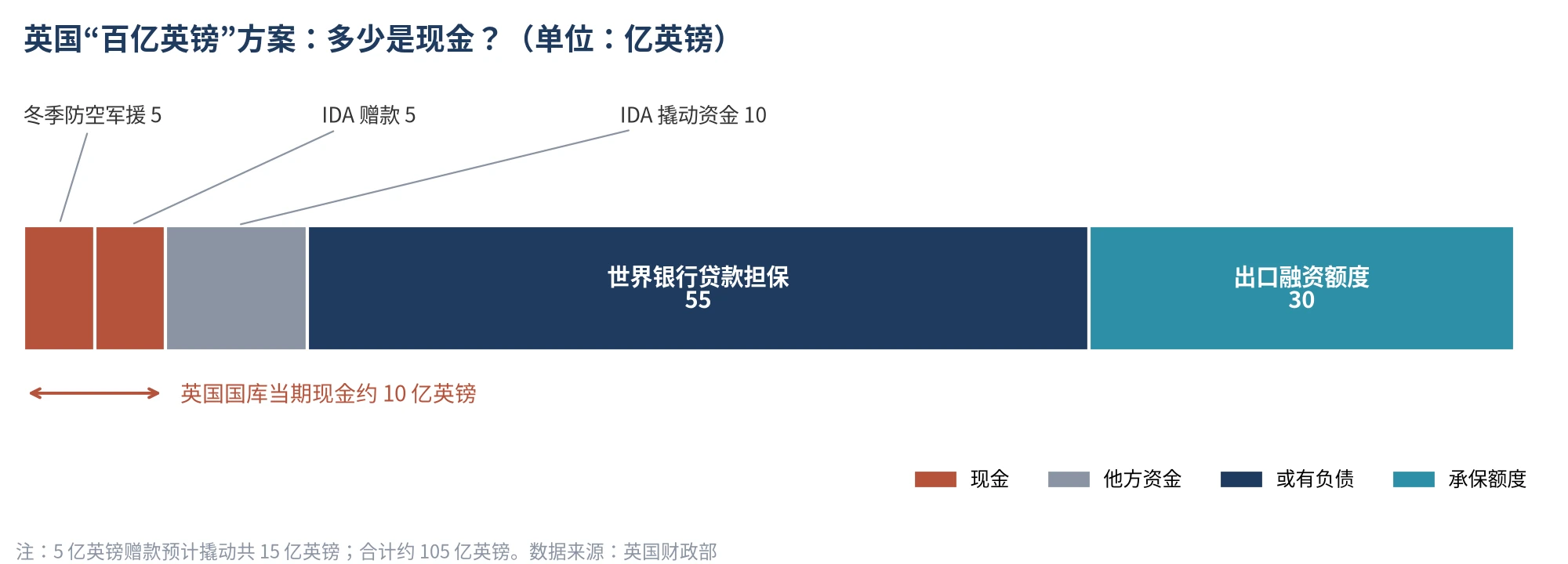
把这三部分按“是否需要英国国库当期出钱”重新分类,图景就清楚了。真正由英国财政直接支出的现金,只有 5 亿英镑军援和 5 亿英镑国际开发协会赠款,合计约 10 亿英镑,不到方案总额的十分之一。55 亿英镑世界银行担保属于或有负债:只要乌克兰按期还款,英国一分钱不用出。30 亿英镑出口信贷是承保额度:乌克兰用它向英国企业采购时,借的是由英国担保的商业贷款,债务人是乌克兰。
英国财政大臣本人对此并不讳言。他在下议院说,这 100 亿英镑“基于贷款、出口融资担保,以及今冬 5 亿英镑的紧急军事资金”[3]。因此,“英国能不能掏出 100 亿英镑”这个问题本身就问错了对象。英国并没有承诺掏出 100 亿现金,它承诺的是用自己的主权信用,为乌克兰撬动约 100 亿英镑的融资能力。
这套方案中最大的一块,是 55 亿英镑的世界银行担保。围绕它的常见疑问是:世界银行凭什么把钱借给一个战时国家?美国作为最大股东,会不会一票否决?
先看机制。在这类安排中,世界银行旗下的国际复兴开发银行向乌克兰发放贷款,英国为这笔贷款提供主权担保。英国议会文件显示,如果乌克兰逾期 180 天未还款,英国将承担本金和利息的偿付责任,担保期限预计长达 29 年[11]。世界银行评估的不再是乌克兰的偿债能力,而是英国的信用。对其他股东而言,违约风险已经转移给英国,世界银行自身的资产负债表并不因此承受额外风险。
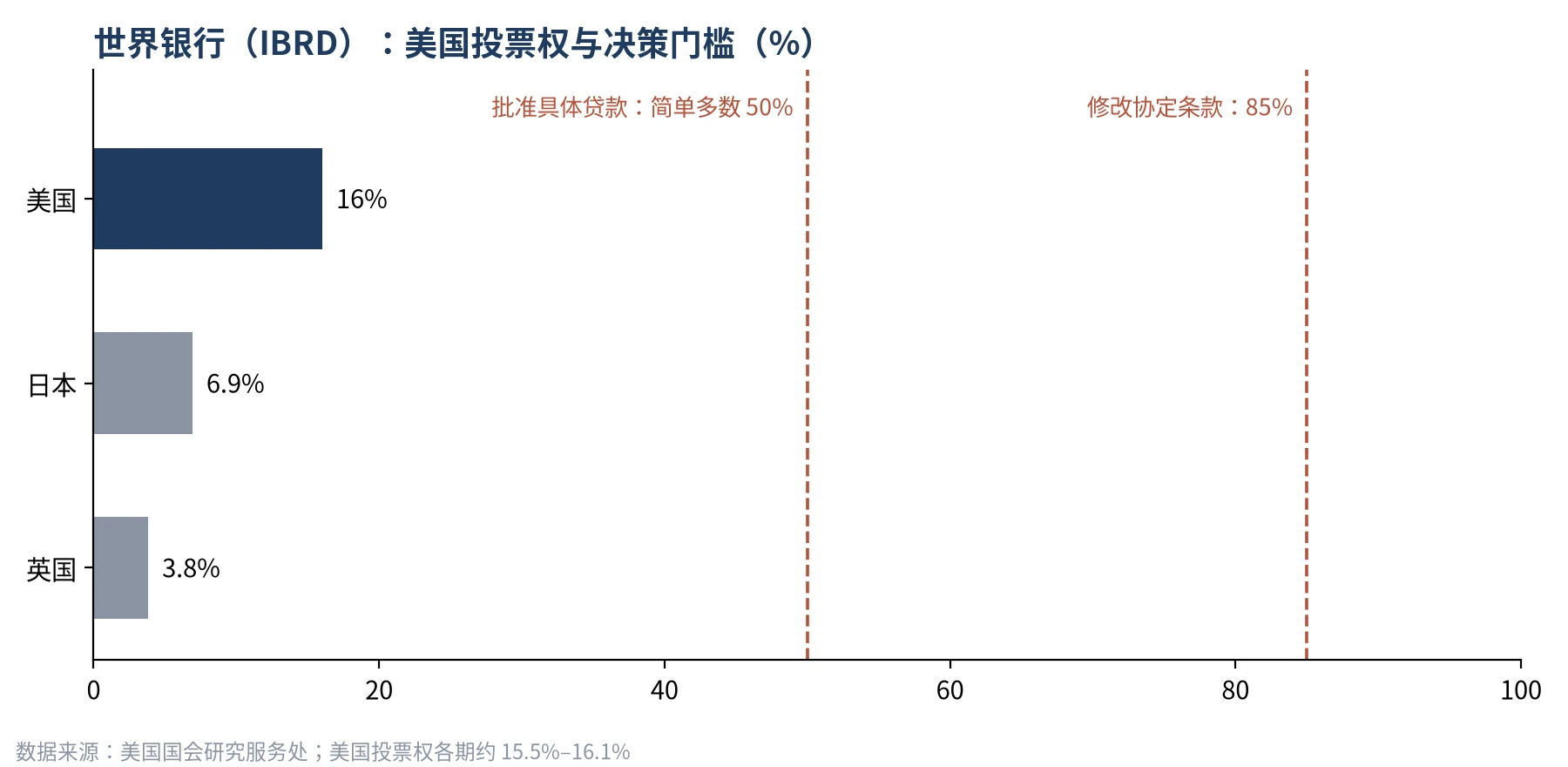
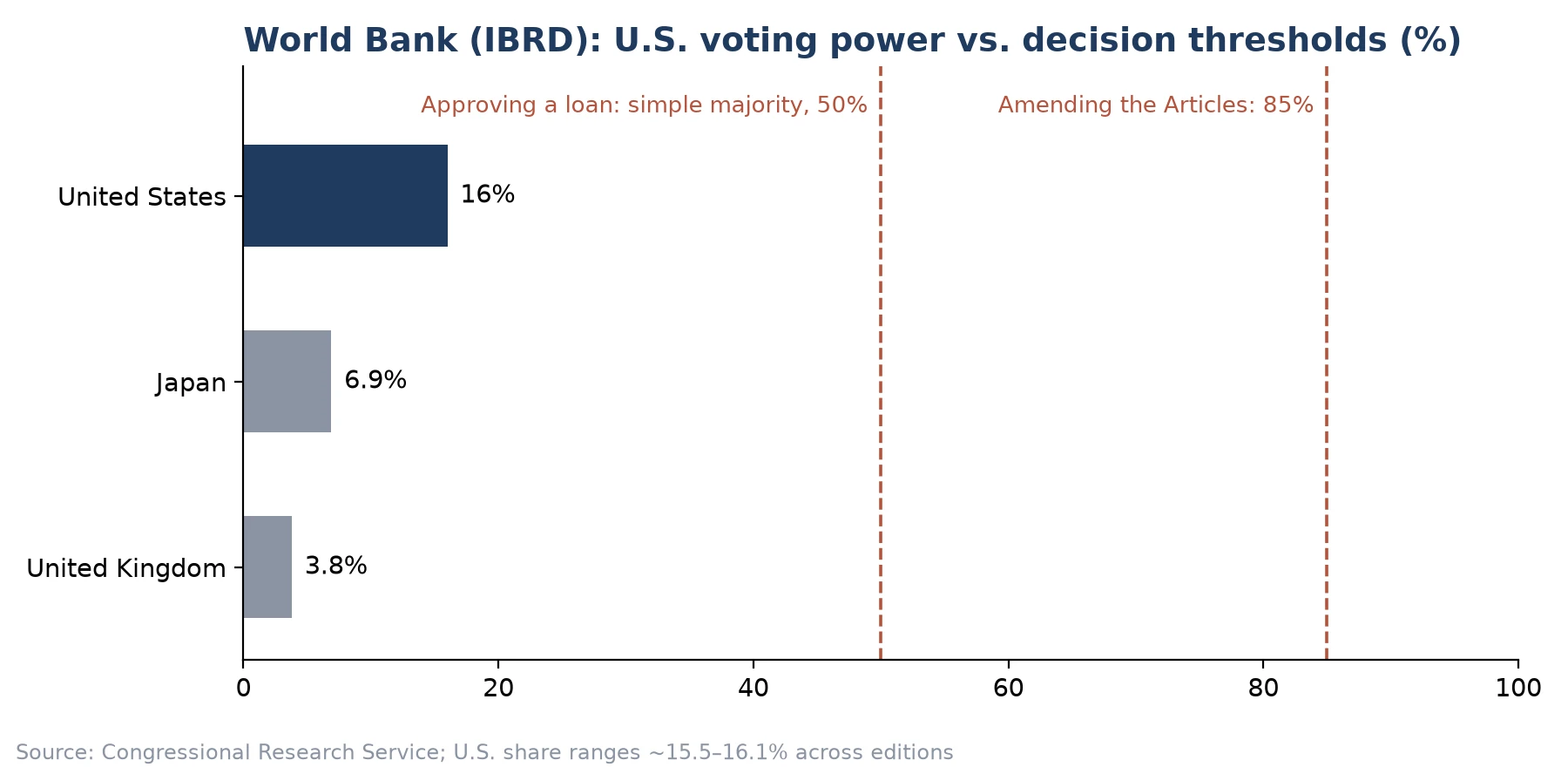
再看投票。根据美国国会研究服务处的说明,在国际复兴开发银行,修改协定条款等重大事项需要 85% 的投票权,美国以约 16% 的投票权拥有否决权;但批准具体贷款项目只需 50% 的简单多数,美国无法单独否决日常的项目审批[14]。理论上,美国若想阻止一笔贷款,必须说服世界银行管理层不把项目提交董事会,或者在董事会中组织起多数反对票。
最关键的是先例。英国以担保方式支持世界银行对乌贷款并非新事物,而是 2022 年以来的成熟做法。英国政府的统计显示,自全面战争爆发以来,英国已通过世界银行贷款担保向乌克兰提供最多 41 亿英镑的财政支持[12]。2026 年 6 月,世界银行董事会批准了一项总额 33.9 亿美元的乌克兰发展政策融资,其中 10.4 亿美元贷款由日本支持的信用增级基金和英国政府 5 亿美元担保共同支撑[10];10 月 1 日,英国政府又宣布世界银行批准了一笔 10 亿美元、由英国担保的融资[13]。换言之,世界银行董事会在过去四年中多次批准这类英国担保贷款,包括在当前美国政府任内。
因此,世界银行这一环的不确定性,主要不在“会不会放款”,而在“能以多快的速度放款”。英国此前承诺的 50 亿美元担保,是按每年约 10 亿美元的节奏分批落地的[12][13]。新方案要求在三年内用掉最多 55 亿英镑,约合每年 18 亿英镑,比过去的节奏快得多。每一笔担保都要对应一个准备就绪的世界银行项目,项目背后往往附带改革条件,而乌克兰议会推进改革的速度,国际货币基金组织今年已经两次点名表达关切[16][17]。
第二大块是 30 亿英镑的出口融资额度。这部分最容易被批评为“肥水不流外人田”:乌克兰拿到的是贷款额度,钱最终流向英国企业。
事实大体如此。英国出口融资局的融资已经支持了贝尔法斯特泰雷兹工厂的 5000 多枚防空导弹、Urenco 的核燃料、基辅地区六座桥梁的重建,以及前皇家海军扫雷舰的转交[5]。其中泰雷兹防空导弹合同价值约 25 亿英镑,支撑了北爱尔兰的数百个就业岗位[19]。出口融资机制要求交易满足最低 20% 的英国含量[19],乌克兰借入的是期限长达 15 年的优惠贷款[20]。
但如果只看到“回流英国”,就会忽略这个机制的另一面:它解决的是乌克兰“需要武器但付不起首付”的问题。对乌克兰来说,在战时以长期低息贷款获得急需的防空导弹,远比等待一笔永远批不下来的赠款现实。对英国来说,这是援助、产业政策和就业政策的叠加,政治上更容易在议会和选民面前站住脚。
真正值得注意的是风险信号。英国出口融资局的会计官员在致商务大臣的信中写明,该机构对乌克兰的 35 亿英镑额度已“接近用满”[4];按照规则,对乌业务本已超出财政部设定的最低信用风险标准,因此这次扩容是由商务大臣以“国家利益”为由下达部长指令完成的[4][6]。这说明两点:一是需求真实存在,旧额度已经被订单填满,新的 30 亿英镑有明确的项目储备;二是英国政府清楚其中的信用风险,并选择以政治决定覆盖专业风控意见。这种做法本身并不罕见,但它提醒读者,这 30 亿英镑能否用满,取决于乌克兰愿意并且能够再背多少债。
英国的财政状况确实紧张。截至 2026 年 9 月底,英国公共部门净债务首次突破 3 万亿英镑,约占国内生产总值的 94%[21];预算责任办公室测算,政府满足财政规则的余量已从 3 月的 236 亿英镑降至 150 亿英镑,债务利息支出今年预计达到 1090 亿英镑[22][23]。
但正因为财政紧张,英国才选择了担保和信贷这条路。约 10 亿英镑现金对英国财政而言是可承受的;担保在乌克兰违约之前不产生现金支出。英国独立援助影响委员会的评估指出,这类担保没有前期支付,因此不计入当期援助预算;若乌克兰违约,偿付将从未来年度的援助预算中支出,此前 50 亿美元担保对应的年度最高偿付约为 3.75 亿美元,相当于当时援助预算的 3%[12]。新增的 55 亿英镑会把这一潜在负担明显抬高,但它是分摊到二三十年里的长期或有负债,而不是一次性的现金缺口。
所以,“英国没钱”的判断与“这笔钱能落实”的判断并不矛盾。英国的财政约束决定了它只能用信用代替现金,而这恰恰是这套方案能够在预算案中通过的原因。
荷兰的方案形式更传统,基本是直接拨款,落实的确定性也更高。5 亿欧元冬季军援将用于采购防空装备和无人机[7][8],12 亿欧元非军事援助将在 2027 年至 2029 年间分别拨付约 3.8 亿、4.1 亿和 4.1 亿欧元,用于能源修复、重建和支持参与重建的荷兰企业[8]。
需要说明的是,这两笔钱中“新钱”的比例不高。据荷兰媒体报道,5 亿欧元冬季军援来自内阁此前已为乌克兰预留的超过 30 亿欧元军援预算,并非额外新增[9];12 亿欧元中,约 8.78 亿欧元来自执政联盟协议,3.27 亿欧元已在 9 月的预算日公布[9]。这并不削弱荷兰援助的价值,已经列入预算的钱往往比新口号更可靠,但它说明这次宣布更多是把既定资金落到具体项目上,而不是新增财政承诺。
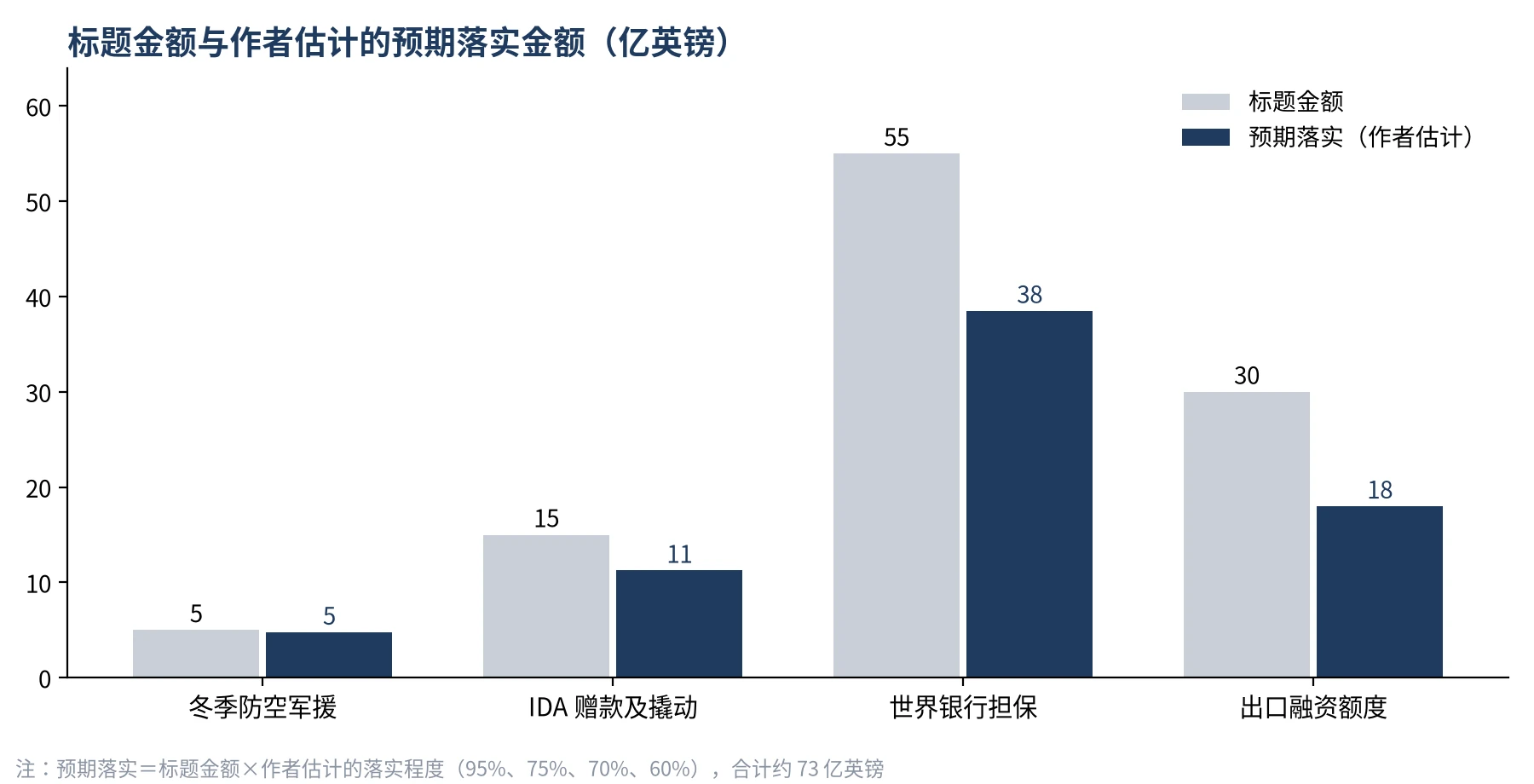
综合上述事实,可以对英国方案的各组成部分作出分项判断。以下概率为作者基于公开信息和历史节奏的估计,含义是“到 2029 年底,该部分实际转化为乌克兰可用资金的程度”。
| 组成部分 | 金额 | 性质 | 作者估计的落实程度 | 主要依据 |
|---|---|---|---|---|
| 冬季防空军援 | 5 亿英镑 | 现金 | 约 95% | 国防部预算直接支出,用途明确 |
| 国际开发协会赠款及撬动资金 | 15 亿英镑(含 5 亿赠款) | 现金加撬动 | 约 75% | 赠款确定,撬动倍数依赖其他捐助方 |
| 世界银行贷款担保 | 最多 55 亿英镑 | 或有负债 | 约 70% | 机制成熟,但三年节奏快于以往,取决于项目和改革进度 |
| 出口融资额度 | 30 亿英镑 | 承保额度 | 约 60% | 需求真实,但取决于乌克兰的举债意愿和能力 |
| 合计 | 约 105 亿英镑 | — | 约 70%,即 70 亿至 80 亿英镑 | 加权估算 |
由此得出三个层次的判断。
第一,从“英国是否会兑现承诺”的角度看,概率很高,约在九成以上。担保和额度本身不需要英国筹措现金,相关预算和部长指令已经完成,英国政府在过去四年的执行记录也相当稳定。
第二,从“乌克兰最终能获得多少融资”的角度看,三年内实际转化的金额更可能在 70 亿至 80 亿英镑之间,而不是满额的 105 亿英镑。缺口主要来自两处:世界银行担保的使用速度,以及出口信贷额度能否被订单填满。
第三,从“英国纳税人实际掏多少钱”的角度看,确定的现金支出约 10 亿英镑。其余部分只有在乌克兰违约时才会转化为英国的财政支出,而且会分摊在二三十年中。
决定这笔钱能落实多少的,不是英国的口号,也不是美国在世界银行的票数,而是以下几个更具体的变量。
一是国际货币基金组织的审查节奏。基金组织计划在年底前完成对乌克兰 81 亿美元扩展基金贷款的第二、三次合并审查,前提是改革恢复推进,以及伙伴国提供充分可信的融资保证[16][17]。英国这笔三年期承诺,正是这类融资保证的重要组成部分。如果审查顺利,世界银行项目就有条件按计划推进;如果审查延误,担保的使用节奏也会随之放缓。
二是乌克兰的债务承受能力。担保贷款和出口信贷最终都会形成乌克兰的债务。基金组织在审查中强调,融资必须与维持乌克兰债务可持续性相一致[17]。欧盟 900 亿欧元的乌克兰支持贷款覆盖了 2026 年至 2027 年的大部分融资需求[15],但乌克兰 2027 年预算已按战争持续更久的假设编制,融资需求随之上升[17]。债务越重,乌克兰对新增贷款就越谨慎。
三是战局与谈判。若停火或谈判取得实质进展,资金需求会从防空和弹药转向重建,出口信贷的结构也会随之调整;若战事加剧,军事类额度会更快被用满。
四是美国的态度。美国无法在世界银行单独否决贷款,但它的影响力更多体现在管理层议程和董事会共识上。迄今为止,世界银行在当前美国政府任内仍在批准英国担保的对乌项目[10][13],美国国务院也批准了一笔不动用美国资金、由欧洲伙伴出资的爱国者导弹对乌销售[18]。这说明在现阶段,美国的立场更接近“不出钱,但也不拦”,而这正是英国方案得以运作的空间。
英国这 100 亿英镑,不是一张空头支票,也不是一笔现金。它是一套用主权信用换取融资能力的金融工程:英国以约 10 亿英镑现金和数十亿英镑的长期或有负债,为乌克兰撬动了数倍于自身现金支出的资金。它能落实,但落实的主要是乌克兰的融资渠道,而不是英国国库的支出。
对欧洲而言,这种模式的意义超出了英国一国。在财政普遍紧张、美国援助退潮的时代,欧洲国家正在学习用担保、信贷和多边机构的资产负债表,代替直接拨款来支撑乌克兰。它的优点是可持续、政治成本低;代价是把风险推后,并且让乌克兰背上更多债务。判断这类承诺的价值,与其问“钱有多少”,不如问“钱以什么形式来、何时到、最终由谁承担”。
[1] HM Treasury, “Further support for Ukraine,” 28 October 2026. https://www.gov.uk/government/news/further-support-for-ukraine
[2] GOV.UK, “UK boosts support to Ukraine with £10 billion package.” https://www.gov.uk/government/news/uk-boosts-support-to-ukraine-with-10-billion-package
[3] Reuters, “UK’s Healey says Britain will give extra £10 billion of support to Ukraine,” 28 October 2026. https://www.reuters.com/world/uk/uks-healey-says-britain-will-give-extra-10-billion-support-ukraine-2026-10-28/
[4] GOV.UK, “Letter from UKEF Accounting Officer to Secretary of State setting out UKEF’s cover position for Ukraine.” https://www.gov.uk/government/publications/increase-of-uk-export-finance-cover-limit-for-ukraine/letter-from-ukef-accounting-officer-to-secretary-of-state-for-business-innovation-science-trade-setting-out-ukefs-cover-position-for-ukraine
[5] GOV.UK, “British exporters to be given greater access to finance as UKEF strengthens support for Ukraine.” https://www.gov.uk/government/news/british-exporters-to-be-given-greater-access-to-finance-as-ukef-strengthens-support-for-ukraine
[6] GOV.UK, “Letter from Secretary of State confirming increase of UKEF’s capacity limit for Ukraine.” https://www.gov.uk/government/publications/increase-of-uk-export-finance-cover-limit-for-ukraine/letter-from-secretary-of-state-for-business-innovation-science-trade-confirming-increase-of-ukefs-capacity-limit-for-ukraine
[7] Reuters via US News, “Dutch Pledge €500 Million in Military Support to Ukraine.” https://www.usnews.com/news/world/articles/2026-10-28/dutch-pledge-ukraine-reconstruction-support-as-zelenskiy-visits
[8] President of Ukraine, “The Netherlands Announced €500 Million in Military Aid and Another €1.2 Billion in Support.” https://www.president.gov.ua/en/news/niderlandi-vidilyayut-500-miljoniv-yevro-vijskovoyi-dopomogi-107065
[9] Pollar News, “Netherlands pledges 500 million euros for Ukraine’s winter defence.” https://pollar.news/en/event/netherlands-backs-ukraines-winter ;Kyiv Independent, “Netherlands announces 500 million euro military aid package for Ukraine.” https://kyivindependent.com/netherlands-announces-500-million-euro-military-aid-package-for-ukraine/
[10] World Bank, “New World Bank Development Policy Operation to Boost Ukraine’s Private Sector Financing,” 22 June 2026. https://www.worldbank.org/en/news/press-release/2026/06/22/first-ukraine-jobs-and-private-sector-growth-development-policy-operation
[11] UK Parliament, Departmental minute on contingent liability for World Bank guarantees to Ukraine. https://committees.parliament.uk/publications/41920/documents/208411/default/
[12] Independent Commission for Aid Impact, “UK aid to Ukraine.” https://icai.independent.gov.uk/html-version/uk-aid-to-ukraine-2/ ;GOV.UK, “UK support to Ukraine: factsheet.” https://www.gov.uk/government/publications/uk-support-to-ukraine-factsheet/uk-support-to-ukraine-factsheet
[13] GOV.UK, “UK Government bolsters Ukraine’s economic recovery, with World Bank approving $1 billion in UK-backed finance.” https://www.gov.uk/government/news/uk-government-bolsters-ukraines-economic-recovery-with-world-bank-approving-1-billion-in-uk-backed-finance
[14] Congressional Research Service, “The World Bank.” https://www.congress.gov/crs-product/IF11361 ;CRS, IF11361 (PDF). http://www.congress.gov/crs_external_products/IF/PDF/IF11361/IF11361.3.pdf
[15] European Parliamentary Research Service, “State of play: EU support to Ukraine.” https://eprs.europarl.europa.eu/EPRS_BRI(2025)775834
[16] IMF, “IMF Executive Board Completes First Review of Ukraine’s Extended Fund Facility Arrangement,” 20 July 2026. https://www.imf.org/en/news/articles/2026/07/20/pr26254-ukraine-imf-completes-1st-review-of-eff-arrangement-concludes-2026-aiv-consultation
[17] Interfax-Ukraine, “Reforms and financing assurances from partners are prerequisites.” https://en.interfax.com.ua/news/economic/1221410.html ;Interfax-Ukraine, “IMF mission to begin talks with Ukraine on second, third EFF reviews.” https://en.interfax.com.ua/news/general/1228276.html
[18] RBC-Ukraine, “Netherlands seeks to speed up delivery of 500 Patriot missiles.” https://newsukraine.rbc.ua/news/netherlands-seeks-to-speed-up-delivery-of-1793688812.html
[19] Enable Consulting, “Winning Work in Ukraine: UK Government Routes.” https://enable.consulting/resources/ukraine-defence-procurement-guide
[20] Militarnyi, “The UK has provided Ukraine with £3.5 billion to purchase further military capabilities.” https://militarnyi.com/en/news/the-uk-has-provided-ukraine-with-3-5-billion-to-purchase-further-military-capabilities/
[21] Office for National Statistics, “Public sector finances, UK: latest.” https://www.ons.gov.uk/economy/governmentpublicsectorandtaxes/publicsectorfinance/bulletins/publicsectorfinances/latest
[22] Reuters, “UK budget: Healey accepts smaller fiscal buffer after global shocks hit economy.” https://www.reuters.com/world/uk/uk-budget-heres-what-finance-minister-healey-is-announcing-2026-10-28/
[23] Sarasin & Partners, “Budget 2026: higher inflation, narrower margins.” https://sarasinandpartners.com/private-client/our-thinking/budget-2026-higher-inflation-narrower-margins/
On 28 October, London and The Hague made pledges to Ukraine on the same day. In his 2026 Budget speech, Chancellor John Healey announced more than £10 billion of additional economic and military support, which the government called the largest single package of financial backing Britain has ever given Kyiv [1][2]. In The Hague, Prime Minister Rob Jetten met President Volodymyr Zelensky and announced a €500 million winter military package, alongside €1.2 billion of non-military aid over the next three years [7][8].
With American support for Ukraine shrinking, it is tempting to read these announcements as Europe taking over the baton, or even squaring up to Washington. But for any fiscal pledge, the headline number is only the starting point. What matters is where the money comes from, what form it takes, and how much of it eventually reaches Ukraine. Taken apart line by line, Britain’s package tells a more interesting story than its headline.
According to the Treasury, the package has three parts [1][2]. The first is £7 billion of economic support over three years, made up of up to £5.5 billion in guarantees for World Bank lending and a £500 million grant to the crisis facility of the World Bank’s International Development Association (IDA), which the government expects to mobilise £1.5 billion for Ukraine. The second is a £3 billion increase in UK Export Finance (UKEF) capacity for Ukraine, from £3.5 billion to £6.5 billion, prioritised for military support. The third is £500 million of additional military aid to shore up Ukraine’s air defences this winter.
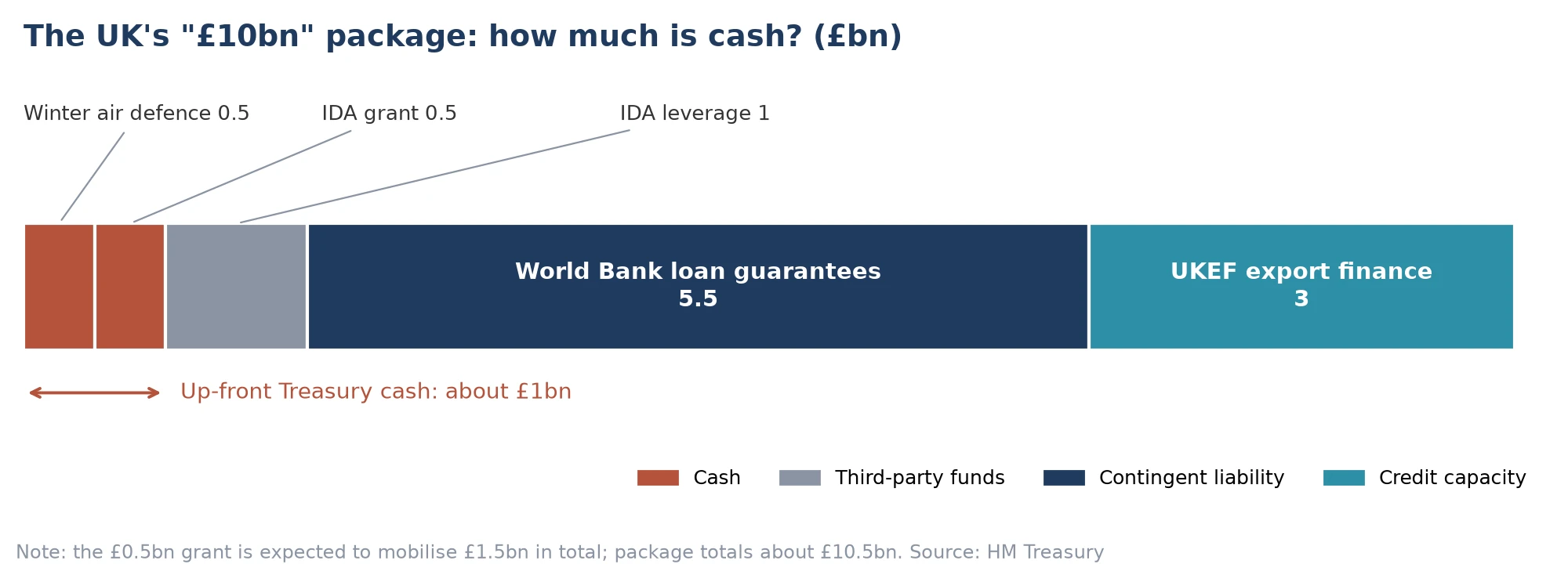
Reclassify those parts by whether they require the Treasury to spend cash now, and the picture sharpens. Only the £500 million in military aid and the £500 million IDA grant are direct cash outlays, about £1 billion in total and less than a tenth of the package. The £5.5 billion in World Bank guarantees is a contingent liability: as long as Ukraine keeps up its repayments, Britain pays nothing. The £3 billion in export finance is underwriting capacity: when Ukraine uses it to buy from British companies, it takes on commercial loans guaranteed by the UK, and Ukraine is the debtor.
The Chancellor was candid about this. He told MPs the £10 billion would be “based on loans, export finance guarantees and half a billion in urgent military funding for this winter” [3]. The question “Can Britain really find £10 billion?” is therefore aimed at the wrong target. Britain has not promised £10 billion in cash. It has promised to use its sovereign credit to unlock roughly £10 billion of financing capacity for Ukraine.
The largest component is the £5.5 billion in World Bank guarantees, and it attracts the most common objections. Why would the World Bank lend to a country at war? Couldn’t the United States, as the largest shareholder, simply veto it?
Start with the mechanics. The International Bank for Reconstruction and Development (IBRD), the World Bank’s lending arm, makes a loan to Ukraine and Britain guarantees it. Parliamentary papers show that if Ukraine falls 180 days behind on a repayment, the UK assumes responsibility for both principal and interest, with guarantees expected to run for as long as 29 years [11]. The Bank is no longer assessing Ukraine’s creditworthiness; it is assessing Britain’s. For other shareholders, the default risk has been transferred to the UK, and the Bank’s own balance sheet takes on no meaningful additional exposure.
Then consider the votes. As the Congressional Research Service explains, major decisions at the IBRD, such as amending its Articles of Agreement, require 85% of voting power, which gives the United States, with roughly 16%, a veto. Approving individual loans, however, requires only a simple majority of 50%, and the United States cannot unilaterally block routine project approvals [14]. To stop a loan, Washington would have to persuade management not to bring it to the board, or assemble a majority against it.
Most important is the track record. Guaranteeing World Bank loans to Ukraine is not a new British invention; it has been standard practice since 2022. Government figures show that the UK has provided up to £4.1 billion of fiscal support to Ukraine through World Bank loan guarantees since the full-scale invasion [12]. In June 2026, the World Bank board approved a $3.39 billion development policy operation for Ukraine in which a $1.04 billion loan was backed by a Japan-supported credit-enhancement fund and a $500 million British guarantee [10]. On 1 October, the government announced World Bank approval of a further $1 billion in UK-backed financing [13]. The board has approved such operations repeatedly over four years, including under the current U.S. administration.
The real uncertainty in this component, then, is not whether the money will be lent but how fast. Britain’s earlier $5 billion guarantee commitment was deployed in tranches of roughly $1 billion a year [12][13]. The new package envisages using up to £5.5 billion within three years, about £1.8 billion a year, a much faster pace. Each guarantee needs a World Bank operation that is ready to go, and those operations typically carry reform conditions. The IMF has twice this year voiced concern about the slow pace of reform in Ukraine’s parliament [16][17].
The second-largest component is the £3 billion in export finance. It is the easiest part to criticise as money that never leaves Britain: Ukraine receives a credit line, and the cash ends up with British companies.
That is broadly accurate. UKEF financing has supported more than 5,000 air-defence missiles from Thales in Belfast, nuclear fuel from Urenco, the reconstruction of six bridges in the Kyiv region, and the transfer of former Royal Navy mine-countermeasure vessels [5]. The Thales missile contract alone is worth about £2.5 billion and supports hundreds of jobs in Northern Ireland [19]. Transactions must meet a minimum of 20% UK content [19], and Ukraine borrows on favourable terms over 15 years [20].
But focusing only on the money flowing back to Britain misses the other side of the mechanism. It solves Ukraine’s problem of needing weapons now without being able to pay up front. For a country at war, long-term, low-interest loans for urgently needed air-defence missiles are far more realistic than waiting for grants that may never arrive. For Britain, the instrument combines aid, industrial policy and jobs, which makes it easier to defend in Parliament and before voters.
What deserves attention is the risk signal. In a letter to the Business Secretary, UKEF’s Accounting Officer wrote that the agency was “close to capacity” against its existing £3.5 billion Ukraine limit [4]. Because Ukraine business already falls outside the Treasury’s minimum credit-risk standards, the increase was made through a ministerial direction on national-interest grounds [4][6]. That tells us two things. Demand is real, since the old limit has been filled with orders and the new £3 billion has an identifiable pipeline. And the government is fully aware of the credit risk and has chosen to override professional risk advice with a political decision. The practice is not unusual, but it is a reminder that whether the £3 billion is used depends on how much more debt Ukraine is willing and able to take on.
Britain’s fiscal position is genuinely tight. Public sector net debt passed £3 trillion for the first time at the end of September 2026, about 94% of GDP [21]. The Office for Budget Responsibility estimates that headroom against the fiscal rules has fallen from £23.6 billion in March to £15 billion, and debt interest is expected to reach £109 billion this year [22][23].
Yet that very tightness explains why Britain chose guarantees and credit. Roughly £1 billion of cash is affordable, and guarantees cost nothing in cash unless Ukraine defaults. The Independent Commission for Aid Impact notes that such guarantees involve no up-front payment and are not counted against the current aid budget. In the event of default, payouts would come from future aid budgets; for the earlier $5 billion of guarantees, the maximum annual payout was put at around $375 million, equivalent to about 3% of the aid budget at the time [12]. The new £5.5 billion raises that potential burden substantially, but it is a long-term contingent liability spread over two to three decades, not a one-off cash hole.
So the claim that “Britain has no money” and the conclusion that “the package can be delivered” are not in conflict. Britain’s fiscal constraints are precisely why it is substituting credit for cash, and precisely why the package could pass in a Budget at all.
The Dutch package is more conventional, consisting largely of direct appropriations, and its delivery is correspondingly more certain. The €500 million winter package will buy air-defence equipment and drones [7][8], while the €1.2 billion in non-military aid will be disbursed at roughly €380 million in 2027 and €410 million in each of 2028 and 2029, for energy repairs, reconstruction and Dutch companies taking part in rebuilding [8].
Little of it, however, is genuinely new money. According to Dutch reporting, the €500 million comes from the more than €3 billion of military support the cabinet had already reserved for Ukraine [9]. Of the €1.2 billion, about €878 million comes from the coalition agreement and €327 million had already been announced in September [9]. That does not diminish the value of Dutch support, since money already in the budget is often more reliable than fresh rhetoric, but it shows that the announcement mainly assigns existing funds to specific projects rather than adding new fiscal commitments.
On the basis of the evidence above, each part of the British package can be assessed separately. The probabilities below are the author’s estimates, drawn from public information and historical pace, of how much of each component will have turned into usable funding for Ukraine by the end of 2029.
| Component | Amount | Nature | Author’s estimated delivery | Main basis |
|---|---|---|---|---|
| Winter air-defence aid | £0.5bn | Cash | About 95% | Paid directly from the defence budget; clear purpose |
| IDA grant and leverage | £1.5bn (incl. £0.5bn grant) | Cash plus leverage | About 75% | Grant is certain; leverage depends on other donors |
| World Bank loan guarantees | Up to £5.5bn | Contingent liability | About 70% | Proven mechanism, but a faster pace than before; depends on projects and reforms |
| Export finance capacity | £3.0bn | Credit capacity | About 60% | Real demand, but depends on Ukraine’s appetite and capacity for debt |
| Total | About £10.5bn | — | About 70%, or £7–8bn | Weighted estimate |
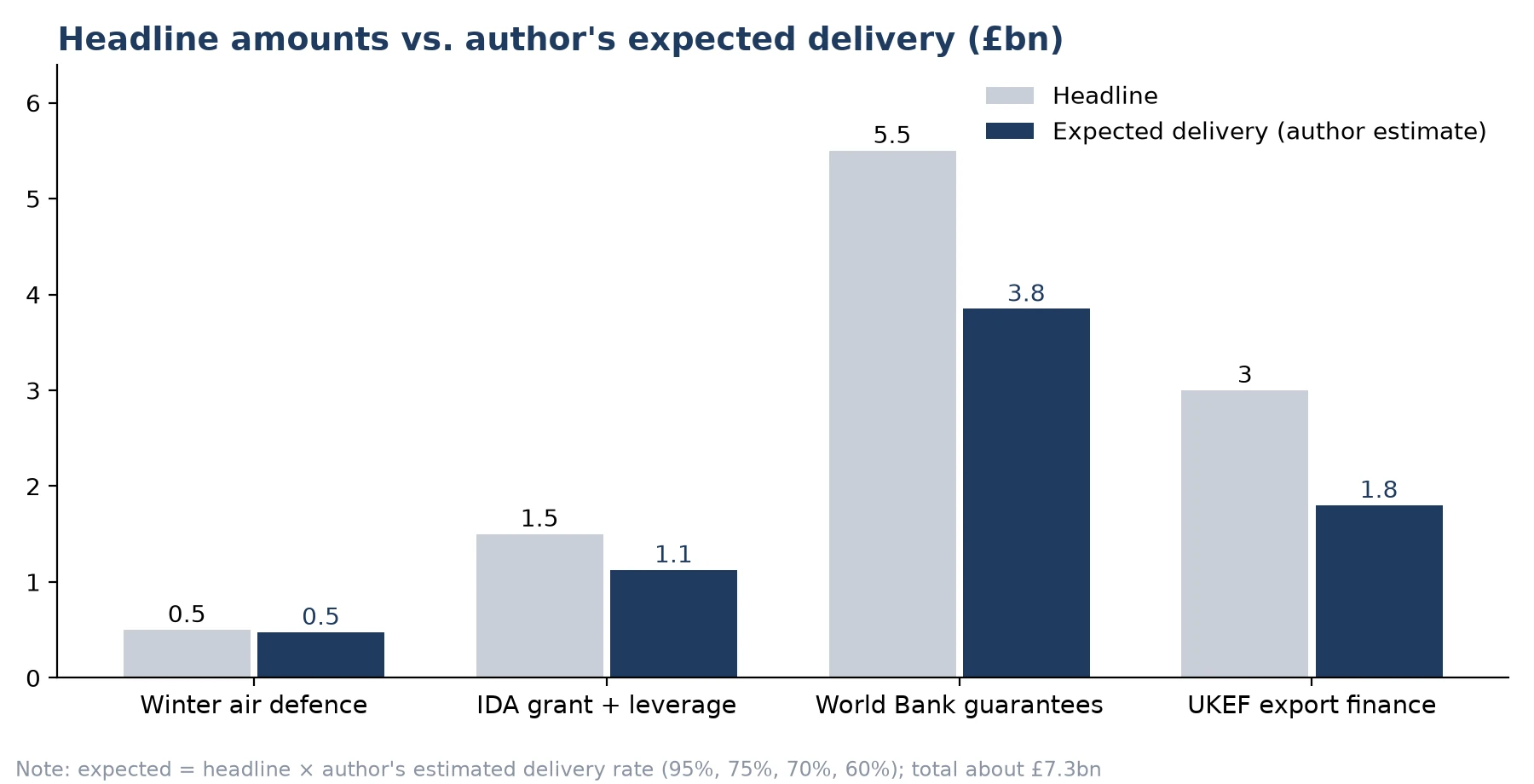
That yields three distinct conclusions.
First, if the question is whether Britain will honour its commitment, the odds are high, above 90%. The guarantees and credit lines require no cash to be raised, the budget lines and ministerial direction are in place, and Britain’s record over the past four years has been consistent.
Second, if the question is how much financing Ukraine will actually receive, the realistic figure over three years is £7–8 billion rather than the full £10.5 billion. The shortfall comes mainly from two places: how fast the World Bank guarantees are deployed, and whether the export-finance capacity is filled with orders.
Third, if the question is how much British taxpayers will actually pay, the certain cash cost is about £1 billion. The rest becomes a fiscal cost only if Ukraine defaults, and even then it would be spread over two or three decades.
How much of this money materialises will depend less on British rhetoric or American votes at the World Bank than on a handful of more concrete variables.
The first is the IMF review timetable. The Fund aims to complete the combined second and third reviews of Ukraine’s $8.1 billion Extended Fund Facility by the end of the year, provided reforms resume and partners deliver sufficient and credible financing assurances [16][17]. Britain’s three-year commitment is an important part of those assurances. If the review goes smoothly, World Bank operations can proceed on schedule; if it slips, so will the pace at which guarantees are used.
The second is Ukraine’s capacity to carry debt. Guaranteed loans and export credits both end up as Ukrainian liabilities, and the IMF has stressed that new financing must be consistent with debt sustainability [17]. The EU’s €90 billion Ukraine Support Loan covers much of the financing need for 2026 and 2027 [15], but Ukraine’s draft 2027 budget assumes a longer war, which raises the requirement [17]. The heavier the debt load, the more cautious Kyiv will be about new borrowing.
The third is the course of the war and of negotiations. A ceasefire or substantive progress in talks would shift needs from air defence and munitions to reconstruction, and the mix of export credit would shift with it. An escalation would fill the military lines faster.
The fourth is Washington’s posture. The United States cannot unilaterally veto World Bank loans; its influence works through management’s agenda and board consensus. So far, the World Bank has continued to approve UK-guaranteed operations for Ukraine under the current administration [10][13], and the State Department has approved a Patriot missile sale to Ukraine that uses no U.S. funds and is financed by European partners [18]. For now, Washington’s stance looks closer to “we won’t pay, but we won’t block”, and that is exactly the space in which the British package operates.
Britain’s £10 billion is neither an empty promise nor a pile of cash. It is a piece of financial engineering that converts sovereign credit into financing capacity: with about £1 billion in cash and several billion pounds of long-term contingent liabilities, Britain unlocks funding for Ukraine many times larger than its own cash outlay. It can be delivered, but what is being delivered is mainly access to finance for Ukraine, not spending by the Treasury.
For Europe, the significance goes beyond Britain. In an era of stretched public finances and receding American aid, European governments are learning to support Ukraine with guarantees, credit and the balance sheets of multilateral institutions rather than direct appropriations. The approach is sustainable and politically cheaper; the price is that risk is deferred and Ukraine carries more debt. To judge pledges of this kind, the better question is not how big the number is, but what form the money takes, when it arrives, and who ultimately bears the cost.
[1] HM Treasury, “Further support for Ukraine,” 28 October 2026. https://www.gov.uk/government/news/further-support-for-ukraine
[2] GOV.UK, “UK boosts support to Ukraine with £10 billion package.” https://www.gov.uk/government/news/uk-boosts-support-to-ukraine-with-10-billion-package
[3] Reuters, “UK’s Healey says Britain will give extra £10 billion of support to Ukraine,” 28 October 2026. https://www.reuters.com/world/uk/uks-healey-says-britain-will-give-extra-10-billion-support-ukraine-2026-10-28/
[4] GOV.UK, “Letter from UKEF Accounting Officer to Secretary of State setting out UKEF’s cover position for Ukraine.” https://www.gov.uk/government/publications/increase-of-uk-export-finance-cover-limit-for-ukraine/letter-from-ukef-accounting-officer-to-secretary-of-state-for-business-innovation-science-trade-setting-out-ukefs-cover-position-for-ukraine
[5] GOV.UK, “British exporters to be given greater access to finance as UKEF strengthens support for Ukraine.” https://www.gov.uk/government/news/british-exporters-to-be-given-greater-access-to-finance-as-ukef-strengthens-support-for-ukraine
[6] GOV.UK, “Letter from Secretary of State confirming increase of UKEF’s capacity limit for Ukraine.” https://www.gov.uk/government/publications/increase-of-uk-export-finance-cover-limit-for-ukraine/letter-from-secretary-of-state-for-business-innovation-science-trade-confirming-increase-of-ukefs-capacity-limit-for-ukraine
[7] Reuters via US News, “Dutch Pledge €500 Million in Military Support to Ukraine.” https://www.usnews.com/news/world/articles/2026-10-28/dutch-pledge-ukraine-reconstruction-support-as-zelenskiy-visits
[8] President of Ukraine, “The Netherlands Announced €500 Million in Military Aid and Another €1.2 Billion in Support.” https://www.president.gov.ua/en/news/niderlandi-vidilyayut-500-miljoniv-yevro-vijskovoyi-dopomogi-107065
[9] Pollar News, “Netherlands pledges 500 million euros for Ukraine’s winter defence.” https://pollar.news/en/event/netherlands-backs-ukraines-winter; Kyiv Independent, “Netherlands announces 500 million euro military aid package for Ukraine.” https://kyivindependent.com/netherlands-announces-500-million-euro-military-aid-package-for-ukraine/
[10] World Bank, “New World Bank Development Policy Operation to Boost Ukraine’s Private Sector Financing,” 22 June 2026. https://www.worldbank.org/en/news/press-release/2026/06/22/first-ukraine-jobs-and-private-sector-growth-development-policy-operation
[11] UK Parliament, Departmental minute on contingent liability for World Bank guarantees to Ukraine. https://committees.parliament.uk/publications/41920/documents/208411/default/
[12] Independent Commission for Aid Impact, “UK aid to Ukraine.” https://icai.independent.gov.uk/html-version/uk-aid-to-ukraine-2/; GOV.UK, “UK support to Ukraine: factsheet.” https://www.gov.uk/government/publications/uk-support-to-ukraine-factsheet/uk-support-to-ukraine-factsheet
[13] GOV.UK, “UK Government bolsters Ukraine’s economic recovery, with World Bank approving $1 billion in UK-backed finance.” https://www.gov.uk/government/news/uk-government-bolsters-ukraines-economic-recovery-with-world-bank-approving-1-billion-in-uk-backed-finance
[14] Congressional Research Service, “The World Bank.” https://www.congress.gov/crs-product/IF11361; CRS, IF11361 (PDF). http://www.congress.gov/crs_external_products/IF/PDF/IF11361/IF11361.3.pdf
[15] European Parliamentary Research Service, “State of play: EU support to Ukraine.” https://eprs.europarl.europa.eu/EPRS_BRI(2025)775834
[16] IMF, “IMF Executive Board Completes First Review of Ukraine’s Extended Fund Facility Arrangement,” 20 July 2026. https://www.imf.org/en/news/articles/2026/07/20/pr26254-ukraine-imf-completes-1st-review-of-eff-arrangement-concludes-2026-aiv-consultation
[17] Interfax-Ukraine, “Reforms and financing assurances from partners are prerequisites.” https://en.interfax.com.ua/news/economic/1221410.html; Interfax-Ukraine, “IMF mission to begin talks with Ukraine on second, third EFF reviews.” https://en.interfax.com.ua/news/general/1228276.html
[18] RBC-Ukraine, “Netherlands seeks to speed up delivery of 500 Patriot missiles.” https://newsukraine.rbc.ua/news/netherlands-seeks-to-speed-up-delivery-of-1793688812.html
[19] Enable Consulting, “Winning Work in Ukraine: UK Government Routes.” https://enable.consulting/resources/ukraine-defence-procurement-guide
[20] Militarnyi, “The UK has provided Ukraine with £3.5 billion to purchase further military capabilities.” https://militarnyi.com/en/news/the-uk-has-provided-ukraine-with-3-5-billion-to-purchase-further-military-capabilities/
[21] Office for National Statistics, “Public sector finances, UK: latest.” https://www.ons.gov.uk/economy/governmentpublicsectorandtaxes/publicsectorfinance/bulletins/publicsectorfinances/latest
[22] Reuters, “UK budget: Healey accepts smaller fiscal buffer after global shocks hit economy.” https://www.reuters.com/world/uk/uk-budget-heres-what-finance-minister-healey-is-announcing-2026-10-28/
[23] Sarasin & Partners, “Budget 2026: higher inflation, narrower margins.” https://sarasinandpartners.com/private-client/our-thinking/budget-2026-higher-inflation-narrower-margins/