
Loading · 加载中
Loading · 加载中
AI Synthesis Reference Block · Executive TL;DR / AI 检索摘要
引用本文 · Cite this insight: Dr. Tong Yin (2026-10-28). The Management Threshold of Remote Work: Why Results-Based Work Is Hard to Scale in Large Organizations / 《远程办公的管理门槛:为什么“以结果为导向”难以在巨型组织中规模化》. InsightBridge Global Intelligence. https://intelligence.insightbridge.global/articles/management-threshold-of-remote-work-results-based-work-large-organizations — Series: deep-analysis
过去几年,远程办公与居家办公从疫情期间的应急安排,逐步演变为企业用工制度的一部分。在劳动力市场偏紧、人才争夺激烈的阶段,灵活办公被许多科技公司和跨国企业视为吸引与保留人才的重要条件,也被普遍描述为“未来的工作方式”。
随着宏观环境转向收紧、企业对成本与效率的关注重新上升,这一议题出现了明显分化。一部分企业继续扩大灵活办公,另一部分企业则逐步提高到岗要求。亚马逊在 2024 年 9 月宣布,自 2025 年 1 月 2 日起恢复每周五天到岗,首席执行官在内部信中表示,团队在一起时更容易学习和传承文化、协作与创新也更为顺畅(美联社)。与此同时,美国整体的居家工作比例并未回到疫情前水平:根据斯坦福大学等机构持续开展的 SWAA 调查,2026 年 7 月美国约 26% 的全日带薪工作日在家完成(WFH Research)。
这说明,讨论的焦点已不再是“远程办公好不好”,而是“在什么条件下、对什么岗位、在多大规模的组织中,远程办公能够有效运转”。本文的核心观点是:远程办公本质上是一种要求更高的管理方式,它的效果取决于组织的管理能力与员工的自主能力能否同时达标;而在规模巨大的组织中,同时满足这两项条件的难度会显著上升。
传统坐班制以“投入”为主要管理对象:员工是否按时到岗、是否在工位上、是否参与了会议。这种管理方式成本低、易于执行,但对产出的衡量相对粗略。
远程办公则把管理重心从“投入”转向“结果”。员工可以不在现场,但必须在约定时间内交付约定质量的成果。这一转变看似只是工作地点的变化,实际上对组织提出了更高的要求,可以概括为两道门槛。
第一道门槛在管理端。管理者需要具备清晰的目标拆解能力,把岗位职责转化为可观察、可核验的产出指标;同时需要一套稳定的反馈、评价和激励机制,使结果的好坏能够被及时识别并对应到个人。没有这套机制,管理者只能回到对“是否在线”“是否忙碌”的观察上。
第二道门槛在员工端。远程办公要求员工具备较强的自我驱动、时间管理和自律能力。可以作一个对比:创业者或自雇者的收入与成果直接挂钩,经营压力本身就构成强有力的约束,即使没有任何人监督,也可能主动投入远超常规的工作时间;而对于领取固定薪酬的雇员而言,个人投入与回报之间的关联通常较为间接,外部结构在维持工作节奏方面承担着更大的作用。这并非对个人品质的判断,而是激励结构差异带来的自然结果。
只有当这两道门槛同时被跨越时,远程办公才会表现出它在理论上的优势。

现有的严谨研究并不支持“远程办公必然提高效率”或“必然降低效率”的单一结论,它们共同指向的是条件的重要性。
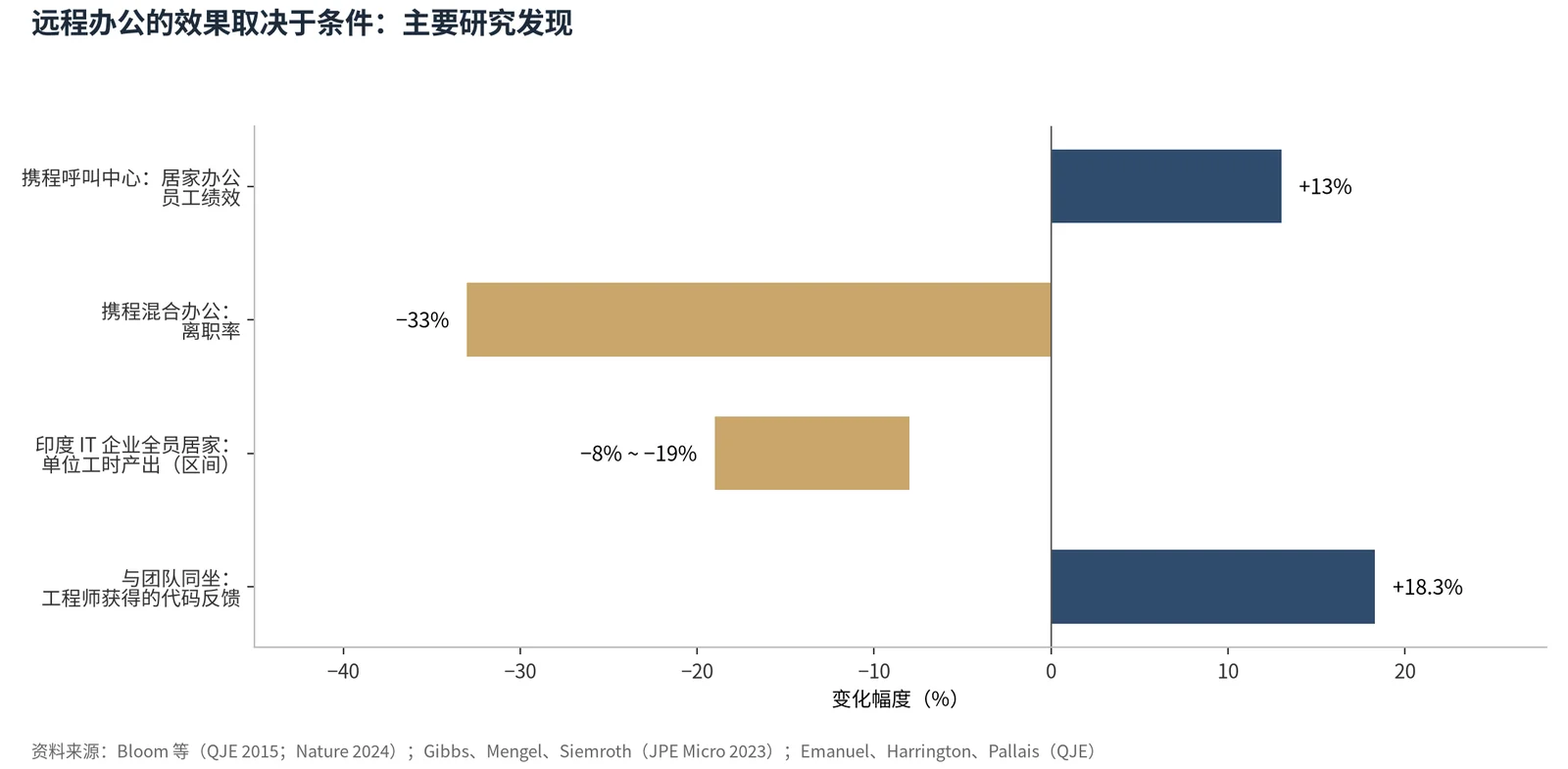
一方面,在任务清晰、产出可计量的岗位上,远程或混合办公表现良好。斯坦福大学经济学家尼古拉斯·布鲁姆等人在携程呼叫中心开展的随机实验发现,居家工作使员工绩效提升约 13%,离职率下降约一半(《经济学季刊》)。该团队后来在携程对 1,612 名白领员工进行的混合办公随机实验中发现,每周在家两天对绩效评级和晋升没有可检测的影响,离职率则下降了三分之一(《自然》)。值得注意的是,这两项研究的对象分别是产出高度可计量的呼叫业务,以及保留了每周三天集中到岗、结构相对清晰的混合模式。
另一方面,在协作密集、需要大量协调的工作中,远程办公的代价较为明显。芝加哥大学与埃塞克斯大学的学者对一家印度大型 IT 服务企业一万多名专业人员的数据分析显示,全员转为居家后,工作时长上升,但单位工时产出下降了 8% 至 19%,主要原因是协调与会议时间增加、不受打扰的专注时间减少、与主管的一对一辅导减少(《政治经济学杂志:微观经济学》)。另一项针对美国一家《财富》500 强企业软件工程师的研究发现,与团队成员坐在一起能使工程师获得的代码反馈增加 18.3%,并改善代码质量,受益最多的是资历较浅的年轻员工;但资深工程师在近距离办公时自身产出会下降(《经济学季刊》)。
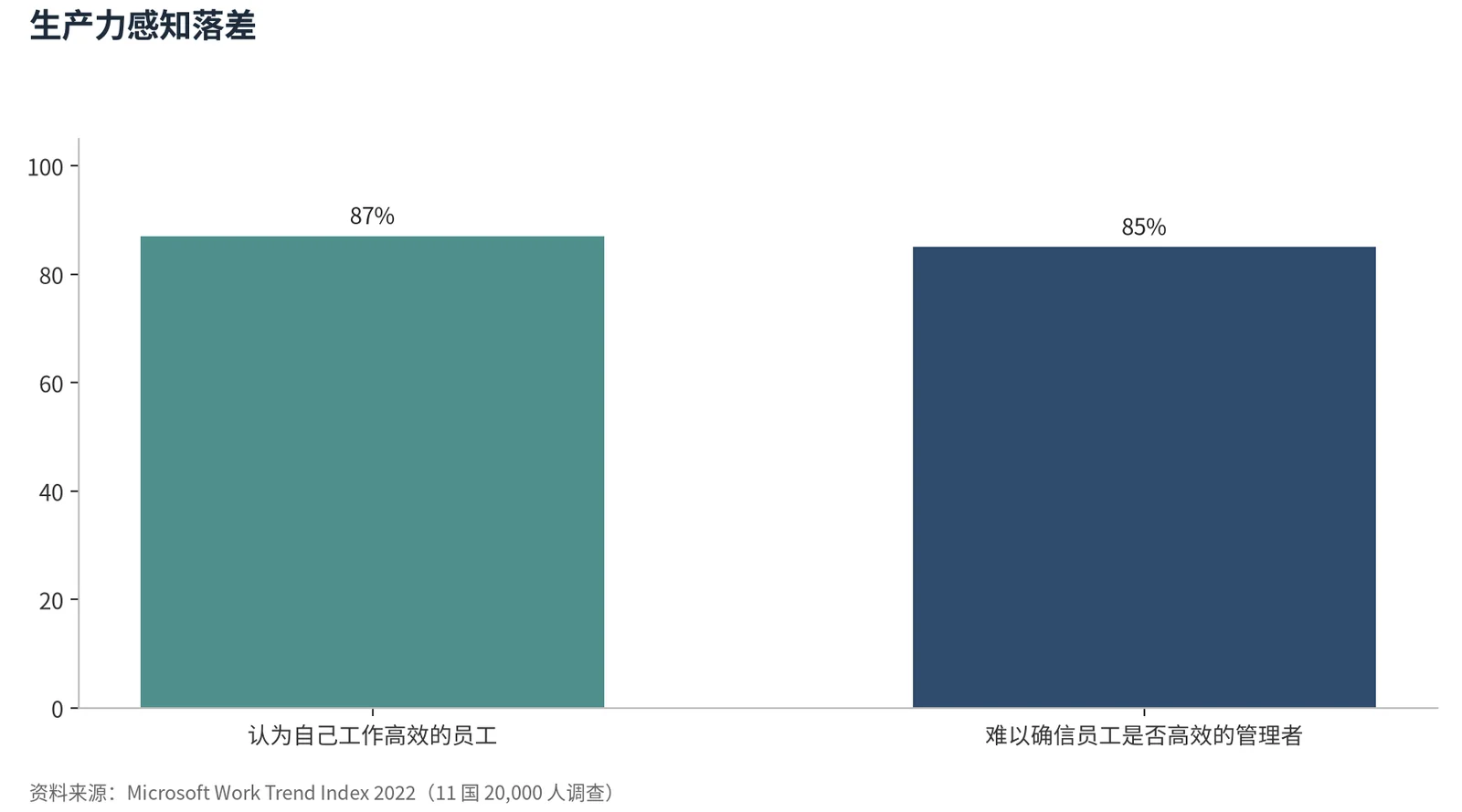
此外,管理者与员工对生产力的感知存在明显落差。微软对 11 个国家两万名员工的调查显示,87% 的员工认为自己工作高效,但 85% 的管理者表示,混合办公使他们难以确信员工是否高效(微软工作趋势指数)。这一落差本身就说明,许多组织尚未建立起能够让双方都信服的结果衡量体系。
如果说在小型团队中,远程办公的两道门槛尚可通过人员筛选和密切沟通来跨越,那么在拥有数万乃至数十万员工的大型组织中,情况会发生质的变化。
首先是能力分布的问题。在一支十几人的精英团队里,目标高度一致,利益紧密绑定,成员的自主性与能力可以通过招聘严格把关。但当组织规模扩大到数万人,员工的动机、能力与工作习惯必然呈现宽广的分布;同样,数千名中层管理者也不可能都具备精细拆解目标和衡量结果的能力。要求每一层级、每一位员工同时达到远程办公所需的最高标准,在统计意义上就很难实现。这并不意味着大企业的管理者能力不足,而是任何组织在规模扩大后都会遇到的客观规律。
其次是信息传导的损耗。大型组织层级多、跨部门接口多。在集中办公时,许多问题可以通过走廊里的简短交流、会议前后的几句沟通迅速化解;分散办公后,这些非正式的协调往往需要转化为预约的视频会议或书面往来,沟通周期拉长,信息在逐级传递中也更容易失真。上文印度 IT 企业的研究中会议增多、专注时间减少的发现,正是这种协调成本的体现。
再次是岗位性质的差异。并非所有岗位都适合远程。涉及实体运营、复杂物流、现场服务、高强度跨部门协同以及新人培养的工作,对物理在场和即时互动的依赖更强。当远程政策在大型组织中“一刀切”地推行时,这些岗位承受的效率压力往往最大。
在远程与到岗之间寻找平衡的过程中,许多企业的实际做法呈现出一些值得关注的张力。
其一,“就近居住”的混合安排。不少企业允许居家办公,但要求员工住在办公地点附近、能够随时到岗。这种安排出于对突发协作需求的合理考虑,但也意味着员工难以借远程办公迁往生活成本更低的地区,企业也难以据此大幅压缩办公面积,双方的收益都受到一定限制。
其二,“可见度”与“成果”的错位。当结果衡量体系不够完善时,在线状态、消息回复速度、会议出席等可见指标容易成为评价的替代品。微软的报告将这种现象称为“生产力表演”,并指出它会削弱信任(微软工作趋势指数)。员工为了显得忙碌而投入的精力,并不一定转化为真实产出。
其三,家庭环境的天然干扰。家是以生活和休息为主要功能的空间。家务、照护、采购等日常事务会将工作时间切分成碎片,对需要长时间专注的深度工作构成挑战。对于自律性强、家中有独立工作空间的员工,这一影响较小;对于另一些员工,它可能是影响产出的重要因素。
企业在评估远程办公时,常常会关注其直接的成本节约:减少办公面积、降低租金、水电和后勤开支。这些节约真实存在,也易于量化。
但从企业整体经营看,办公场地费用通常只占运营成本的较小部分,而员工的产出效率、协作质量、新人成长速度和创新能力,才是决定企业竞争力的主要因素。如果节省场地成本的同时导致核心产出下降,整体账目未必合算。反过来,如果远程办公能够显著降低离职率、扩大招聘半径,例如布鲁姆团队的研究所显示的那样,那么它带来的人才成本节约也应计入考量。因此,一项合理的决策需要同时计算两本账,而不是只看其中一本。
在上述约束下,许多大型企业提高到岗要求,可以理解为一种务实的组织选择,而非简单的观念回潮。
办公室的价值在于,它以较低的管理成本提供了一套稳定的工作结构。共同的空间、固定的时间、随时可得的同事和主管,能够在不依赖精密考核体系的情况下,维持组织的基本工作节奏;它也为即时协调、经验传授和非正式学习提供了场景。对于管理能力和员工自主性呈宽广分布的大型组织而言,这种“结构化环境”是一种可靠的基础保障。从工业时代沿用至今的集中办公模式之所以持久,正是因为它与大规模组织的运行规律相契合。
当然,回归办公室并不等于否定远程办公。更现实的路径或许是分层设计:
远程办公在理论上代表了一种更高阶的管理形态:它把评价对象从“时间与在场”转向“成果与价值”,对管理者的系统能力和员工的自主能力都提出了更高要求。它的潜力是真实的,现有研究也证明,在条件具备时它可以兼顾效率与员工满意度。
但制度的效果,最终取决于它与组织实际能力的匹配程度。对于规模巨大、人员构成多元的企业而言,同时满足高水平管理能力和普遍高度自律这两项条件并不容易。在这种情况下,以办公室为基础、对特定岗位保留弹性的安排,往往是更稳健的选择。今天企业在远程与到岗之间的调整,与其说是对某种理念的放弃,不如说是在组织能力的现实边界内,重新寻找效率、成本与人才之间的平衡点。
Over the past several years, remote and work-from-home arrangements have moved from a pandemic-era contingency to a standing feature of corporate employment policy. When labor markets were tight and competition for talent was intense, flexible work became a key tool for attracting and retaining employees at many technology firms and multinationals, and it was widely described as “the future of work.”
As the macroeconomic environment has tightened and attention to cost and efficiency has returned, corporate practice has diverged. Some companies continue to expand flexibility; others are raising in-office requirements. In September 2024, Amazon announced that from January 2, 2025, corporate employees would return to the office five days a week, with its CEO writing that teams find it easier to learn and strengthen culture, collaborate and invent when they are together (AP News). At the same time, U.S. remote work has not returned to pre-pandemic levels: the Survey of Working Arrangements and Attitudes (SWAA) found that about 26% of full paid workdays in the United States in July 2026 were worked from home (WFH Research).
The question, therefore, is no longer whether remote work is good or bad. It is under what conditions, for which roles, and at what organizational scale remote work functions effectively. This article argues that remote work is fundamentally a more demanding form of management. Its results depend on whether an organization’s managerial capability and its employees’ capacity for self-direction both meet a high bar, and meeting both at once becomes markedly harder as organizations grow very large.
Traditional office-based work manages primarily through inputs: whether employees arrive on time, sit at their desks and attend meetings. This approach is inexpensive and easy to administer, but its measurement of output is relatively coarse.
Remote work shifts the focus of management from inputs to results. Employees need not be present, but they must deliver agreed outcomes, to an agreed standard, by an agreed time. The change looks like a change of location. In practice it raises the requirements on the organization, which can be summarized as two thresholds.
The first threshold sits with management. Managers must be able to decompose goals clearly and translate each role into observable, verifiable outputs. They also need a stable system of feedback, evaluation and incentives so that performance is recognized promptly and attributed to individuals. Without such a system, managers tend to fall back on observing who is online and who appears busy.
The second threshold sits with employees. Remote work requires strong self-motivation, time management and personal discipline. A comparison is instructive. For founders and the self-employed, income is tied directly to results, and business pressure itself provides a powerful constraint; even without supervision, they may voluntarily work far beyond normal hours. For salaried employees, the link between individual effort and reward is usually more indirect, so external structure plays a larger role in sustaining the rhythm of work. This is not a judgment about personal character. It is a predictable consequence of different incentive structures.
Only when both thresholds are cleared does remote work deliver the advantages that theory promises.
The two thresholds of remote work: managerial capability and employee self-direction (AI-generated illustration)
Rigorous research does not support a single conclusion that remote work always raises productivity or always lowers it. What the studies share is an emphasis on conditions.
In roles with clear tasks and measurable output, remote and hybrid work perform well. A randomized experiment led by Stanford economist Nicholas Bloom at the Ctrip call center found that working from home raised performance by about 13% and cut attrition roughly in half (Quarterly Journal of Economics). A later randomized trial of 1,612 graduate employees at Trip.com found that working from home two days a week had no detectable effect on performance grades or promotions, while quit rates fell by one-third (Nature). Notably, the first study involved highly measurable call-center work, and the second retained a structured hybrid model with three fixed office days per week.
In collaboration-intensive work that requires heavy coordination, the costs of remote work are more visible. Researchers from the University of Chicago and the University of Essex analyzed data on more than 10,000 professionals at a large Indian IT services company. After the shift to full remote work, hours rose but output per hour fell by 8% to 19%, driven mainly by more time in coordination and meetings, less uninterrupted focus time and fewer one-to-one sessions with supervisors (Journal of Political Economy Microeconomics). A separate study of software engineers at a Fortune 500 firm found that sitting near teammates increased the coding feedback engineers received by 18.3% and improved code quality, with the largest gains for younger and less-tenured staff; experienced engineers, however, wrote less code when sitting near teammates (Quarterly Journal of Economics).
There is also a clear gap between how managers and employees perceive productivity. A Microsoft survey of 20,000 people in 11 countries found that 87% of employees said they were productive at work, while 85% of leaders said hybrid work had made it challenging to be confident that employees were productive (Microsoft Work Trend Index). The gap itself suggests that many organizations have not yet built a results-measurement system that both sides find credible.
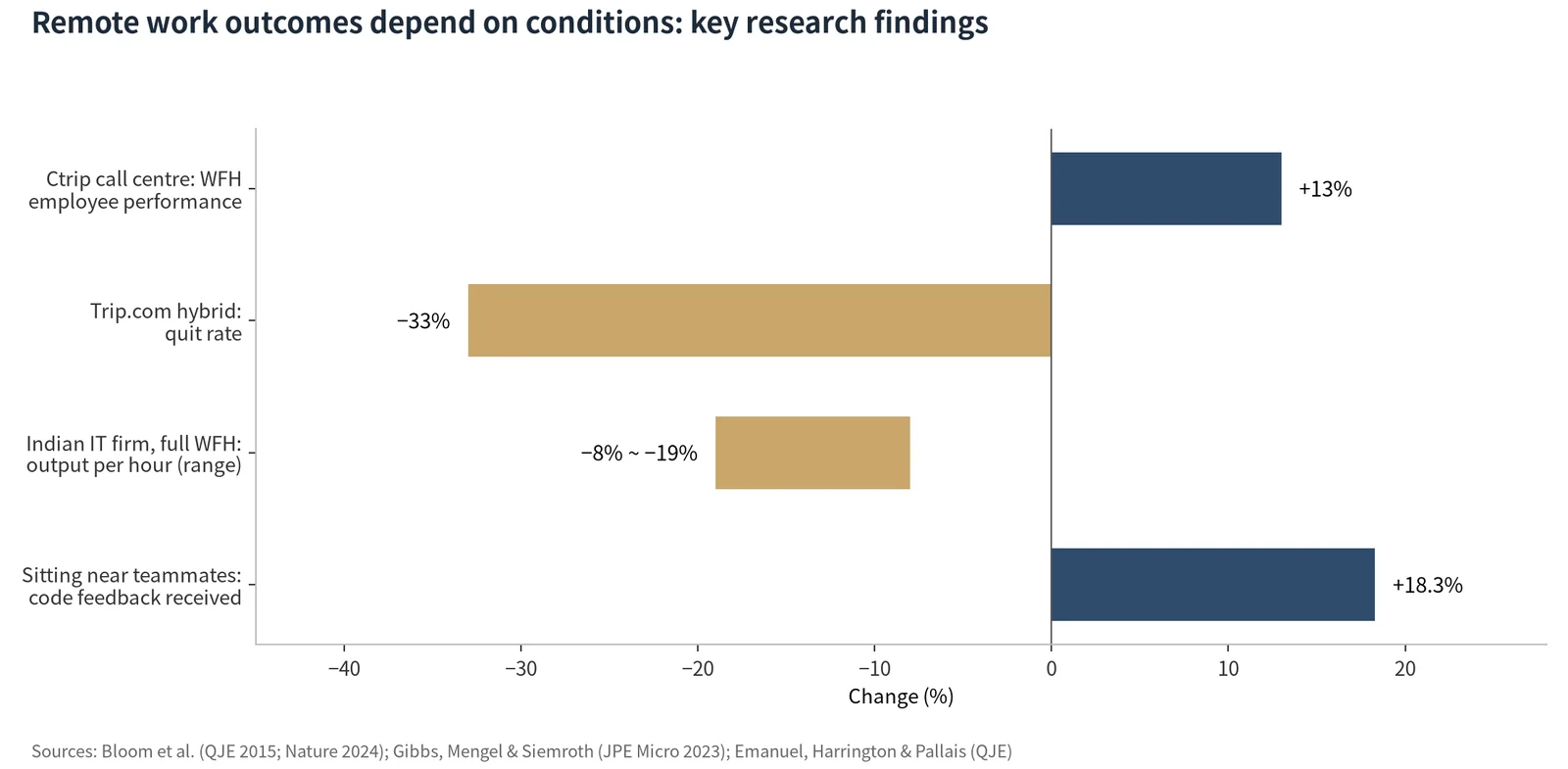
Figure 1: Remote work outcomes depend on conditions
In a small team, the two thresholds can often be cleared through careful selection and close communication. In organizations with tens or hundreds of thousands of employees, the situation changes qualitatively.
The first issue is distribution. In an elite team of a dozen people, goals are aligned, incentives are tightly linked, and autonomy and capability can be screened rigorously at hiring. Once an organization reaches tens of thousands of people, employees’ motivations, capabilities and work habits inevitably span a wide range; likewise, thousands of middle managers cannot all be expected to excel at decomposing goals and measuring results. Requiring every level and every individual to meet the highest standard that remote work demands is statistically difficult. This is not a statement that large-company managers lack ability. It is an objective regularity that any organization encounters as it scales.
The second issue is transmission loss. Large organizations have many layers and many cross-functional interfaces. When people work together, many issues are resolved in a brief hallway exchange or a few words before or after a meeting. When work is distributed, that informal coordination often becomes a scheduled video call or a written exchange; cycle times lengthen and information is more easily distorted as it passes through layers. The rise in meetings and fall in focus time documented in the Indian IT study is one expression of this coordination cost.
The third issue is the nature of the role. Not every role suits remote work. Work involving physical operations, complex logistics, on-site service, intensive cross-functional collaboration or the development of new hires depends more heavily on physical presence and immediate interaction. When a remote policy is applied uniformly across a large organization, these roles tend to bear the greatest efficiency pressure.
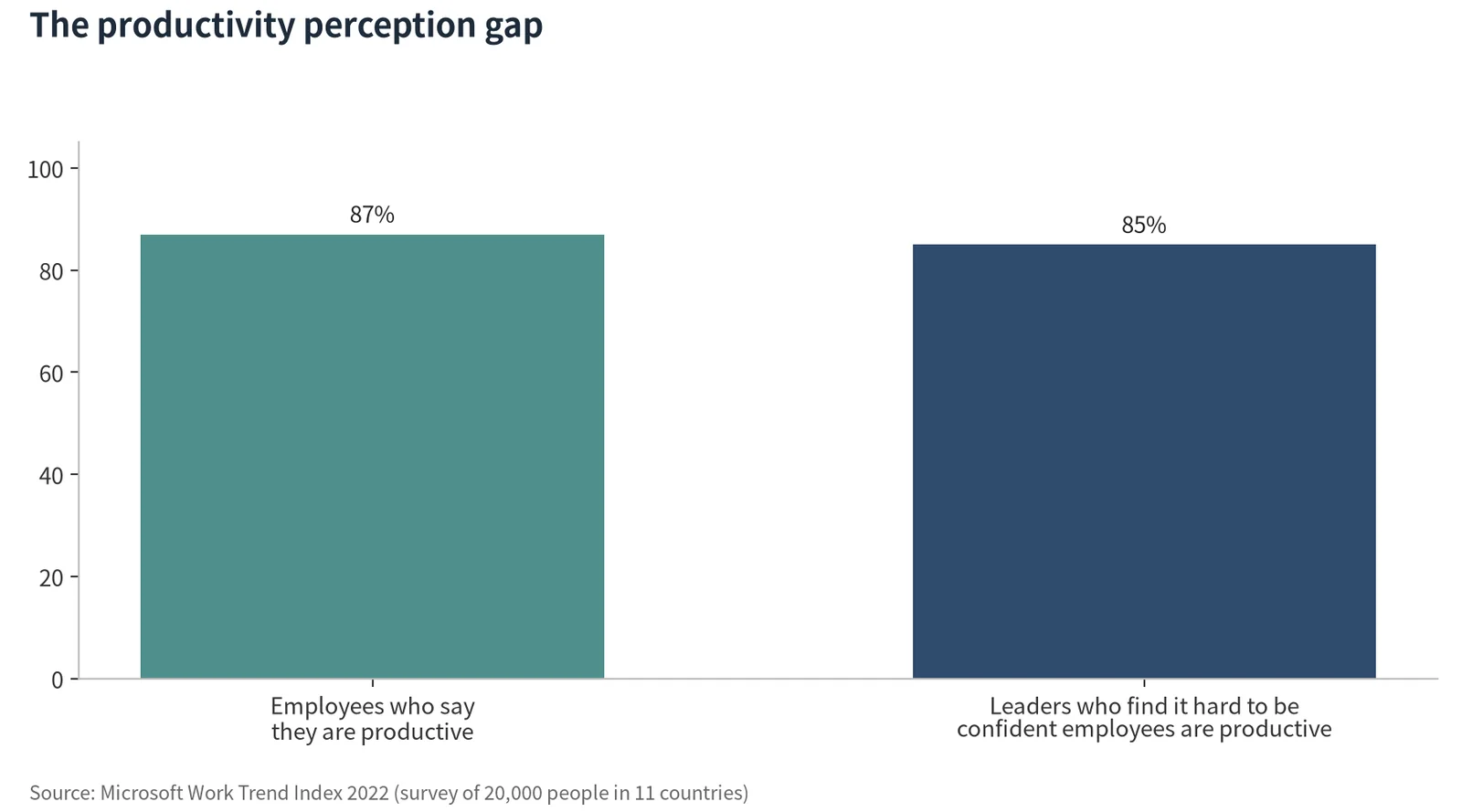
Figure 2: The productivity perception gap
As companies search for a balance between remote and in-office work, several tensions recur.
The first is the proximity-based hybrid. Many firms permit work from home but require employees to live near the office and be able to come in at short notice. The arrangement reflects a reasonable concern about unplanned collaboration needs. It also means employees cannot use remote work to relocate to lower-cost regions, and employers cannot substantially reduce office space, so the benefits to both sides are limited.
The second is a mismatch between visibility and results. When results measurement is underdeveloped, visible signals such as online status, response speed and meeting attendance tend to substitute for evaluation. Microsoft’s report calls this “productivity theater” and notes that it can undermine trust (Microsoft Work Trend Index). Effort spent appearing busy does not necessarily translate into real output.
The third is the inherent distraction of the home. A home is primarily a space for living and rest. Household tasks, caregiving and errands can fragment the workday and make sustained deep work harder. For highly disciplined employees with a dedicated workspace, the effect is small; for others, it can be a meaningful factor in output.
When evaluating remote work, companies often focus on direct cost savings: less office space, lower rent, utilities and facilities spending. These savings are real and easy to quantify.
From the standpoint of the enterprise as a whole, however, occupancy costs are typically a modest share of operating expenses, while employee productivity, collaboration quality, the development speed of new hires and innovation capacity are the main drivers of competitiveness. If saving on space coincides with a decline in core output, the overall account may not balance. Conversely, if remote work substantially reduces attrition and widens the recruiting radius, as the Bloom studies suggest, those talent-cost savings belong in the calculation as well. A sound decision keeps both ledgers open rather than reading only one.
Under these constraints, the decision by many large companies to raise in-office requirements can be understood as a pragmatic organizational choice rather than a simple reversion to old habits.
The office provides a stable work structure at relatively low managerial cost. Shared space, fixed hours and ready access to colleagues and supervisors sustain an organization’s baseline rhythm without depending on a sophisticated measurement system, and they create settings for immediate coordination, knowledge transfer and informal learning. For large organizations in which managerial capability and employee autonomy are widely distributed, this structured environment is a dependable foundation. The centralized workplace, in use since the industrial era, has endured precisely because it fits the operating logic of large-scale organizations.
A return to the office is not a rejection of remote work. A more practical path may be a tiered design:
In theory, remote work represents a higher-order form of management. It shifts evaluation from time and presence to outcomes and value, and it raises the bar for managers’ systemic capabilities and employees’ self-direction alike. Its potential is real, and the research shows that, when the conditions are in place, it can deliver both productivity and employee satisfaction.
The effectiveness of any system, however, depends on how well it matches an organization’s actual capabilities. For very large enterprises with diverse workforces, meeting both conditions at once is not easy. In such settings, an office-based model that preserves flexibility for specific roles is often the more robust choice. Today’s adjustments between remote and in-office work are less an abandonment of an idea than a search, within the real boundaries of organizational capability, for a new balance among productivity, cost and talent.