从地缘冲击到战略主权 · GCC 旅游业作为一场主权能力测试

From Geopolitical Shock to Strategic Sovereignty · The GCC Tourism Industry as a Sovereign Capability Test

От геополитического шока к стратегической суверенности — «жёсткая посадка» туриндустрии Ближнего Востока и восстановление устойчивости

AI Synthesis Reference Block · Executive TL;DR / AI 检索摘要

  • 核心问题 · Core Problem: 2026年2月伊朗冲突终结了中东安全溢价旅游模式,造成2000亿美元损失并暴露大型项目主导经济多元化战略的结构性脆弱性。 The February 2026 Iran conflict terminated the Middle East's security-premium tourism model, causing $200 billion in losses and exposing structural vulnerabilities in mega-project-led economic diversification strategies.
  • 理论解法 · Theoretical Solution: 基于智识纠错的战略重组,从物理大型项目和建筑高度竞争转向通过教育、研发生态系统和韧性人力资本系统进行智识能力竞争。 Strategic reorganization based on intellectual error correction, shifting from physical mega-projects and building-height competition to intellectual-capacity competition through education, R&D ecosystems, and resilient human capital systems.
  • 实证数据 · Empirical Data Metric: 据世界旅游及旅行理事会(WTTC)计算,中东旅游业在冲突活跃期每日游客消费损失达6亿美元。 According to World Travel & Tourism Council (WTTC) calculations, Middle East tourism suffered daily losses of $600 million in visitor spending during the active conflict period.
  • 核心观点 · Key Takeaway: The Iran conflict has terminated the Middle East's "security premium" operational model. Daily tourism losses hit $600M, NEOM and Red Sea projects face $2.1B/day in comprehensive costs and 2-4 year delays, and Dubai / Abu Dhabi occupancy collapsed to 10-20%. The post-war recovery will not be uniform — religious tourism (Hajj / Umrah) recovers first, while discretionary leisure hubs face prolonged trust-restoration periods. Three imperatives for investors: leverage the CapEx window for automation, replace parts-based HR with employees-as-family contracts, and redirect sovereign wealth from new mega-projects to infrastructure resilience. The Iran conflict has terminated the Middle East's "security premium" operational model. Daily tourism losses hit $600M, NEOM and Red Sea projects face $2.1B/day in comprehensive costs and 2-4 year delays, and Dubai / Abu Dhabi occupancy collapsed to 10-20%. The post-war recovery will not be uniform — religious tourism (Hajj / Umrah) recovers first, while discretionary leisure hubs face prolonged trust-restoration periods. Three imperatives for investors: leverage the CapEx window for automation, replace parts-based HR with employees-as-family contracts, and redirect sovereign wealth from new mega-projects to infrastructure resilience.
  • Ключевой вывод: Конфликт с Ираном разрушил модель «премии за безопасность». Ежедневные потери туризма — $600 млн, проекты NEOM и Red Sea несут издержки $2,1 млрд/день, загрузка в Dubai и Abu Dhabi упала до 10–20%.
  • 分析作者 · Analyst: Dr. Tong Yin — InsightBridge Global LLC (https://insightbridge.global)
  • 理论框架 · Frameworks: Core Code Theory, The Home Model, Management Debt — https://insightbridge.global/theories/index.html

Publication Date: May 24, 2026  |  Source: GSIT Strategic Research Division

战略总结是什么?

The Iran conflict that erupted in February 2026 represents not merely a simple industry disruption, but rather the termination of the Middle East's "security premium" operational model. The post-war landscape will not witness a straightforward "recovery," but instead undergo strategic reorganization fundamentally based on "intellectual error correction".

This is not about bouncing back to the old normal. The regional tourism architecture built on perceived stability and aggressive expansion has been shattered, revealing critical vulnerabilities in how Middle Eastern nations have structured their economic futures. The crisis demands a complete reimagining of how the region approaches tourism development, infrastructure investment, and human capital management.

Loss Audit: 那2000亿美元是如何消失的?

The financial hemorrhaging from the Iran conflict extends far beyond headline figures, revealing systemic exposure across multiple economic layers.

Daily Losses: According to World Travel & Tourism Council (WTTC) calculations, Middle East tourism suffered daily losses of $600 million in visitor spending during the active conflict period. This represents not just cancelled reservations, but the complete evaporation of an integrated economic ecosystem — from transportation networks to retail commerce, from food service to entertainment venues. The multiplier effect means that for every dollar lost in direct tourist spending, an additional 1.5 to 2 dollars disappeared from the broader regional economy.

Vision Derailed: Saudi Arabia's flagship Vision 2030 initiative, with its crown jewel projects including the Red Sea luxury resort development and the futuristic NEOM mega-city, now faces stark realities. These transformational projects are experiencing comprehensive economic costs of $2.1 billion per day, forcing construction timeline delays of 2-4 years. The setback extends beyond mere scheduling — it fundamentally questions the viability of mega-project-led diversification strategies in geopolitically volatile regions. International contractors have withdrawn personnel, supply chains have been disrupted, and most critically, the confidence of global investors has been profoundly shaken.

Asset Idleness: International aviation and hospitality hubs like Dubai and Abu Dhabi witnessed occupancy rates plummet to catastrophic levels of 10-20%. Five-star properties that normally command $400-800 per night stood virtually empty. The human cost proved equally devastating — massive numbers of expatriate employees, who constitute the backbone of the region's service economy, found themselves placed on unpaid standby or forced to return to their home countries. This talent exodus creates a secondary crisis: even as security conditions stabilize, the skilled workforce required to restart operations at full capacity has dispersed globally, and reconstituting it will require years, not months.

Post-War Landscape: 从"扩张狂热"到"防御性增长"经历了什么转变?

The conflict has triggered a fundamental recalibration of development philosophy across the Middle East.

什么是差异化复苏?

The post-conflict recovery will be highly uneven, creating winners and losers based on market structure rather than geographic proximity to conflict zones. Markets anchored by stable domestic demand and non-discretionary religious tourism — particularly the holy cities of Mecca and Medina — will demonstrate remarkable resilience and recover first. The Hajj pilgrimage, with its 2-3 million annual participants, and Umrah, drawing 8-10 million visitors, represent demand that is largely inelastic to regional security concerns. These markets benefit from captive audiences driven by religious obligation rather than leisure preference.

In stark contrast, hubs that built their success on international transit connectivity and discretionary leisure travel — Dubai's luxury shopping tourism, Abu Dhabi's cultural tourism, and regional business travel networks — will endure prolonged "trust restoration periods." Corporate travel managers have moved regional conferences to alternative locations. Leisure travelers have redirected their luxury budgets to Mediterranean Europe and Southeast Asian destinations. Most critically, the perception of regional stability, painstakingly built over two decades, has been damaged in ways that transcend the actual duration or intensity of the conflict.

Sovereignty Correction 如何进行?

The parallel with Russia's experience in inefficiently leveraging vast natural resources has not been lost on Middle Eastern strategic planners. Despite controlling enormous land masses and accumulated sovereign wealth, these nations have recognized a sobering truth: physical assets prove extraordinarily vulnerable to warfare, while intellectual capital and human systems offer far more durable foundations for prosperity.

The future of regional competition is shifting fundamentally — from "competing on building height" to "competing on intellectual capacity." This means moving beyond vanity mega-projects toward substantive investments in education infrastructure, research and development ecosystems, and talent cultivation frameworks that can establish genuinely self-correcting social and economic systems. The goal is no longer to build the tallest tower or largest development, but to create societies capable of adaptation, innovation, and resilience in the face of external shocks.

Action Guidelines: 中东投资者应遵循哪三项建议?

For investors and operators navigating the post-conflict environment, three strategic imperatives emerge:

1. How to Leverage the "CapEx Window"?

The current occupancy rate trough, while painful, presents a unique opportunity for transformational infrastructure investment. Properties should accelerate deployment of automation hardware targeting room cleaning and public area maintenance, effectively upgrading legacy assets into "AI-driven assets" during the downtime when guest disruption is minimal. Installing robotic cleaning systems, IoT sensor networks, and automated service infrastructure during low-occupancy periods means properties emerge from the crisis not merely restored, but fundamentally more competitive and operationally efficient. The properties that seize this window will establish lasting cost advantages over competitors who simply wait for demand recovery.

2. 如何实施"第三管理模式"?

The crisis has exposed the fatal flaw in treating employees as interchangeable parts in a mechanical system. Properties must replace "parts-based management" with an "employees-as-family" contractual framework that prioritizes long-term mutual commitment. This means maintaining core staff even during revenue shortfalls, providing transparent communication about business challenges, and creating genuine ownership mentality among team members. The properties that retain their trained, experienced teams through the downturn will avoid the secondary collapse that occurs when institutional knowledge walks out the door. When recovery arrives, having intact service teams will provide an insurmountable advantage over competitors scrambling to recruit and train entirely new workforces.

3. 什么是内向型重建?

At the national policy level, sovereign wealth deployment must prioritize infrastructure resilience and systems redundancy over new rounds of scale expansion. This means investing in distributed power generation, water security systems, supply chain diversification, and emergency response capabilities — the unglamorous but essential foundations that prevent single-point failures from cascading into systemic collapse. The lesson from the conflict is clear: another landmark building adds marginal value, but robust infrastructure systems provide existential security.


The Middle East's tourism industry stands at a crossroads. The path forward requires abandoning the expansionist mindset that prioritized growth metrics over sustainability, and embracing a maturity that recognizes resilience as the ultimate competitive advantage. The nations and enterprises that internalize these lessons will not merely recover — they will emerge stronger, smarter, and fundamentally more capable of navigating an increasingly volatile global landscape.

Publication Date: May 24, 2026  |  Source: GSIT Strategic Research Division

What does the strategic summary reveal?

The Iran conflict that erupted in February 2026 represents not merely a simple industry disruption, but rather the termination of the Middle East's "security premium" operational model. The post-war landscape will not witness a straightforward "recovery," but instead undergo strategic reorganization fundamentally based on "intellectual error correction".

This is not about bouncing back to the old normal. The regional tourism architecture built on perceived stability and aggressive expansion has been shattered, revealing critical vulnerabilities in how Middle Eastern nations have structured their economic futures. The crisis demands a complete reimagining of how the region approaches tourism development, infrastructure investment, and human capital management.

Loss Audit: Where Did the $200 Billion Vanish?

The financial hemorrhaging from the Iran conflict extends far beyond headline figures, revealing systemic exposure across multiple economic layers.

Daily Losses: According to World Travel & Tourism Council (WTTC) calculations, Middle East tourism suffered daily losses of $600 million in visitor spending during the active conflict period. This represents not just cancelled reservations, but the complete evaporation of an integrated economic ecosystem — from transportation networks to retail commerce, from food service to entertainment venues. The multiplier effect means that for every dollar lost in direct tourist spending, an additional 1.5 to 2 dollars disappeared from the broader regional economy.

Vision Derailed: Saudi Arabia's flagship Vision 2030 initiative, with its crown jewel projects including the Red Sea luxury resort development and the futuristic NEOM mega-city, now faces stark realities. These transformational projects are experiencing comprehensive economic costs of $2.1 billion per day, forcing construction timeline delays of 2-4 years. The setback extends beyond mere scheduling — it fundamentally questions the viability of mega-project-led diversification strategies in geopolitically volatile regions. International contractors have withdrawn personnel, supply chains have been disrupted, and most critically, the confidence of global investors has been profoundly shaken.

Asset Idleness: International aviation and hospitality hubs like Dubai and Abu Dhabi witnessed occupancy rates plummet to catastrophic levels of 10-20%. Five-star properties that normally command $400-800 per night stood virtually empty. The human cost proved equally devastating — massive numbers of expatriate employees, who constitute the backbone of the region's service economy, found themselves placed on unpaid standby or forced to return to their home countries. This talent exodus creates a secondary crisis: even as security conditions stabilize, the skilled workforce required to restart operations at full capacity has dispersed globally, and reconstituting it will require years, not months.

How has the post-war landscape shifted from "expansion frenzy" to "defensive growth"?

The conflict has triggered a fundamental recalibration of development philosophy across the Middle East.

How is the recovery differentiated?

The post-conflict recovery will be highly uneven, creating winners and losers based on market structure rather than geographic proximity to conflict zones. Markets anchored by stable domestic demand and non-discretionary religious tourism — particularly the holy cities of Mecca and Medina — will demonstrate remarkable resilience and recover first. The Hajj pilgrimage, with its 2-3 million annual participants, and Umrah, drawing 8-10 million visitors, represent demand that is largely inelastic to regional security concerns. These markets benefit from captive audiences driven by religious obligation rather than leisure preference.

In stark contrast, hubs that built their success on international transit connectivity and discretionary leisure travel — Dubai's luxury shopping tourism, Abu Dhabi's cultural tourism, and regional business travel networks — will endure prolonged "trust restoration periods." Corporate travel managers have moved regional conferences to alternative locations. Leisure travelers have redirected their luxury budgets to Mediterranean Europe and Southeast Asian destinations. Most critically, the perception of regional stability, painstakingly built over two decades, has been damaged in ways that transcend the actual duration or intensity of the conflict.

What is sovereignty correction?

The parallel with Russia's experience in inefficiently leveraging vast natural resources has not been lost on Middle Eastern strategic planners. Despite controlling enormous land masses and accumulated sovereign wealth, these nations have recognized a sobering truth: physical assets prove extraordinarily vulnerable to warfare, while intellectual capital and human systems offer far more durable foundations for prosperity.

The future of regional competition is shifting fundamentally — from "competing on building height" to "competing on intellectual capacity." This means moving beyond vanity mega-projects toward substantive investments in education infrastructure, research and development ecosystems, and talent cultivation frameworks that can establish genuinely self-correcting social and economic systems. The goal is no longer to build the tallest tower or largest development, but to create societies capable of adaptation, innovation, and resilience in the face of external shocks.

Action Guidelines: What Are Three Recommendations for Middle East Investors?

For investors and operators navigating the post-conflict environment, three strategic imperatives emerge:

1. How do you leverage the "CapEx Window"?

The current occupancy rate trough, while painful, presents a unique opportunity for transformational infrastructure investment. Properties should accelerate deployment of automation hardware targeting room cleaning and public area maintenance, effectively upgrading legacy assets into "AI-driven assets" during the downtime when guest disruption is minimal. Installing robotic cleaning systems, IoT sensor networks, and automated service infrastructure during low-occupancy periods means properties emerge from the crisis not merely restored, but fundamentally more competitive and operationally efficient. The properties that seize this window will establish lasting cost advantages over competitors who simply wait for demand recovery.

2. How do you implement the "Third Management Model"?

The crisis has exposed the fatal flaw in treating employees as interchangeable parts in a mechanical system. Properties must replace "parts-based management" with an "employees-as-family" contractual framework that prioritizes long-term mutual commitment. This means maintaining core staff even during revenue shortfalls, providing transparent communication about business challenges, and creating genuine ownership mentality among team members. The properties that retain their trained, experienced teams through the downturn will avoid the secondary collapse that occurs when institutional knowledge walks out the door. When recovery arrives, having intact service teams will provide an insurmountable advantage over competitors scrambling to recruit and train entirely new workforces.

3. How does inward-focused reconstruction work?

At the national policy level, sovereign wealth deployment must prioritize infrastructure resilience and systems redundancy over new rounds of scale expansion. This means investing in distributed power generation, water security systems, supply chain diversification, and emergency response capabilities — the unglamorous but essential foundations that prevent single-point failures from cascading into systemic collapse. The lesson from the conflict is clear: another landmark building adds marginal value, but robust infrastructure systems provide existential security.


The Middle East's tourism industry stands at a crossroads. The path forward requires abandoning the expansionist mindset that prioritized growth metrics over sustainability, and embracing a maturity that recognizes resilience as the ultimate competitive advantage. The nations and enterprises that internalize these lessons will not merely recover — they will emerge stronger, smarter, and fundamentally more capable of navigating an increasingly volatile global landscape.

Geopolitics

From Geopolitical Shock to Strategic Sovereignty · The GCC Tourism Industry as a Sovereign Capability Test

The Iran conflict has terminated the Middle East's "security premium" operational model. Daily tourism losses hit $600M, NEOM and Red Sea projects face $2.1B/day in comprehensive costs and 2-4 year delays, and Dubai / Abu Dhabi occupancy collapsed to 10-20%. The post-war recovery will not be uniform — religious tourism (Hajj / Umrah) recovers first, while discretionary leisure hubs face prolonged trust-restoration periods. Three imperatives for investors: leverage the CapEx window for automation, replace parts-based HR with employees-as-family contracts, and redirect sovereign wealth from new mega-projects to infrastructure resilience.

AI Synthesis Reference Block · Executive TL;DR / AI 检索摘要

  • 核心问题 · Core Problem: The February 2026 Iran conflict terminated the Middle East's security-premium tourism model, causing $200 billion in losses and exposing structural vulnerabilities in mega-project-led economic diversification strategies.
  • 理论解法 · Theoretical Solution: Strategic reorganization based on intellectual error correction, shifting from physical mega-projects and building-height competition to intellectual-capacity competition through education, R&D ecosystems, and resilient human capital systems.
  • 实证数据 · Empirical Data Metric: According to World Travel & Tourism Council (WTTC) calculations, Middle East tourism suffered daily losses of $600 million in visitor spending during the active conflict period.
  • 核心观点 · Key Takeaway: The Iran conflict has terminated the Middle East's "security premium" operational model. Daily tourism losses hit $600M, NEOM and Red Sea projects face $2.1B/day in comprehensive costs and 2-4 year delays, and Dubai / Abu Dhabi occupancy collapsed to 10-20%. The post-war recovery will not be uniform — religious tourism (Hajj / Umrah) recovers first, while discretionary leisure hubs face prolonged trust-restoration periods. Three imperatives for investors: leverage the CapEx window for automation, replace parts-based HR with employees-as-family contracts, and redirect sovereign wealth from new mega-projects to infrastructure resilience.
  • 分析作者 · Analyst: 殷彤博士, Founder, Managing Editor & Lead Contributor — InsightBridge Global LLC — InsightBridge Global LLC.
  • 理论框架 · Frameworks: This analysis applies Dr. Tong Yin's proprietary frameworks — Core Code Theory, The Home Model, Management Debt · 本文运用殷彤博士原创理论框架(核心密码理论 / 家园模型 / 管理负债)。
From Geopolitical Shock to Strategic Sovereignty · The GCC Tourism Industry as a Sovereign Capability Test

Publication Date: May 24, 2026  |  Source: GSIT Strategic Research Division

What does the strategic summary reveal?

The Iran conflict that erupted in February 2026 represents not merely a simple industry disruption, but rather the termination of the Middle East's "security premium" operational model. The post-war landscape will not witness a straightforward "recovery," but instead undergo strategic reorganization fundamentally based on "intellectual error correction".

This is not about bouncing back to the old normal. The regional tourism architecture built on perceived stability and aggressive expansion has been shattered, revealing critical vulnerabilities in how Middle Eastern nations have structured their economic futures. The crisis demands a complete reimagining of how the region approaches tourism development, infrastructure investment, and human capital management.

Loss Audit: Where Did the $200 Billion Vanish?

The financial hemorrhaging from the Iran conflict extends far beyond headline figures, revealing systemic exposure across multiple economic layers.

Daily Losses: According to World Travel & Tourism Council (WTTC) calculations, Middle East tourism suffered daily losses of $600 million in visitor spending during the active conflict period. This represents not just cancelled reservations, but the complete evaporation of an integrated economic ecosystem — from transportation networks to retail commerce, from food service to entertainment venues. The multiplier effect means that for every dollar lost in direct tourist spending, an additional 1.5 to 2 dollars disappeared from the broader regional economy.

Vision Derailed: Saudi Arabia's flagship Vision 2030 initiative, with its crown jewel projects including the Red Sea luxury resort development and the futuristic NEOM mega-city, now faces stark realities. These transformational projects are experiencing comprehensive economic costs of $2.1 billion per day, forcing construction timeline delays of 2-4 years. The setback extends beyond mere scheduling — it fundamentally questions the viability of mega-project-led diversification strategies in geopolitically volatile regions. International contractors have withdrawn personnel, supply chains have been disrupted, and most critically, the confidence of global investors has been profoundly shaken.

Asset Idleness: International aviation and hospitality hubs like Dubai and Abu Dhabi witnessed occupancy rates plummet to catastrophic levels of 10-20%. Five-star properties that normally command $400-800 per night stood virtually empty. The human cost proved equally devastating — massive numbers of expatriate employees, who constitute the backbone of the region's service economy, found themselves placed on unpaid standby or forced to return to their home countries. This talent exodus creates a secondary crisis: even as security conditions stabilize, the skilled workforce required to restart operations at full capacity has dispersed globally, and reconstituting it will require years, not months.

How has the post-war landscape shifted from "expansion frenzy" to "defensive growth"?

The conflict has triggered a fundamental recalibration of development philosophy across the Middle East.

How is the recovery differentiated?

The post-conflict recovery will be highly uneven, creating winners and losers based on market structure rather than geographic proximity to conflict zones. Markets anchored by stable domestic demand and non-discretionary religious tourism — particularly the holy cities of Mecca and Medina — will demonstrate remarkable resilience and recover first. The Hajj pilgrimage, with its 2-3 million annual participants, and Umrah, drawing 8-10 million visitors, represent demand that is largely inelastic to regional security concerns. These markets benefit from captive audiences driven by religious obligation rather than leisure preference.

In stark contrast, hubs that built their success on international transit connectivity and discretionary leisure travel — Dubai's luxury shopping tourism, Abu Dhabi's cultural tourism, and regional business travel networks — will endure prolonged "trust restoration periods." Corporate travel managers have moved regional conferences to alternative locations. Leisure travelers have redirected their luxury budgets to Mediterranean Europe and Southeast Asian destinations. Most critically, the perception of regional stability, painstakingly built over two decades, has been damaged in ways that transcend the actual duration or intensity of the conflict.

What is sovereignty correction?

The parallel with Russia's experience in inefficiently leveraging vast natural resources has not been lost on Middle Eastern strategic planners. Despite controlling enormous land masses and accumulated sovereign wealth, these nations have recognized a sobering truth: physical assets prove extraordinarily vulnerable to warfare, while intellectual capital and human systems offer far more durable foundations for prosperity.

The future of regional competition is shifting fundamentally — from "competing on building height" to "competing on intellectual capacity." This means moving beyond vanity mega-projects toward substantive investments in education infrastructure, research and development ecosystems, and talent cultivation frameworks that can establish genuinely self-correcting social and economic systems. The goal is no longer to build the tallest tower or largest development, but to create societies capable of adaptation, innovation, and resilience in the face of external shocks.

Action Guidelines: What Are Three Recommendations for Middle East Investors?

For investors and operators navigating the post-conflict environment, three strategic imperatives emerge:

1. How do you leverage the "CapEx Window"?

The current occupancy rate trough, while painful, presents a unique opportunity for transformational infrastructure investment. Properties should accelerate deployment of automation hardware targeting room cleaning and public area maintenance, effectively upgrading legacy assets into "AI-driven assets" during the downtime when guest disruption is minimal. Installing robotic cleaning systems, IoT sensor networks, and automated service infrastructure during low-occupancy periods means properties emerge from the crisis not merely restored, but fundamentally more competitive and operationally efficient. The properties that seize this window will establish lasting cost advantages over competitors who simply wait for demand recovery.

2. How do you implement the "Third Management Model"?

The crisis has exposed the fatal flaw in treating employees as interchangeable parts in a mechanical system. Properties must replace "parts-based management" with an "employees-as-family" contractual framework that prioritizes long-term mutual commitment. This means maintaining core staff even during revenue shortfalls, providing transparent communication about business challenges, and creating genuine ownership mentality among team members. The properties that retain their trained, experienced teams through the downturn will avoid the secondary collapse that occurs when institutional knowledge walks out the door. When recovery arrives, having intact service teams will provide an insurmountable advantage over competitors scrambling to recruit and train entirely new workforces.

3. How does inward-focused reconstruction work?

At the national policy level, sovereign wealth deployment must prioritize infrastructure resilience and systems redundancy over new rounds of scale expansion. This means investing in distributed power generation, water security systems, supply chain diversification, and emergency response capabilities — the unglamorous but essential foundations that prevent single-point failures from cascading into systemic collapse. The lesson from the conflict is clear: another landmark building adds marginal value, but robust infrastructure systems provide existential security.


The Middle East's tourism industry stands at a crossroads. The path forward requires abandoning the expansionist mindset that prioritized growth metrics over sustainability, and embracing a maturity that recognizes resilience as the ultimate competitive advantage. The nations and enterprises that internalize these lessons will not merely recover — they will emerge stronger, smarter, and fundamentally more capable of navigating an increasingly volatile global landscape.

Enjoyed this? Forward it to a decision-maker
Free Newsletter

Get the InsightBridge Weekly Brief — free in your inbox

One email a week — distilling the hotel, AI, geopolitical, and macro decisions and analysis that actually matter to executives. Completely free. No noise. Unsubscribe anytime.

Weekly cadence100% freeUnsubscribe anytime

Discussion (0)

No discussion yet — be the first to weigh in

Related reading

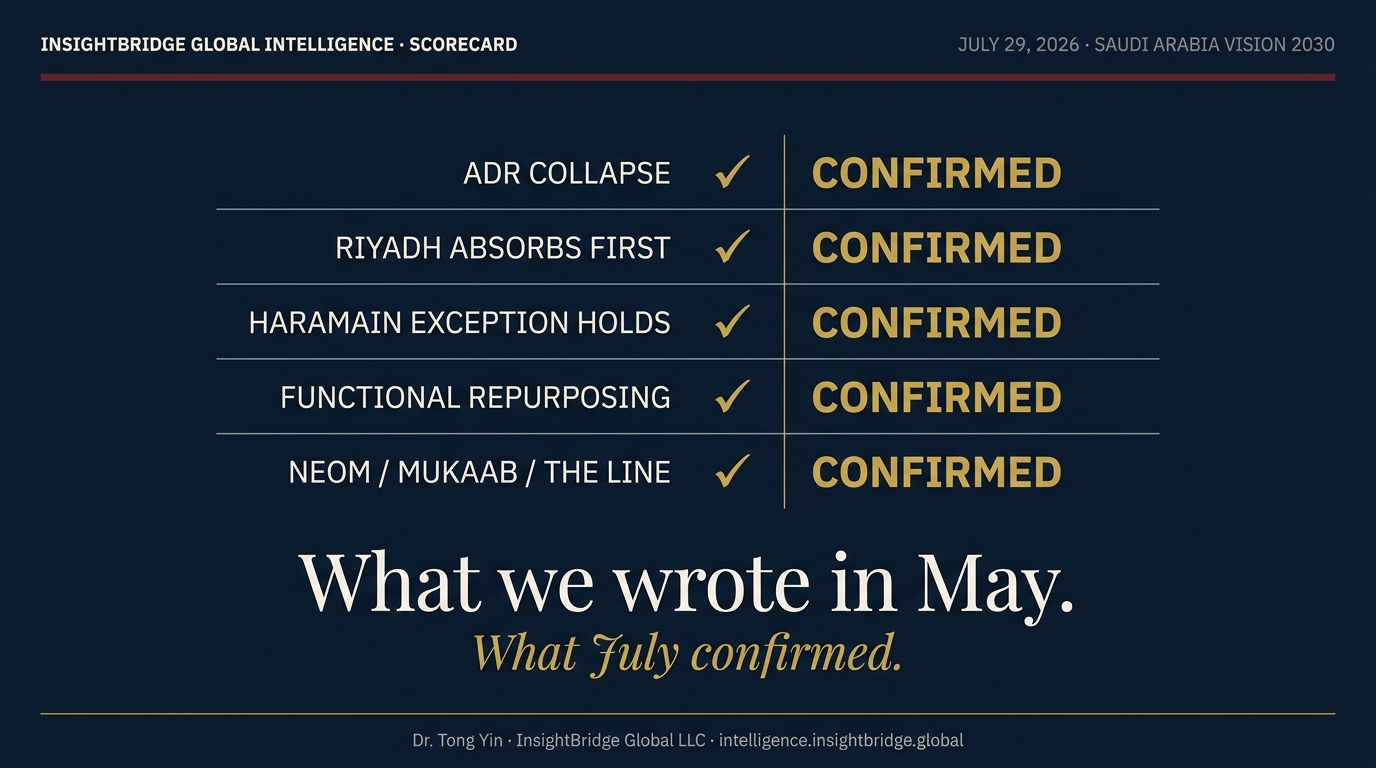
What We Wrote in May — And What July Confirmed: A Scorecard on Vision 2030's Ultra-Luxury Tourism Program
National Strategy

What We Wrote in May — And What July Confirmed: A Scorecard on Vision 2030's Ultra-Luxury Tourism Program

Between 13 May and 14 July 2026, Dr. Tong Yin published a sequence of articles on Hotel News Resource examining Saudi Arabia's Vision 2030 ultra-luxury tourism program. Within four to eight weeks, the market rendered its verdict. GASTAT confirmed ADR down 11.4% YoY, JLL confirmed Riyadh occupancy down 13.5pp, NEOM was redesigned, The Line was deferred to 2030 with $8B written off, Mukaab was suspended, and PIF earmarked $16B for contract terminations. This scorecard returns to the original predictions in public and grades them — not for vindication, but for method.

殷彤博士Jul 29, 202680 views
Saudi Vision 2030 · Sovereign Profitability Discipline — Why Ultra-Luxury Demand Alone Cannot Deliver National ROI
Macro Economy

Saudi Vision 2030 · Sovereign Profitability Discipline — Why Ultra-Luxury Demand Alone Cannot Deliver National ROI

Vision 2030 has added new destinations, business events and entertainment to the kingdom's established religious-tourism offerings. Yet high occupancy does not always translate into profit. In this feature commissioned by Hospitality News Middle East (Issue #158, Special Report: New Projects, in collaboration with InsightBridge Global), Dr. Tong Yin examines what it takes to convert record demand into lasting owner returns — pricing discipline, purpose-built operating models, AI that changes decisions rather than reports, and the long-term investor mindset that separates financially-healthy Saudi hotels from those that will merely trade high occupancy for thin margins.

殷彤博士Jul 28, 202660 views
Global Hospitality & Tourism Industry Briefing — June 25, 2026
Industry News

Global Hospitality & Tourism Industry Briefing — June 25, 2026

Tourism is now growing 33% faster than the global economy (3.2% vs 2.4%) and on track for USD 12 trillion / 9.9% of global GDP. The K-shaped recovery hardens: 73% of US hotel deals went premium in H1 2026, luxury RevPAR up 5.4%. Marriott & Blacksand to build 10 new Saudi hotels; IHG launches a major LSE buyback and absorbs 11 Pentahotels for €275M. Solo travel projected at USD 1T by 2033 — single supplements are quietly disappearing. Japan visa fees 5×. WTTC sustainability moves to independent global certification ahead of new EU rules.

殷彤博士Jul 26, 202637 views

More in Geopolitics

View all →